
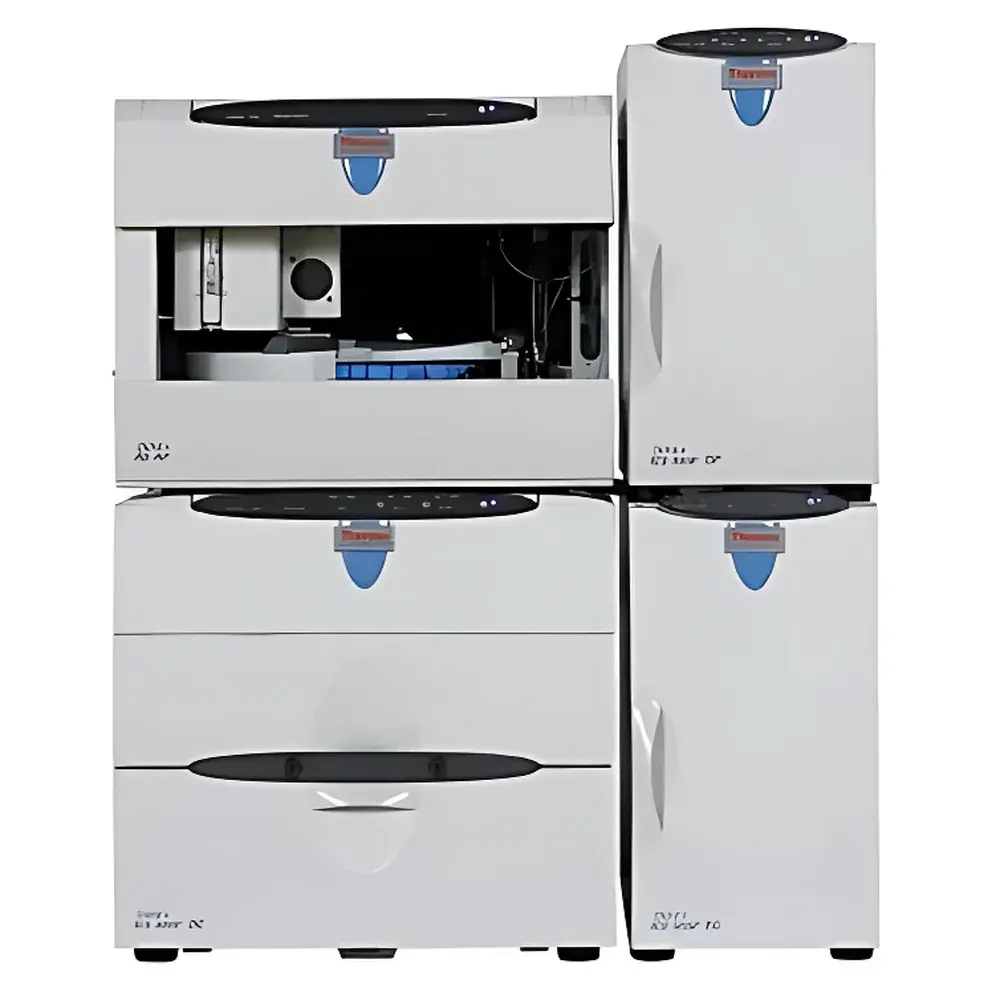
Thermo Scientific Dionex ICS-5000+ High-Pressure Ion Chromatography System
| Brand | Thermo Fisher |
|---|---|
| Origin | USA |
| Manufacturer | Thermo Fisher Scientific |
| Product Type | Imported Laboratory Instrument |
| Model | ICS-5000+ |
| Pump Pressure Rating | 6000 psi |
| Maximum Operating Pressure | 6000 psi |
| Operating Temperature Range | 4–40 °C |
| Eluent Concentration Range | 0–100 mM (KOH), dependent on eluent chemistry |
Overview
The Thermo Scientific Dionex ICS-5000+ High-Pressure Ion Chromatography (HPIC™) System represents the first commercially deployed capillary-scale, high-pressure ion chromatograph engineered for full “eluent generation on demand” operation—commonly referred to as the “just-add-water” architecture. Built upon a modular, dual-pressure-capable platform, the ICS-5000+ integrates capillary, microbore, and standard-bore chromatographic flow paths within a single instrument framework. Its core measurement principle relies on suppressed conductivity detection following high-efficiency anion or cation exchange separation under precisely controlled high-pressure gradients (up to 6000 psi). This enables compatibility with sub-4 µm particle-packed columns—delivering enhanced peak capacity, improved resolution, and accelerated analysis cycles without compromising reproducibility. Designed for long-term method stability and regulatory compliance, the system supports routine operation across environmental, pharmaceutical, food safety, clinical, and materials science laboratories requiring trace-level anion/cation quantification with low carryover and high baseline stability.
Key Features
- Capillary HPIC architecture with integrated electrolytic eluent generation (EG) capable of continuous operation for up to 18 months using only deionized water—reducing annual eluent consumption to ≤5.25 L
- 6000 psi pressure rating supporting high-resolution separations on 4 µm and smaller particle-size columns, including fast-separation and high-efficiency IC columns
- Dual-system configuration option enabling simultaneous or sequential analysis modes—including 2D-IC (IC×IC), IC-MS, IC-MS/MS, and IC-ICP/MS coupling
- Multi-detector compatibility: suppressed conductivity, pulsed amperometric detection (PAD), UV/Vis, fluorescence, charged aerosol detection (CAD), and mass spectrometry interfaces
- AS-DV and AS-AP automated sample processors with AutoTrayShake, Puncture Offset, online filtration, temperature-controlled autosampling (4–40 °C), and programmable dilution/preconcentration
- Real-time monitoring of eluent conductivity and pH prior to injection—enabling intelligent sample release logic and adaptive method execution
Sample Compatibility & Compliance
The ICS-5000+ accommodates diverse analyte classes—including inorganic anions/cations, organic acids, amino acids, carbohydrates, nucleotides, small-molecule pharmaceuticals, antibiotics, and peptides—across matrices such as drinking water, wastewater, biological fluids, food extracts, and semiconductor process chemicals. Its hardware and software architecture conforms to international quality and data integrity requirements: fully compliant with FDA 21 CFR Part 11, EU Annex 11, and GLP/GMP audit-trail specifications. All critical parameters—including pump pressure, column oven temperature, detector response, and autosampler status—are timestamped, version-controlled, and electronically signed within Chromeleon CDS. The system supports IQ/OQ/PQ documentation packages aligned with ISO/IEC 17025 and ASTM D4327, D6919, and D7237 standards.
Software & Data Management
Chromeleon Chromatography Data System (CDS) 7.1 serves as the native, enterprise-grade control and data handling platform. It provides bidirectional control of over 300 chromatographic instruments from 30+ manufacturers—including Thermo’s full portfolio of IC, HPLC, UHPLC, GC, and MS systems. The interface adheres to Windows-native interaction paradigms (drag-and-drop method building, context-aware wizards, customizable dashboards) while enforcing role-based access control, electronic signatures, and immutable audit trails. Integrated D-Library access enables cross-referencing of validated methods and retention time libraries published by global users and Thermo application scientists. Raw data files are stored in vendor-neutral .cdf format, supporting third-party reprocessing and long-term archival per ISO 14721 (OAIS) guidelines.
Applications
- Regulatory environmental testing: EPA Methods 300.0, 300.1, 317.0, 321.8, and ASTM D4327 for nitrate, fluoride, sulfate, perchlorate, and bromate in water
- Pharmaceutical quality control: USP , , and ICH Q5C-compliant counterion analysis, residual salt profiling, and excipient purity assessment
- Food & beverage safety: Quantification of preservatives (benzoate, sorbate), sweeteners (acesulfame-K, sucralose), and biogenic amines in complex matrices
- Clinical diagnostics: Simultaneous determination of chloride, phosphate, and organic acids in serum, urine, and cerebrospinal fluid
- Electronics-grade chemical analysis: Trace anion impurities (Cl⁻, F⁻, SO₄²⁻) in ultrapure water and photoresist solvents at sub-ppq levels
FAQ
What is the maximum operating pressure supported by the ICS-5000+?
The system is rated for continuous operation at up to 6000 psi, enabling use of high-efficiency, sub-4 µm particle columns.
Can the ICS-5000+ perform two-dimensional ion chromatography?
Yes—via optional dual-pump, dual-column, and dual-detector configurations supporting comprehensive 2D-IC (IC×IC) for complex matrix separation.
Is Chromeleon CDS qualified for regulated environments?
Yes—Chromeleon 7.1 includes full 21 CFR Part 11 compliance features: electronic signatures, audit trail, user authentication, and secure data archiving.
What eluents can be generated on-line with the EG module?
Potassium hydroxide (KOH) is standard; methanesulfonic acid (MSA) and other electrolytes are supported via optional EG cartridges.
Does the system support temperature-sensitive samples?
Yes—the AS-AP and AS-DV autosamplers include Peltier-cooled trays (4–40 °C) and programmable incubation protocols for thermolabile analytes.





