
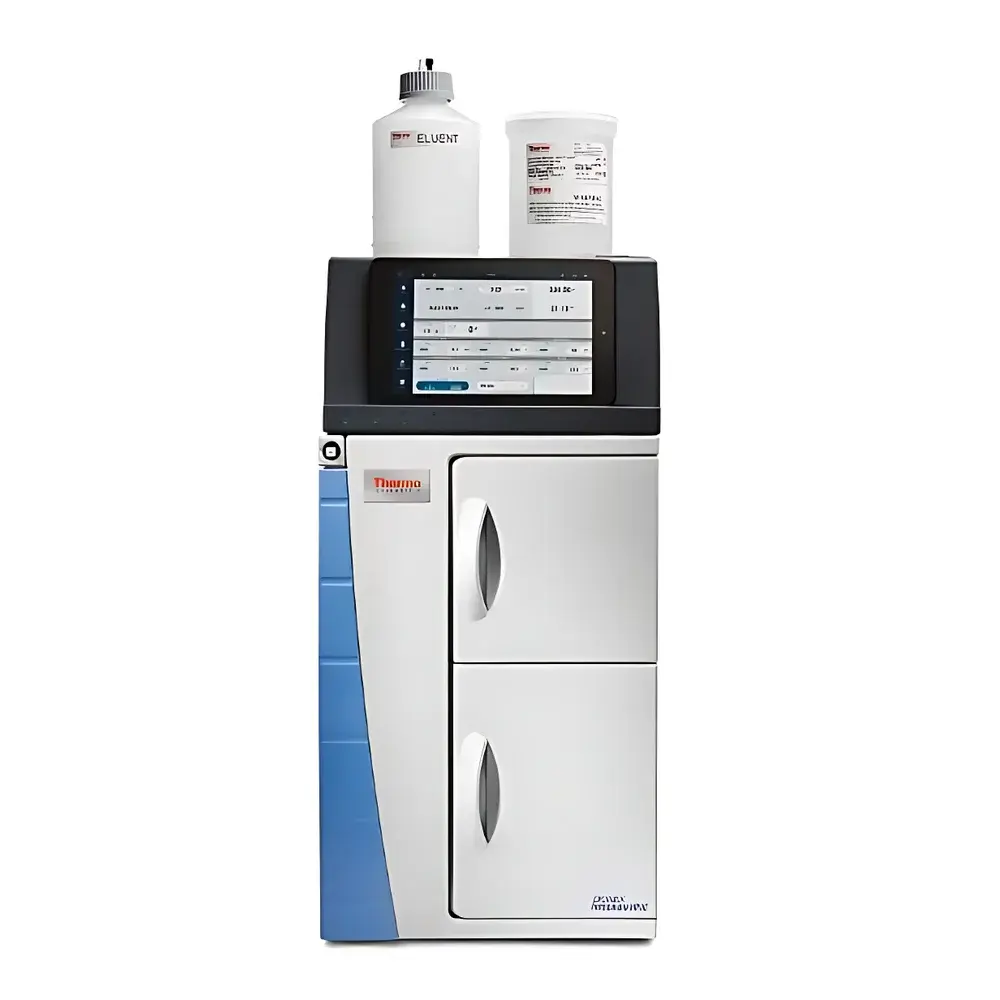
Thermo Scientific Dionex Integrion High-Pressure Ion Chromatography System
| Brand | Thermo Fisher |
|---|---|
| Origin | USA |
| Manufacturer | Thermo Fisher Scientific |
| Product Type | Imported Laboratory Instrument |
| Model | Integrion |
| Pump Pressure Rating | 6000 psi |
| Flow Rate Range | 0.001–22.4 mL/min |
| Eluent Flow Rate Range | 0.001–22.4 mL/min |
| Maximum Operating Pressure | 5000 psi |
| Column Oven Temperature Range | Ambient +5°C to 80°C |
| Temperature Stability | ±0.05°C |
| Eluent Concentration Range | 0.1–100 mM (dependent on eluent chemistry) |
Overview
The Thermo Scientific Dionex Integrion High-Pressure Ion Chromatography (HPIC) System represents a foundational advancement in modern ion analysis for regulated and research laboratories. Engineered around high-pressure liquid chromatography principles applied specifically to ionic species, the Integrion platform leverages robust isocratic and gradient elution capabilities, coupled with precise electrochemical detection and electrolytically generated eluents, to deliver reproducible, high-resolution separation of anions, cations, organic acids, and amines. Its architecture integrates pressure-stable fluidics, thermally controlled column compartments, and real-time system diagnostics—designed explicitly for compliance-critical environments where method robustness, data integrity, and operational traceability are non-negotiable. Unlike conventional low-pressure IC systems, the Integrion’s 6000 psi pump rating enables full compatibility with sub-4 µm particle-packed columns—significantly enhancing peak capacity, resolution, and analysis speed without sacrificing baseline stability or column lifetime.
Key Features
- High-pressure binary or quaternary gradient-capable pump with pressure rating up to 6000 psi and ultra-low pulsation (<0.1% RSD), enabling stable operation with 4 µm Dionex IonPac columns
- RFIC-EG (Reagent-Free Ion Chromatography – Electrolytic Eluent Generation): On-line electrolytic generation of eluents from deionized water—eliminating manual preparation, minimizing contamination risk, and improving inter-run reproducibility of eluent concentration (0.1–100 mM range)
- CR-TC (Carbonate Removal – Trace Contaminant) eluent purification system integrated upstream of the detector to remove trace carbonate and other ionic impurities that compromise baseline stability and sensitivity
- Integrated degassing module providing continuous online eluent degassing—critical for maintaining consistent conductivity response and avoiding bubble-induced signal noise
- Dual-detector capability: swappable, factory-calibrated conductivity detector and pulsed amperometric detector (PAD), supporting DC, pulsed, and integrated amperometry modes for carbohydrate, amino acid, and thiol analysis
- Viper fingertight fitting technology and optimized flow-path geometry minimize dead volume, reduce carryover, and ensure rapid system equilibration and method transfer fidelity
Sample Compatibility & Compliance
The Integrion HPIC system supports diverse sample matrices—including environmental water, pharmaceutical excipients, food extracts, semiconductor process chemicals, and biological fluids—following appropriate sample pretreatment (e.g., filtration, dilution, matrix elimination cartridges). It complies with key regulatory frameworks governing analytical instrumentation in quality control and GxP environments: ASTM D4327 (anion analysis in water), ISO 10304-1/3 (determination of dissolved anions/cations), USP <645> (conductivity of water for injection), and EPA Methods 300.0, 300.1, and 317.0. All hardware and software components support audit trail, electronic signature, and user access control per FDA 21 CFR Part 11 requirements when deployed with Chromeleon CDS v7.3 or later under validated configurations. Column oven temperature stability (±0.05°C) ensures retention time precision required for pharmacopeial method validation (ICH Q2(R2)).
Software & Data Management
Chromeleon Chromatography Data System (CDS) v7.3+ serves as the native, fully integrated software platform. It provides comprehensive sequence management, real-time instrument control, automated calibration, and quantitative reporting compliant with GLP/GMP workflows. The system includes embedded IC-specific tools: an IC Fault Diagnosis Knowledge Base delivering context-aware troubleshooting guidance; consumables installation wizards with step-by-step video and torque specifications; and a dynamic Consumables Warehouse that auto-detects installed columns, suppressors, and electrolytic modules—displaying lot numbers, expiration dates, usage history, and remaining service life. Remote monitoring and parameter adjustment are supported via the Chromeleon Mobile app on iOS or Android tablets, with localized language interfaces (English, Chinese, Japanese, German, French) and offline-accessible operation/maintenance documentation.
Applications
The Integrion HPIC system delivers validated performance across multiple application domains: quantification of low-level nitrate and perchlorate in drinking water per EPA Method 317.0; simultaneous analysis of organic acids (e.g., lactate, acetate, citrate) in bioprocess monitoring; speciation of iodide, bromide, and chlorate in disinfection byproduct studies; cation profiling (Na⁺, K⁺, Ca²⁺, Mg²⁺, NH₄⁺) in pharmaceutical formulations; and high-sensitivity carbohydrate mapping in monoclonal antibody glycosylation studies using PAD detection. Its modularity also supports hyphenated techniques—such as IC-UV for non-conductive analytes, IC-MS for elemental speciation (e.g., As(III)/As(V)), and IC-ICP-MS for ultra-trace metalloid quantification—via standardized interface kits and synchronization protocols.
FAQ
What column particle sizes is the Integrion HPIC system rated for?
The system is fully validated for use with 4 µm Dionex IonPac columns and compatible with other commercially available sub-5 µm IC columns meeting 6000 psi pressure ratings.
Does the RFIC-EG module require external CO₂ scrubbing for carbonate-sensitive applications?
No—the integrated CR-TC cartridge removes residual carbonate generated during electrolysis, eliminating the need for external scrubbers in most routine analyses.
Can the system operate unattended for extended sequences?
Yes—auto-sampler compatibility (up to 120 positions), scheduled maintenance alerts, and predictive consumables monitoring enable overnight and weekend operation under validated conditions.
Is Chromeleon CDS validation support available for regulated labs?
Thermo Fisher provides IQ/OQ documentation packages, 21 CFR Part 11 configuration guides, and qualified installation services through certified field application specialists.
How does temperature control impact retention time reproducibility?
With ±0.05°C column oven stability over 80°C operating range, the system achieves <0.15% RSD in retention time across 100+ injections—meeting USP system suitability criteria for IC methods.




