
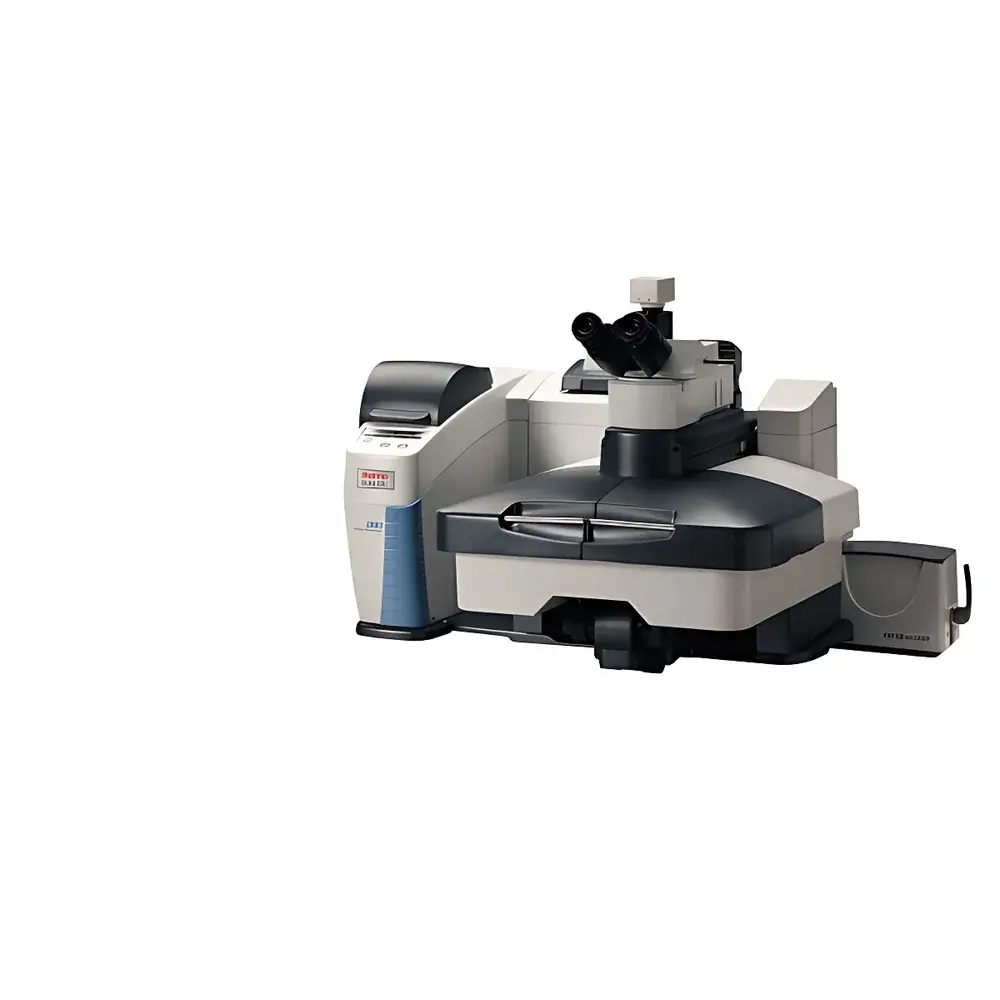
Thermo Scientific DXRxi Raman Microscope Imaging Spectrometer
| Brand | Thermo Fisher |
|---|---|
| Origin | USA |
| Manufacturer Type | Original Equipment Manufacturer (OEM) |
| Origin Category | Imported Instrument |
| Model | Thermo Scientific DXRxi |
| Pricing | Available Upon Request |
Overview
The Thermo Scientific DXRxi Raman Microscope Imaging Spectrometer is a fully integrated, research-grade confocal Raman imaging platform engineered for high spatial resolution chemical mapping and spectral characterization at the micro- and sub-micron scale. Built upon a robust inverted optical microscope architecture, the DXRxi combines a high-efficiency holographic transmission grating spectrometer, motorized XYZ stage, and precision laser excitation modules to deliver quantitative, reproducible Raman spectra with diffraction-limited spatial resolution. Its core measurement principle relies on inelastic scattering of monochromatic laser light—typically at 532 nm or 785 nm excitation wavelengths—enabling non-destructive, label-free identification and distribution analysis of molecular vibrations across heterogeneous samples. Designed for routine use in regulated and academic laboratories alike, the system operates under strict alignment with ISO/IEC 17025-compliant instrument qualification protocols and supports full traceability per GLP and GMP documentation requirements.
Key Features
- Automated optical alignment and wavelength calibration—no manual tools or user intervention required
- Intelligent modular design: interchangeable lasers, edge filters, and gratings enable configuration switching in under 10 seconds
- Real-time visual parameter optimization via live Raman preview and signal-to-noise feedback during acquisition
- Auto-focus functionality combining white-light microscopy and Raman signal maximization for precise targeting on topographically irregular surfaces
- I-class laser safety certification during standard microscope viewing mode; automatic beam interlock disengages laser emission when visible-light path is active
- Class 3B laser operation only when external fiber probe is connected and actively engaged—requires ANSI Z136.1-compliant eyewear and procedural controls
- High-speed XY raster scanning with sub-micron step resolution and synchronized spectral acquisition up to 1,000 spectra/sec
Sample Compatibility & Compliance
The DXRxi accommodates a broad range of solid, thin-film, powder, and encapsulated samples—including conductive, insulating, hydrated, and temperature-sensitive materials—without vacuum or metal coating requirements. It supports standard 25 mm and 32 mm diameter microscope slides, petri dishes, silicon wafers, and custom sample holders compatible with environmental chambers (optional). The system meets CE marking requirements for electromagnetic compatibility (EN 61326-1) and laser product safety (EN 60825-1:2014). For regulated environments, OMNIC™xi software includes 21 CFR Part 11-compliant audit trail, electronic signature, and user-role-based access control—validated for use in pharmaceutical QC, forensic casework, and materials release testing per ASTM E1840 and ISO 21508 standards.
Software & Data Management
OMNIC™xi is a dedicated, GPU-accelerated software suite designed explicitly for large-scale Raman hyperspectral data handling. It provides real-time spectral preprocessing—including automated background subtraction, cosmic ray removal, fluorescence correction, and intensity normalization—alongside multivariate analysis tools such as PCA, cluster analysis, and spectral unmixing. The software enables batch processing of >10⁶ spectra per dataset, generates false-color chemical maps with pixel-level confidence metrics, and exports metadata-rich .spa/.spc files compatible with third-party chemometric platforms (e.g., MATLAB, Python scikit-learn, Unscrambler®). All raw and processed data are stored in a hierarchical folder structure with embedded timestamps, instrument configuration logs, and operator annotations—ensuring full ALCOA+ compliance (Attributable, Legible, Contemporaneous, Original, Accurate, Complete, Consistent, Enduring, Available).
Applications
- Nanomaterials characterization: graphene layer counting, carbon nanotube chirality mapping, quantum dot composition profiling
- Pharmaceutical solid-state analysis: polymorph distribution, API-excipient interaction, tablet coating uniformity
- Geological mineral identification and phase mapping in thin sections and drill cores
- Biomedical tissue diagnostics: lipid/protein/nucleic acid spatial distribution in frozen or FFPE sections
- Forensic trace evidence analysis: fiber dye identification, paint layer stratigraphy, explosive residue localization
- Failure analysis in microelectronics: stress-induced shifts in Si/SiO₂ Raman peaks, contaminant identification on wafer surfaces
FAQ
What laser wavelengths are available on the DXRxi platform?
Standard configurations include 532 nm and 785 nm diode-pumped solid-state lasers; optional 633 nm and 488 nm modules are available for specialized resonance Raman applications.
Can the DXRxi perform depth profiling through transparent layers?
Yes—confocal pinhole aperture and precise Z-motor control enable optical sectioning with axial resolution down to ~1 µm (dependent on objective NA and laser wavelength).
Is OMNIC™xi validated for use in FDA-regulated environments?
Yes—the software includes IQ/OQ documentation templates, electronic signature workflows, and full audit trail functionality compliant with 21 CFR Part 11 and Annex 11 requirements.
How does the system handle fluorescence interference?
It employs multiple strategies: optimized 785 nm excitation, adaptive background modeling, multi-point baseline correction, and optional notch filter upgrades for high-fluorescence samples.
What microscope objectives are supported?
Standard support for 10×, 20×, 50×, and 100× long-working-distance and oil-immersion objectives (Nikon CFI Plan Apo series); custom objective integration is possible via standardized RMS thread mount.




