
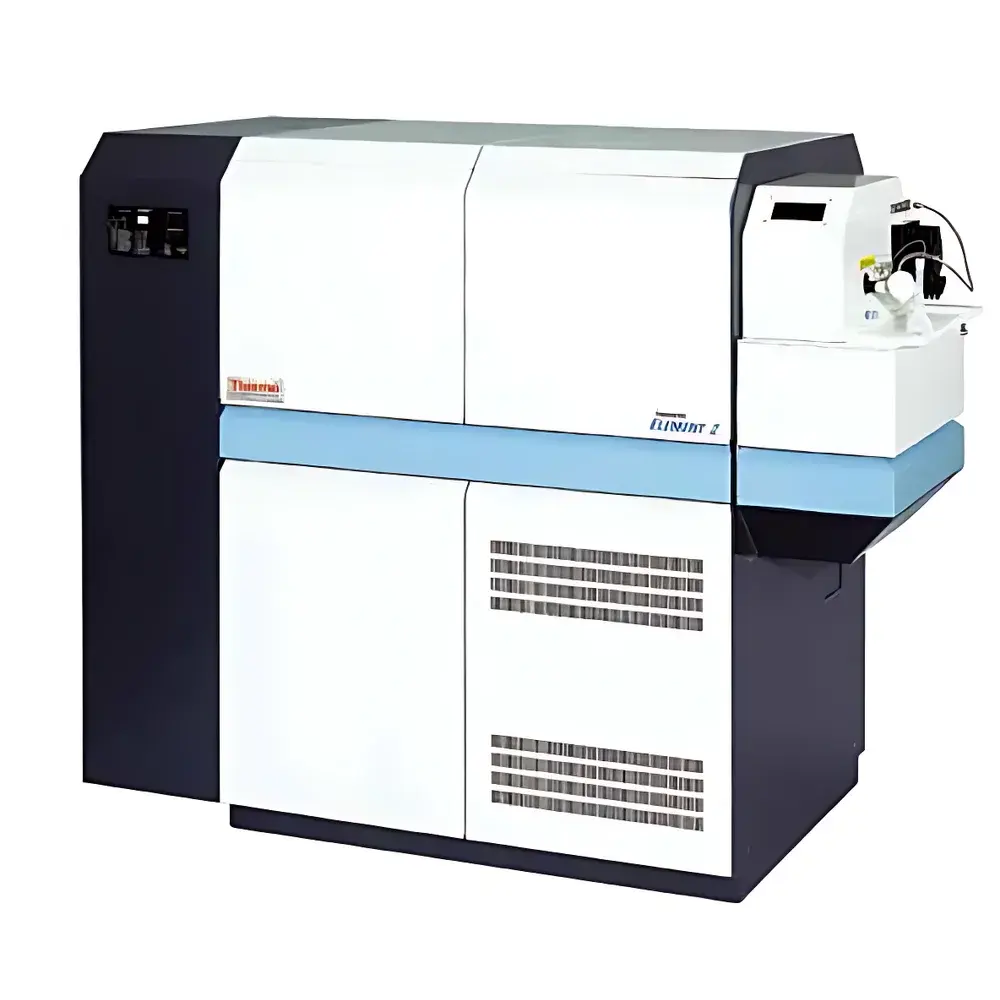
Thermo Scientific ELEMENT 2/XR High-Resolution Single-Collector ICP-MS
| Brand | Thermo Fisher |
|---|---|
| Origin | Germany |
| Manufacturer | Thermo Fisher Scientific |
| Instrument Type | Magnetic Sector ICP-MS |
| Model | ELEMENT 2/XR |
| Resolution Modes | Fixed Low/Medium/High Resolution Slits |
| Linear Dynamic Range | 12 orders of magnitude |
| Interface | Jet Sample Introduction System |
Overview
The Thermo Scientific ELEMENT 2/XR is a high-resolution, single-collector inductively coupled plasma mass spectrometer (HR-SC-ICP-MS) engineered for trace element and isotopic analysis at sub-picogram-per-gram detection levels. Utilizing double-focusing magnetic sector mass analyser architecture, the instrument separates ions based on momentum and energy, delivering mass-resolving powers up to 10,000 (M/ΔM, 10% valley definition), enabling direct resolution of isobaric interferences—such as 40Ar16O+ on 56Fe+, 40Ar35Cl+ on 75As+, or 138Ba16O+ on 154Gd+—without reliance on collision/reaction cell chemistry. Designed and manufactured in Bremen, Germany, the ELEMENT 2/XR meets stringent ISO 9001-certified production standards and is deployed globally in accredited environmental laboratories, nuclear safeguards facilities, geochemical reference material certification programs, and advanced materials R&D centers.
Key Features
- Triple fixed-slit resolution configuration: Dedicated low-, medium-, and high-resolution slits (e.g., 300, 4000, and 10,000 M/ΔM) allow rapid, reproducible switching between sensitivity-optimized and interference-free acquisition modes without real-time tuning or recalibration.
- Jet interface technology: A proprietary high-efficiency sample introduction system combining a micro-flow nebulizer with an enhanced Ni sampler/skimmer cone geometry, delivering >10× higher ion transmission efficiency compared to conventional ICP-MS interfaces—critical for low-volume, high-value samples such as single-cell digests or micro-sampled geological specimens.
- 12-decade linear dynamic range: Achieved via dual Faraday cup and discrete-dynode electron multiplier detection, enabling quantification from major-element concentrations (wt%) down to sub-attogram absolute detection limits in a single run—eliminating manual dilution steps and reducing carryover risk.
- Magnetic sector stability: Temperature-stabilized 7.0 Tesla permanent magnet with active field homogenization ensures long-term mass calibration stability (<0.1 ppm/h drift), supporting multi-day unattended operation required for isotopic ratio monitoring in nuclear forensics or geochronology applications.
- Robust plasma interface: Optimized RF generator (27.12 MHz) and torch design deliver stable, cool-plasma conditions compatible with high-TDS (>25% w/v) and organic solvent matrices (e.g., 20% methanol), minimizing oxide and doubly charged ion formation (<1.5% CeO+/Ce+).
Sample Compatibility & Compliance
The ELEMENT 2/XR accepts liquid samples introduced via standard pneumatic nebulization, laser ablation (with compatible 193 nm ArF excimer systems), or hydride generation. It supports full compliance with ISO/IEC 17025:2017 method validation requirements, including documented linearity assessment (per ISO 8466-1), limit of detection (LOD) determination (per IUPAC guidelines), and isotopic ratio precision reporting (per ASTM D7089). Data integrity workflows align with FDA 21 CFR Part 11 and EU Annex 11 expectations, including electronic signatures, audit trails for method parameters and calibration history, and role-based user access control within Thermo Scientific Qtegra Intelligent Scientific Data Solution™ software.
Software & Data Management
Controlled exclusively through Qtegra ISDS v3.5+ software, the ELEMENT 2/XR provides integrated sequence management, real-time interference correction algorithms (e.g., mathematical deconvolution of polyatomic overlaps), and automated internal standard normalization. All raw data files (.raw) are stored in vendor-neutral, XML-based formats compliant with ASTM E2871-21 for long-term archival. Software modules support GLP/GMP-compliant reporting templates—including certified reference material (CRM) comparison reports aligned with NIST SRM documentation—and export to LIMS via ASTM E1482-compliant interfaces.
Applications
- Environmental monitoring: Quantification of ultra-trace heavy metals (e.g., U, Pu, Am) in seawater per EPA Method 200.8 Rev. 5.4; isotopic fingerprinting of Pb and Sr in airborne particulates for source apportionment.
- Nuclear safeguards: Isotopic assay of 235U/238U, 240Pu/239Pu, and minor actinides in spent fuel reprocessing streams per IAEA Technical Reports Series No. 433.
- Geochemistry: High-precision Lu–Hf, Sm–Nd, and Re–Os isotope ratio measurements in zircon, garnet, and sulfide minerals for crustal evolution modeling.
- Materials science: Depth-resolved impurity profiling in semiconductor wafers (Si, GaAs) using femtosecond LA-ICP-MS; dopant uniformity mapping in battery cathode materials (Ni, Co, Mn).
- Biomedical research: Quantitative metalloproteomics via species-specific isotope dilution (e.g., 67Zn-labeled transferrin tracking in cell lysates).
FAQ
What resolution settings are available on the ELEMENT 2/XR, and how are they selected?
The instrument features three physically fixed entrance and exit slits corresponding to low (~300), medium (~4,000), and high (~10,000) mass resolution. Selection is performed via motorized slit changers under software control—no manual intervention or vacuum break required.
Does the ELEMENT 2/XR support hyphenated techniques such as HPLC-ICP-MS?
Yes. The system includes dedicated time-resolved acquisition mode with sub-100 ms dwell times and external TTL synchronization inputs for seamless integration with HPLC, IC, or CE separation systems.
Is remote diagnostics and service support available?
Thermo Fisher’s iCAP Connect platform enables secure, encrypted remote access for predictive maintenance alerts, firmware updates, and collaborative troubleshooting by certified field application scientists—subject to customer IT policy approval.
How is mass calibration maintained during extended analytical sequences?
An internal reference gas (e.g., Xe or Bi) is periodically introduced via a dedicated valve; automated peak centering routines correct for thermal drift in real time, ensuring mass accuracy remains within ±0.002 Da over 24-hour acquisitions.
Can the ELEMENT 2/XR be upgraded to multi-collector capability?
No. The ELEMENT 2/XR is a single-collector platform. For multi-collector HR-ICP-MS, Thermo Fisher offers the Neptune Plus system, which shares core magnet and interface engineering but incorporates multiple Faraday and secondary electron multiplier detectors.




