
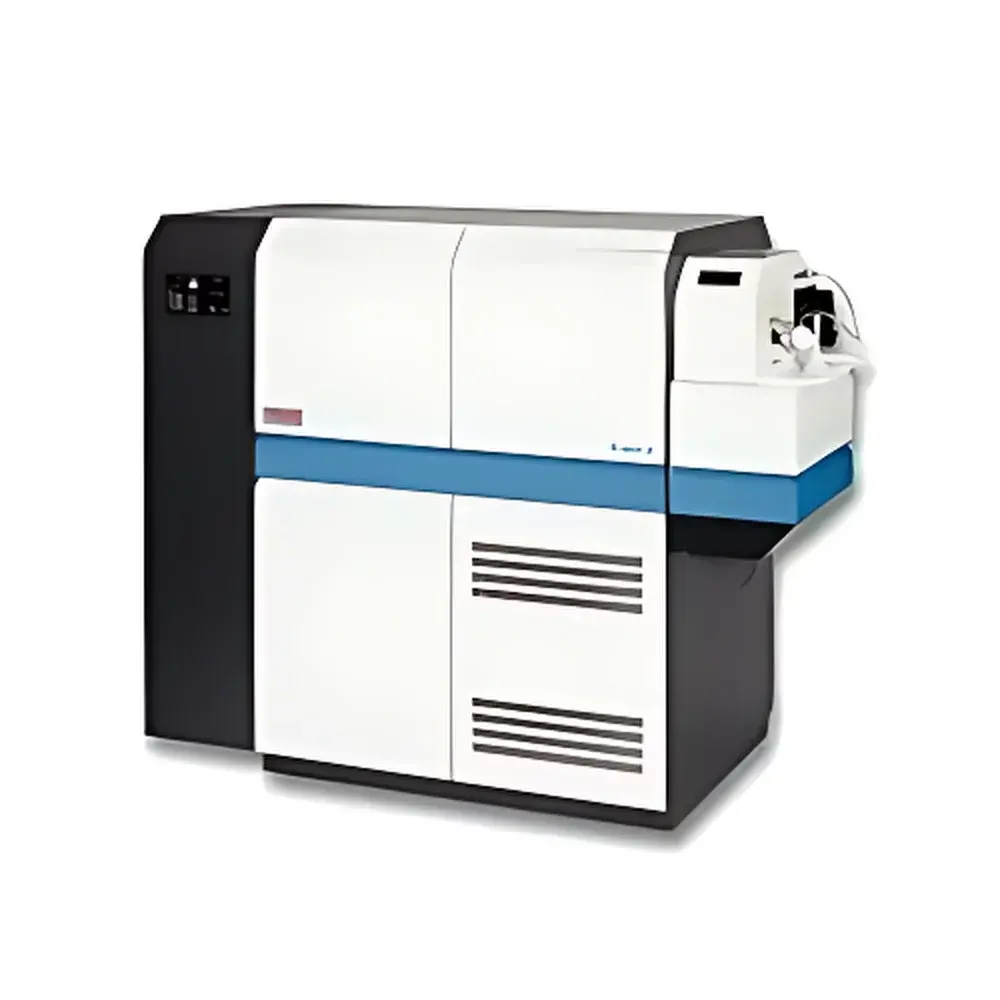
Thermo Scientific ELEMENT™ Series ICP-MS
| Brand | Thermo Fisher |
|---|---|
| Origin | Switzerland |
| Manufacturer Type | Authorized Distributor |
| Origin Category | Imported |
| Model | ELEMENT™ Series ICP-MS |
| Price Range | USD 200,000–270,000 |
| Instrument Type | Sector Field Magnetic Sector ICP-MS |
| Mass Resolution (at 10% peak height, m/Δm) | >10,000 |
| Detection Limit (in aqueous solution, 3σ) | <0.2 fg L⁻¹ for ²³⁸U |
| Sensitivity (for ²³⁸U at 1 µg L⁻¹) | >1 × 10⁹ cps per µg L⁻¹ |
| Dynamic Range | 0.2 cps (SEM) to >1 × 10¹² cps (Faraday) |
Overview
The Thermo Scientific ELEMENT™ Series represents a class of high-performance, double-focusing magnetic sector field inductively coupled plasma mass spectrometers (ICP-MS) engineered for ultra-trace elemental and isotopic analysis across demanding research, regulatory, and industrial laboratories. Unlike quadrupole-based systems, the ELEMENT platform employs a dual-focusing geometry—combining electrostatic and magnetic sectors—to achieve mass-resolving powers exceeding 10,000 (m/Δm at 10% peak height), enabling definitive separation of isobaric and polyatomic interferences (e.g., 40Ar16O+ from 56Fe+, 40Ar35Cl+ from 75As+). This resolution capability is fundamental to achieving sub-femtogram-per-liter detection limits (<0.2 fg L⁻¹ for uranium in standard aqueous matrixes) and robust accuracy in complex, high-salt, or organic-rich samples without extensive chemical separation. The system operates with both hot and cold plasma modes, supporting optimized ionization efficiency for refractory elements (e.g., B, P, S, Zn) and minimization of oxide formation (
Key Features
- Double-focusing magnetic sector architecture delivering mass resolution up to 10,000+ for unambiguous interference removal
- Dual-detector configuration: High-gain secondary electron multiplier (SEM) for ultra-low-level detection and integrated Faraday cup for high-intensity signal measurement
- Seamless, sub-millisecond (<1 ms) automatic switching between SEM and Faraday modes during acquisition
- Extended linear dynamic range spanning 12 orders of magnitude—from 0.2 cps (SEM threshold) to >1 × 10¹² cps (Faraday saturation limit)
- Programmable dwell times as short as 1 ms per isotope, enabling high-fidelity transient signal capture from laser ablation, HPLC-ICP-MS, and GC-ICP-MS interfaces
- Optimized ion optics with energy filtering and collision/reaction cell compatibility (optional) for enhanced polyatomic suppression
- Robust plasma interface with high-efficiency nickel sampler and skimmer cones designed for long-term stability in high-matrix applications
Sample Compatibility & Compliance
The ELEMENT™ Series supports direct analysis of liquid samples (aqueous, diluted acids, digests), laser-ablated solids, and chromatographically separated species. It accommodates sample introduction via standard nebulizers (e.g., MicroMist, Apex Q), desolvating systems (e.g., Aridus III), and solid sampling platforms (e.g., New Wave UP213). Method validation aligns with ISO/IEC 17025, ASTM D5673 (trace metals in water), USP <232>/<233> (elemental impurities), and EPA Method 6020B. Data integrity meets FDA 21 CFR Part 11 requirements through audit-trail-enabled software, electronic signatures, and secure user-role management—fully compliant with GLP and GMP workflows.
Software & Data Management
Instrument control, data acquisition, and quantitative processing are performed using Thermo Scientific Qtegra™ Intelligent Scientific Data Solution (ISDS) software. Qtegra provides full traceability from raw counts to final concentration, including real-time background subtraction, internal standard correction, isotope dilution calibration (ID-ICP-MS), and multi-collector mode for high-precision ratio measurements. All raw data files are stored in vendor-neutral .raw format with embedded metadata (instrument parameters, tuning logs, QC results). Automated report generation supports customizable templates aligned with laboratory-specific SOPs and regulatory submission formats (e.g., PDF/A-2, CSV export with ISO 8601 timestamps).
Applications
- Geochemical fingerprinting and radiogenic isotope dating (e.g., U–Pb, Lu–Hf, Re–Os)
- High-purity material certification (semiconductor-grade Si, GaAs, Li-ion battery cathodes)
- Environmental monitoring of ultra-trace metals in seawater, snowpack, and atmospheric particulates
- Biological and clinical metallomics (metal-protein speciation, intracellular metal quantification)
- Nuclear safeguards and fuel cycle analysis (isotopic composition of U, Pu, Am, Cm)
- Pharmaceutical elemental impurity screening per ICH Q3D guidelines
FAQ
What distinguishes ELEMENT™ from quadrupole ICP-MS instruments?
The ELEMENT™ Series uses magnetic sector mass analyzers—not quadrupoles—delivering superior mass resolution, lower detection limits, and higher precision for isotopic ratio measurements.
Can the system perform simultaneous multi-element analysis?
Yes—via rapid sequential scanning or multi-collector operation (on ELEMENT XR™), enabling true simultaneous detection of multiple isotopes with no duty-cycle loss.
Is laser ablation supported out-of-the-box?
Yes—the instrument includes dedicated LA-ICP-MS acquisition modes, time-resolved data handling, and integration-ready interfaces for major ablation systems (e.g., CETAC, Photon Machines).
How is data integrity ensured for regulated environments?
Qtegra ISDS enforces ALCOA+ principles: Attributable, Legible, Contemporaneous, Original, Accurate, plus Complete, Consistent, Enduring, and Available—fully auditable under FDA 21 CFR Part 11 and EU Annex 11.
What maintenance intervals are recommended for routine operation?
Daily autotune and sensitivity checks; monthly cone cleaning and vacuum system inspection; annual mass calibration and detector verification per Thermo Scientific Service Plan documentation.





