
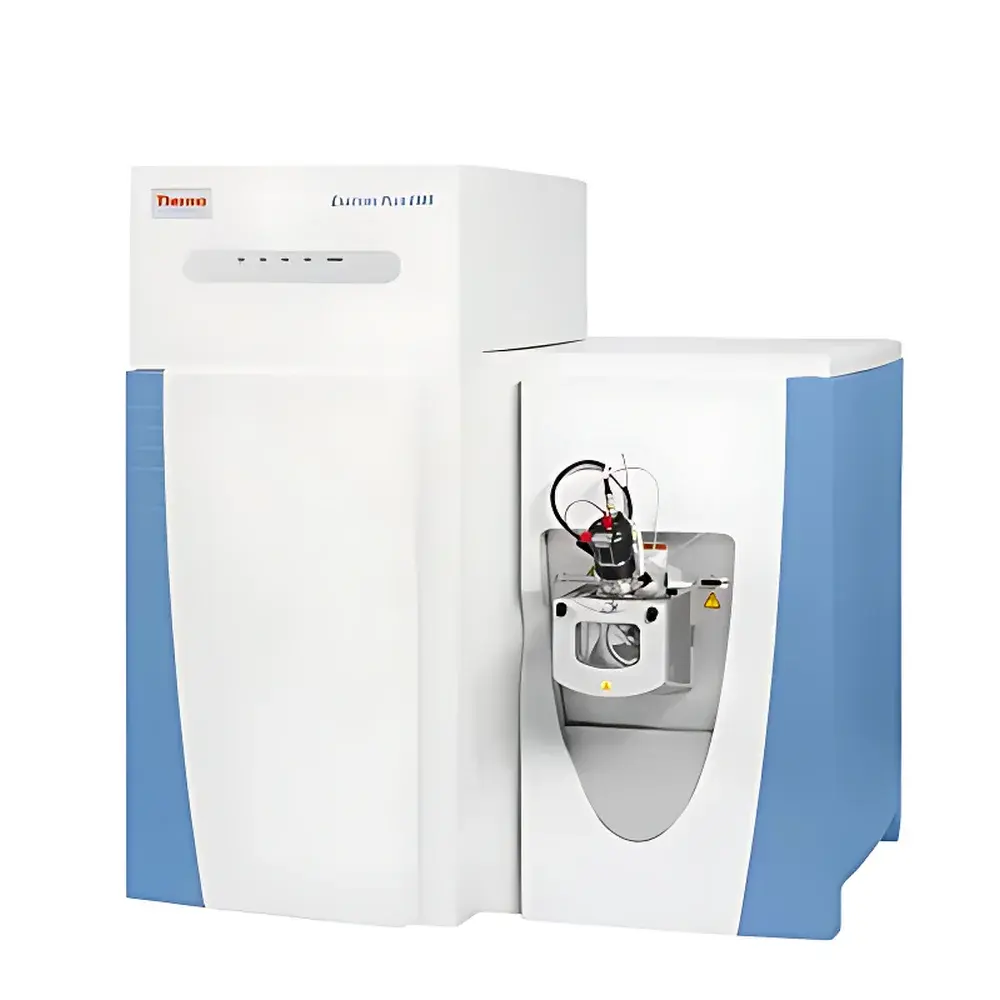
Thermo Scientific Exactive Plus (EMR) Orbitrap Liquid Chromatography Mass Spectrometer
| Brand | Thermo Fisher |
|---|---|
| Origin | USA |
| Manufacturer Type | Original Equipment Manufacturer (OEM) |
| Import Status | Imported |
| Model | Exactive Plus (EMR) Orbitrap LCMS |
| Instrument Type | Orbitrap-based LC-MS |
| Mass Range | Extended up to 6,000 m/z (with EMR option) |
| Resolution | Up to 140,000 FWHM @ m/z 200 |
| Mass Accuracy | < 3 ppm RMS (internal calibration), < 5 ppm RMS (external calibration) |
| Sensitivity | Sub-femtomole level for peptides (S/N ≥ 10 in full-scan mode) |
| Exact Mass Measurement | Yes, with real-time internal lock mass correction |
Overview
The Thermo Scientific Exactive Plus (EMR) Orbitrap Liquid Chromatography Mass Spectrometer is a high-performance benchtop LC-MS platform engineered for structural proteomics, intact protein characterization, and comprehensive small-molecule profiling. Built upon the robust Orbitrap mass analyzer architecture, it delivers high-resolution, accurate-mass (HRAM) measurements with extended mass range capability enabled by the optional Extended Mass Range (EMR) hardware module. This configuration supports reliable detection and characterization of large biomolecules—including monoclonal antibodies (mAbs), PEGylated proteins, oligomeric complexes, glycoforms, and multi-subunit assemblies—while preserving native-like conformational integrity during electrospray ionization (ESI). The system operates on the principle of electrostatic trapping and Fourier-transform ion cyclotron resonance (FT-ICR)-inspired detection, where ions oscillate radially within the Orbitrap analyzer under precisely tuned electric fields, generating image currents that are digitized and transformed into high-fidelity mass spectra.
Key Features
- Extended Mass Range (EMR) option enabling full-scan acquisition up to m/z 6,000, critical for intact protein analysis under native or near-native conditions
- Resolution up to 140,000 FWHM at m/z 200, ensuring baseline separation of isotopic fine structure and elimination of isobaric interferences in complex matrices
- Real-time internal lock-mass calibration using co-infused reference compounds, delivering sustained mass accuracy < 3 ppm RMS (internal) across multi-hour LC gradients
- Ultra-high-speed polarity switching: complete positive- and negative-ion full-scan cycles in < 2 seconds, without compromising mass accuracy or sensitivity
- Simultaneous acquisition modes including Full Scan, All-Ion Fragmentation (AIF), Data-Dependent AIF (ddAIF), and alternating Full Scan/AIF — all within a single run
- Integrated HCD cell enabling controlled, reproducible fragmentation for confident peptide sequencing, PTM localization, and small-molecule structural elucidation
- Benchtop footprint (0.75 m²) with simplified gas and power requirements, suitable for shared core facilities and regulated QC labs
Sample Compatibility & Compliance
The Exactive Plus (EMR) accommodates diverse sample introduction methods, including standard ESI, nano-ESI, and optional heated electrospray (H-ESI) for enhanced desolvation of labile macromolecular complexes. It supports direct coupling to UHPLC systems (e.g., Thermo Vanquish) with flow rates from 50 nL/min to 1 mL/min. In regulated environments, the platform complies with 21 CFR Part 11 requirements when operated with Thermo Scientific Chromeleon CDS v7.3+ and appropriate audit-trail-enabled configurations. Method validation aligns with ICH Q2(R2), USP <1225>, and ISO/IEC 17025 guidelines for analytical instrument qualification (AIQ), including installation qualification (IQ), operational qualification (OQ), and performance qualification (PQ) protocols. Routine operation meets GLP/GMP documentation standards for biopharmaceutical characterization workflows.
Software & Data Management
Data acquisition and processing are managed through Thermo Scientific Compound Discoverer 3.3 and BioPharma Finder 4.1 software suites — both built on a common foundation supporting vendor-neutral data import (mzML), spectral deconvolution, charge-state deconvolution, and automated glycoform annotation. Raw files include embedded metadata compliant with Proteomics Standards Initiative (PSI) mzML 1.2 schema. All processing steps generate immutable audit trails, electronic signatures, and version-controlled method templates. For enterprise integration, the system supports secure LDAP authentication, role-based access control (RBAC), and export to LIMS via standardized APIs. Batch processing pipelines support automated peak detection, alignment, normalization, and statistical filtering per MetaboAnalyst 5.0 and Progenesis QI interoperability profiles.
Applications
- Biopharmaceutical Development: Intact mass analysis of mAbs, ADCs, bispecifics; higher-order structure assessment via native MS; glycosylation profiling and microheterogeneity mapping
- Clinical & Translational Research: Biomarker discovery in plasma/serum using untargeted metabolomics and lipidomics workflows with retention-time-aligned feature detection
- Environmental & Food Safety: Multi-residue screening of pesticides, mycotoxins, and veterinary drug residues at sub-ppb levels in complex food extracts
- Forensic Toxicology: Broad-spectrum identification of novel psychoactive substances (NPS), opioids, and designer drugs in blood and urine without prior target lists
- Drug Metabolism & Pharmacokinetics (DMPK): Structural characterization of Phase I/II metabolites via HRAM-triggered HCD fragmentation and in silico prediction integration
- Academic Proteomics: Top-down and middle-down proteomics for histone PTM analysis, splice variant identification, and protein complex stoichiometry determination
FAQ
What is the maximum recommended mass range for intact protein analysis using the EMR option?
The EMR configuration extends the upper limit of full-scan detection to m/z 6,000, enabling routine analysis of proteins up to ~60 kDa in their intact form under optimized native ESI conditions.
Does the Exactive Plus (EMR) support quantitative workflows such as label-free or SILAC-based quantitation?
Yes — its high mass accuracy and reproducible retention time alignment support robust label-free quantitation (LFQ) and spectral counting. While not designed for heavy-isotope dilution (e.g., TMT, iTRAQ), it integrates seamlessly with external spike-in standards for absolute quantification.
Is the system compatible with non-Thermo UHPLC systems?
Yes — the Exactive Plus interfaces with third-party LC systems via standard analog/digital I/O triggers and timed event synchronization, provided they support MS-ready gradient delay compensation and stable flow delivery.
How is instrument performance verified post-installation?
Performance verification follows Thermo’s IQ/OQ/PQ protocol suite, including resolution, mass accuracy, sensitivity (e.g., angiotensin II S/N ≥ 100:1 at 1 fmol), and retention time stability over 24 h using NIST-traceable calibrants.
Can raw data be reprocessed years after acquisition using updated algorithms?
Yes — all raw data are stored in open-format mzML files, enabling retrospective reprocessing with newer versions of Compound Discoverer or third-party tools like Skyline or OpenMS without dependency on proprietary binaries.





