
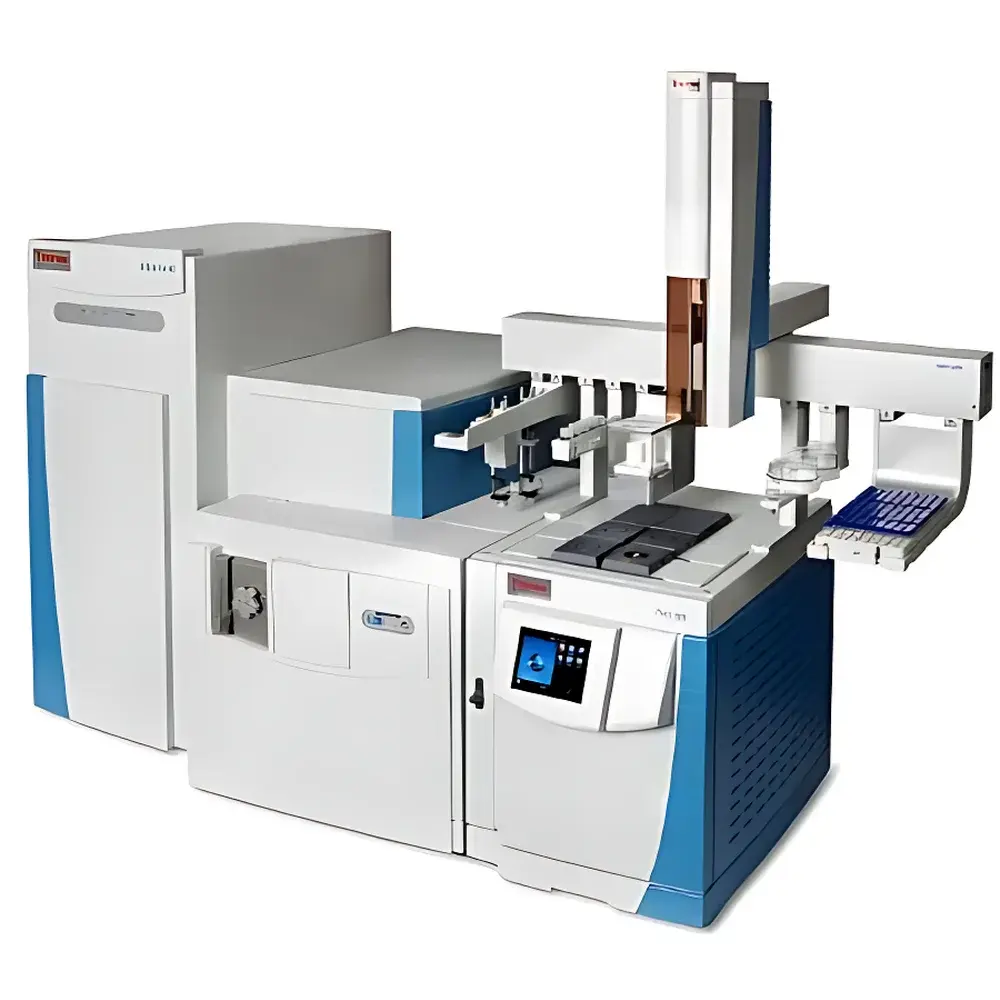
Thermo Scientific Q Exactive GC Orbitrap Hybrid Quadrupole-Orbitrap Mass Spectrometer
| Brand | Thermo Fisher |
|---|---|
| Origin | Germany |
| Manufacturer | Thermo Fisher Scientific |
| Product Type | Imported Instrument |
| Model | Q Exactive™ GC Orbitrap |
| Instrument Category | Orbitrap-based GC-MS/MS System |
| Chromatography Type | Conventional Gas Chromatography Coupled Mass Spectrometry |
| Mass Range | Not Specified |
| Resolution | Up to 100,000 (FWHM) at m/z 272 |
| Mass Accuracy | < 1 ppm (typical, internal calibration) |
| Sensitivity | < 6 fg OFN (octafluoronaphthalene) LOD under EI mode |
| Scan Speed | Not Specified |
Overview
The Thermo Scientific™ Q Exactive™ GC Orbitrap™ system is a high-resolution, accurate-mass (HRAM) gas chromatography–mass spectrometry platform engineered for comprehensive sample characterization in complex matrices. At its core lies the coupling of robust capillary gas chromatography with a hybrid quadrupole–Orbitrap mass analyzer—enabling simultaneous full-scan HRAM acquisition and targeted MS/MS fragmentation in a single run. Unlike conventional triple quadrupole GC-MS systems optimized solely for quantitative workflows, the Q Exactive GC Orbitrap integrates high-fidelity qualitative identification with quantitative precision, leveraging the inherent advantages of Orbitrap technology: electrostatic ion trapping, Fourier-transform-based signal detection, and long transient acquisition for ultra-high resolution and sub-ppm mass accuracy. This architecture supports both discovery-driven untargeted analysis and hypothesis-driven quantitation—making it suitable for environmental monitoring, food safety screening, forensic toxicology, petrochemical profiling, and impurity identification in pharmaceutical development.
Key Features
- Hybrid Quadrupole–Orbitrap Architecture: Combines a high-transmission quadrupole mass filter for precursor ion selection with an Orbitrap mass analyzer for high-resolution, accurate-mass detection—enabling both data-dependent and data-independent acquisition (DDA/DIA) modes.
- Advanced Quadrupole Technology (AQT): Delivers enhanced isolation efficiency and transmission across a broad m/z range, improving sensitivity and reproducibility in targeted MS/MS experiments.
- Variable Electron Voltage (VeV) Ionization: Enables controlled electron ionization energy tuning (10–100 eV), facilitating softer ionization for labile compounds while retaining structural information—critical for isomer differentiation and metabolite identification.
- ExtractaBrite™ Ion Source: A modular, vacuum-locked electron ionization/chemical ionization (EI/CI) source that allows rapid interchange of ion source components—including source liners, filaments, and CI reagent gases—without breaking vacuum or interrupting system operation.
- Vacuum-Lock Column Swapping: Supports column replacement without venting the mass spectrometer, minimizing downtime and preserving instrument stability and calibration integrity over extended operational cycles.
- High Dynamic Range Detection: Achieves linear dynamic range exceeding 5 orders of magnitude in quantitative mode, validated per ASTM D7893 and ISO 17025-compliant protocols.
Sample Compatibility & Compliance
The Q Exactive GC Orbitrap accommodates a wide range of volatile and semi-volatile organic compounds—from hydrocarbons and pesticides to polycyclic aromatic hydrocarbons (PAHs), flame retardants, and residual solvents—provided they are amenable to GC separation (typically < 600 Da, vaporizable below 350 °C). Its analytical workflow aligns with multiple international regulatory frameworks: EPA Methods 8270/8260, EU Regulation (EC) No 396/2005 for pesticide residues, USP and for method validation, and FDA 21 CFR Part 11 requirements for electronic records and signatures. The system supports audit-trail-enabled software operation compliant with GLP and GMP environments, including full traceability of instrument parameters, calibration history, and raw data integrity.
Software & Data Management
Controlled via Thermo Scientific™ TraceFinder™ and Compound Discoverer™ software suites, the Q Exactive GC Orbitrap enables end-to-end workflow automation—from method setup and instrument control to peak integration, library searching (NIST, Wiley, mzCloud), and statistical analysis. All raw data files (.raw) are stored in vendor-neutral formats compatible with open-source tools such as MZmine and XCMS Online. The platform supports secure user role management, electronic signature enforcement, and automated report generation aligned with ISO/IEC 17025 documentation standards. Data archival and retrieval comply with long-term retention policies required under FDA 21 CFR Part 11 and EU Annex 11 guidelines.
Applications
- Non-targeted screening of environmental contaminants in soil, water, and air samples
- Residue analysis in agricultural commodities and processed foods
- Impurity profiling and degradation product identification in API synthesis
- Forensic toxicology screening for novel psychoactive substances (NPS)
- Metabolite identification in preclinical ADME studies
- Comprehensive hydrocarbon typing in petroleum and biofuel applications
FAQ
What ionization methods are supported by the Q Exactive GC Orbitrap?
Electron Ionization (EI) and Chemical Ionization (CI) are fully supported via the ExtractaBrite™ source, with optional configurations for negative-ion mode and reactive gas switching (e.g., methane, isobutane).
Is the system compatible with legacy GC hardware?
Yes—the Q Exactive GC Orbitrap interfaces seamlessly with standard Agilent, Shimadzu, and Thermo Scientific TRACE™ 1300/1310 GC platforms using industry-standard analog/digital I/O and GC trigger synchronization.
Does the system meet regulatory requirements for regulated laboratories?
Yes—it supports 21 CFR Part 11-compliant operation when configured with appropriate software licensing, network authentication, and audit trail settings—validated for use in GLP, GMP, and ISO/IEC 17025-accredited facilities.
What is the typical mass calibration frequency?
Internal calibration using lock mass correction (e.g., perfluorotributylamine, PFTBA) ensures sub-ppm mass accuracy over multi-hour acquisitions; external recalibration is recommended every 48–72 hours depending on usage intensity and ambient conditions.
Can the system perform retrospective data mining?
Yes—full-scan HRAM data acquisition preserves all ion signals across the measured m/z range, enabling post-acquisition reprocessing for new targets without re-injecting samples.





