
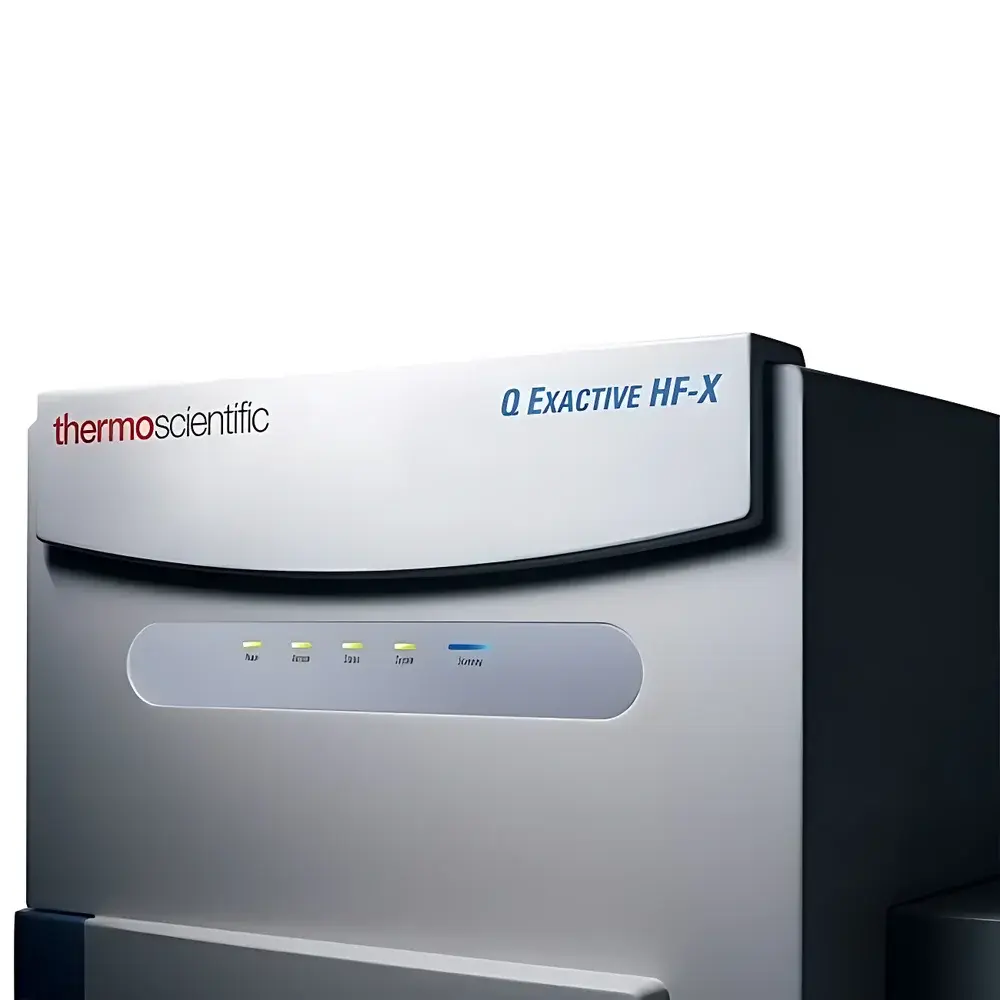
Thermo Scientific Q Exactive HF-X Hybrid Quadrupole-Orbitrap Mass Spectrometer
| Brand | Thermo Fisher |
|---|---|
| Origin | USA |
| Manufacturer Type | Original Equipment Manufacturer (OEM) |
| Import Status | Imported |
| Model | Q Exactive HF-X |
| Instrument Type | Quadrupole-Time-of-Flight (Q-TOF) hybrid with Orbitrap mass analyzer |
| Application Scope | General-purpose high-resolution LC-MS/MS for proteomics, metabolomics, and small-molecule analysis |
Overview
The Thermo Scientific Q Exactive HF-X Hybrid Quadrupole-Orbitrap Mass Spectrometer is an advanced high-resolution, accurate-mass (HRAM) platform engineered for demanding quantitative and qualitative applications in life science research. Unlike conventional time-of-flight or triple quadrupole systems, the Q Exactive HF-X integrates a high-field Orbitrap mass analyzer with a front-end quadrupole mass filter and advanced ion optics—enabling simultaneous precursor selection, fragmentation (HCD), and high-fidelity detection at up to 40 Hz scan speed. Its core architecture leverages electrodynamic ion funnel technology and an upgraded high-capacity transfer tube to maximize ion transmission efficiency across a broad m/z range (50–6,000), resulting in improved signal-to-noise ratios and sub-part-per-trillion (ppt) limit-of-detection performance in complex biological matrices.
Key Features
- High-field Orbitrap analyzer delivering up to 500,000 resolution at m/z 200, with mass accuracy < 1 ppm (internal calibration) and < 3 ppm (external calibration) over extended acquisition periods.
- Enhanced ion transmission system featuring a redesigned electrically driven ion funnel and large-bore transfer tube—optimized for increased sensitivity in both data-dependent (DDA) and data-independent (DIA) acquisition modes.
- Real-time scanning capability at up to 40 Hz in full MS/ddMS2 mode, enabled by fast polarity switching, intelligent duty cycle management, and Advanced Peak Detection (APD) algorithms for robust peak centroiding and deconvolution.
- Integrated quadrupole mass filter enabling unit-resolution isolation with < 0.4 Da isolation width—critical for multiplexed isobaric tagging workflows such as TMTpro and iTRAQ.
- Robust hardware architecture compliant with ISO 9001-certified manufacturing standards; designed for continuous operation under GLP- and GMP-aligned laboratory environments.
Sample Compatibility & Compliance
The Q Exactive HF-X interfaces seamlessly with standard UHPLC systems (e.g., Thermo Vanquish Flex, Waters ACQUITY UPLC) and supports reversed-phase, HILIC, and ion-pairing chromatographic methods. It accommodates nanoflow, microflow, and analytical flow rates (50 nL/min to 1 mL/min) via configurable source modules (HESI, FESI, nanoFlex). The instrument meets key regulatory requirements for analytical traceability: audit trail functionality complies with FDA 21 CFR Part 11 when operated with Thermo Scientific Chromeleon CDS v7.3 or later; raw data files (.raw) are structured according to the mzML 1.1.0 open standard and support long-term archival per ISO/IEC 17025 guidelines. Method validation protocols align with ICH Q2(R2) and USP for identification and quantitation in biomarker discovery and biopharmaceutical characterization.
Software & Data Management
Data acquisition is controlled through Thermo Scientific Tune software (v3.1+), supporting method templating, real-time spectral preview, and automated calibration routines. Quantitative and qualitative analysis is performed using Thermo Scientific Compound Discoverer (v3.3+) for untargeted workflows or Proteome Discoverer (v2.5+) for bottom-up proteomics—including integrated support for TMT, label-free quantitation (LFQ), and PRM (Parallel Reaction Monitoring). All software modules generate ALCOA+ compliant metadata, including user authentication logs, instrument configuration snapshots, and raw data hash verification. Raw files are directly importable into open-source platforms such as Skyline, MaxQuant, and OpenMS—ensuring interoperability within FAIR (Findable, Accessible, Interoperable, Reusable) data frameworks.
Applications
The Q Exactive HF-X serves as a foundational platform for high-throughput discovery and targeted verification studies. In proteomics, it enables deep coverage of human cell lysates (>10,000 proteins per run), phosphoproteome profiling with stoichiometric quantification, and intact protein analysis via native MS coupling. In metabolomics, its dynamic range (>5 orders of magnitude) and retention time stability support longitudinal cohort studies requiring batch-corrected feature alignment. For small-molecule applications, the system delivers confident structural elucidation through MS2 and MS3 spectral libraries (NIST, mzCloud), supporting pesticide residue screening, impurity profiling in APIs, and forensic toxicology panels. Its versatility extends to clinical research labs pursuing CLIA-waived assay development and translational biomarker validation pipelines.
FAQ
What distinguishes the Q Exactive HF-X from earlier Q Exactive models?
The HF-X introduces a higher-field Orbitrap (240 kV), upgraded ion optics, and APD-based real-time peak processing—delivering improved resolution, faster scanning, and enhanced quantitative precision in multiplexed experiments.
Is the Q Exactive HF-X compatible with non-Thermo LC systems?
Yes—it accepts standard analog/digital trigger signals and supports external clock synchronization with third-party UHPLC platforms via TTL or Ethernet-based timing protocols.
Can the system be validated for regulated bioanalysis?
Yes—when deployed with validated software versions and documented IQ/OQ/PQ protocols, the platform meets requirements for GLP-compliant biomarker assays and early-phase pharmacokinetic studies.
What maintenance intervals are recommended for optimal performance?
Source cleaning every 72 hours of cumulative runtime; Orbitrap vacuum system inspection annually; ion transfer tube replacement every 6 months under typical proteomics usage conditions.
Does the instrument support real-time database searching during acquisition?
No—real-time search is not implemented; however, raw files are fully compatible with Comet, Andromeda, and MSFragger engines via post-acquisition processing pipelines.





