
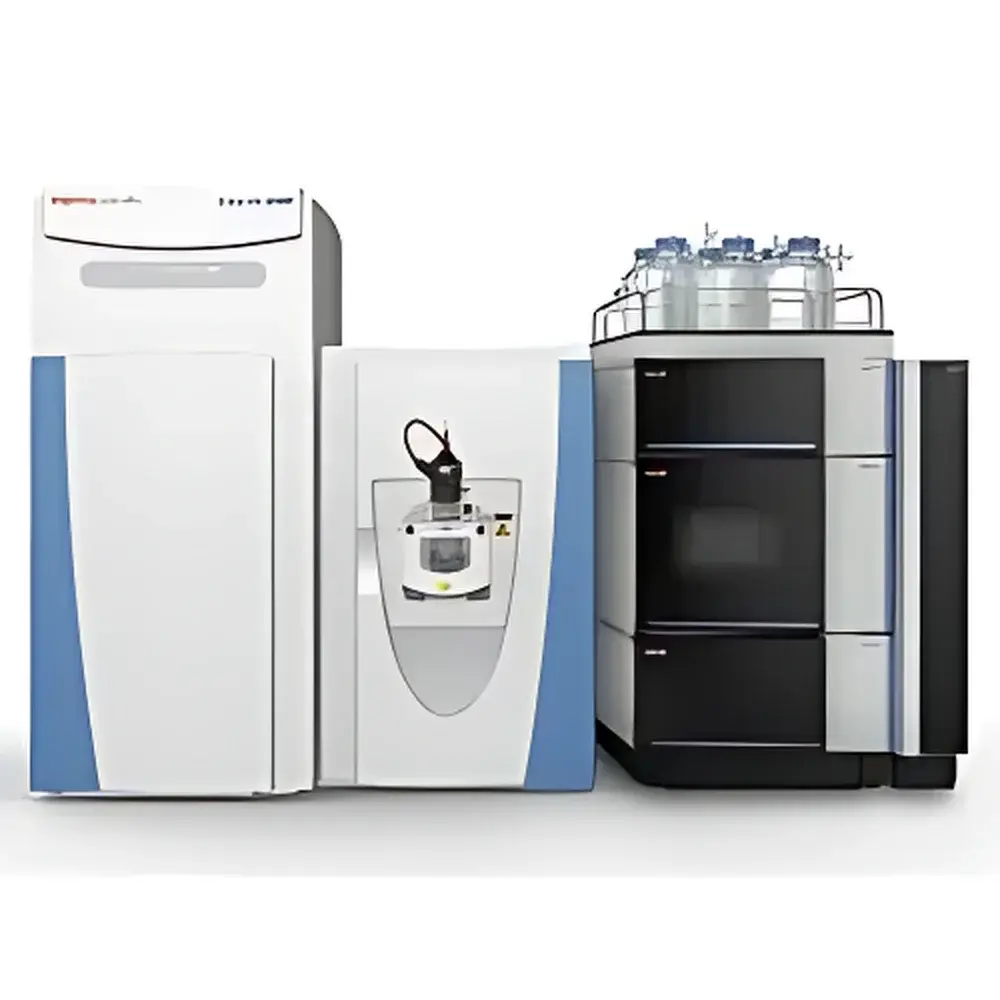
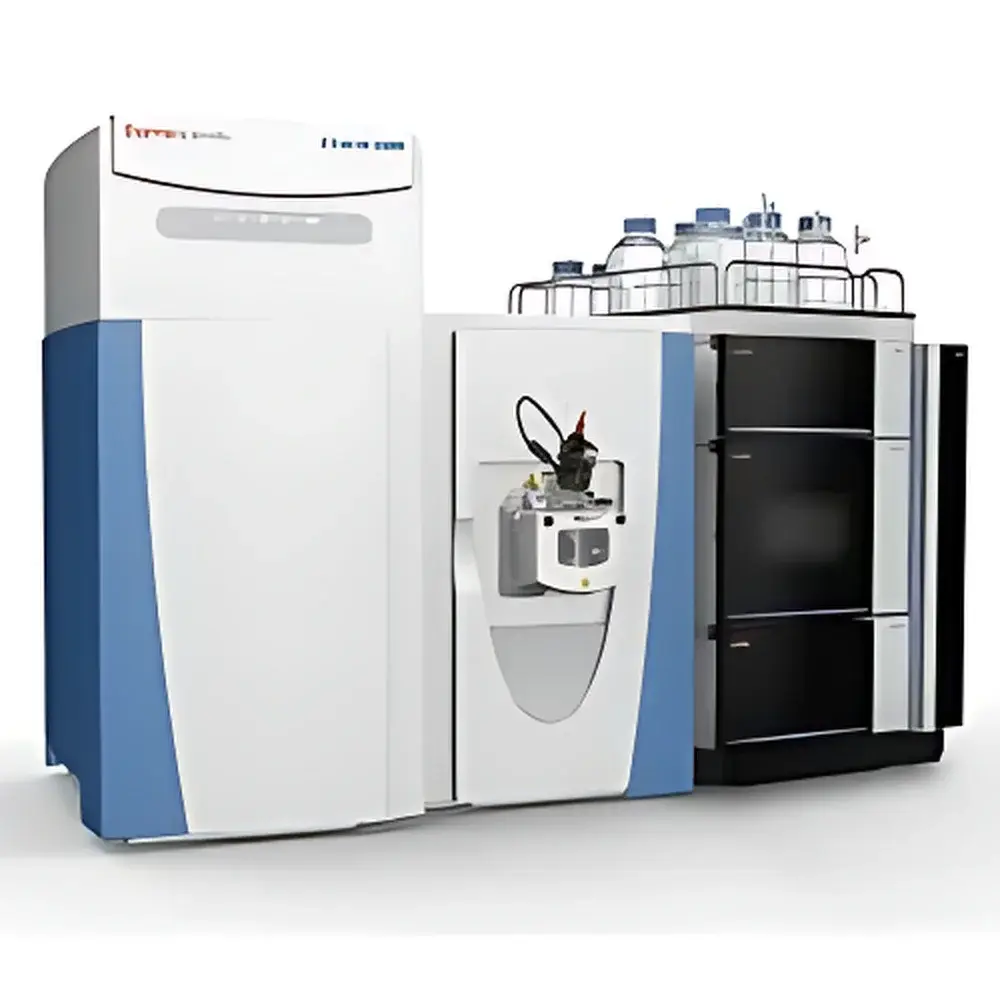
Thermo Scientific Q Exactive UHMR Hybrid Quadrupole-Orbitrap Mass Spectrometer
| Brand | Thermo Fisher |
|---|---|
| Origin | USA |
| Manufacturer Type | Original Equipment Manufacturer (OEM) |
| Origin Category | Imported |
| Model | Q Exactive UHMR |
| Instrument Type | Quadrupole-Orbitrap Hybrid Mass Spectrometer |
| Mass Range | Up to 80,000 m/z |
| Precursor Selection Range | Up to 25,000 m/z |
| Ion Transmission | Enhanced In-Source Capture |
| Fragmentation | HCD in Injection Flatapole Cell |
| Application Focus | Native MS, Top-Down Proteomics, Intact Protein & Mega-Dalton Complex Analysis |
Overview
The Thermo Scientific™ Q Exactive™ UHMR (Ultra-High Mass Range) Hybrid Quadrupole-Orbitrap™ Mass Spectrometer is engineered for native mass spectrometry and top-down proteomics of intact proteins, large protein assemblies, and membrane-bound complexes. Unlike conventional LC-MS platforms optimized for denatured peptides, the Q Exactive UHMR employs a fundamentally re-engineered ion path—including an extended mass range quadrupole, high-transmission in-source capture optics, and a modified Injection Flatapole collision cell—to preserve noncovalent interactions and enable high-fidelity analysis across the 1–80,000 m/z range. Its Orbitrap mass analyzer delivers high mass accuracy (<3 ppm RMS), high resolution (up to 240,000 FWHM at m/z 2000), and robust reproducibility for both MS1 and MS2 acquisitions under native conditions. The system supports pseudo-MS3 workflows via sequential isolation and fragmentation—critical for mapping post-translational modifications, stoichiometric ligand binding, and conformational heterogeneity within megadalton-scale biomolecular machines.
Key Features
- Ultra-high mass range capability: Full-scan detection up to m/z 80,000 with calibrated mass accuracy and isotopic fidelity.
- Quadrupole-based precursor selection up to m/z 25,000, enabling selective isolation of intact subunits or heterogeneous complexes without signal dilution.
- In-source capture technology enhances ion transmission efficiency for low-abundance, high-mass species while maintaining native conformational integrity.
- HCD fragmentation in the Injection Flatapole cell provides tunable activation energy—supporting both gentle dissociation (to retain bound cofactors or lipids) and energetic cleavage (for top-down sequence coverage).
- Orbitrap detection with real-time internal calibration ensures long-term mass stability across multi-hour native LC-MS runs.
- Integrated vacuum architecture minimizes gas-phase unfolding and preserves solution-like structural features during transfer from ESI source to detector.
Sample Compatibility & Compliance
The Q Exactive UHMR accommodates a broad spectrum of native samples, including soluble multimeric enzymes, virus-like particles, ribonucleoprotein complexes, detergent-solubilized membrane proteins (e.g., GPCRs, ion channels), and synthetic macromolecular constructs. Sample introduction is compatible with standard nano-ESI sources, chip-based nanospray, and native-friendly liquid chromatography methods (e.g., SEC-MALS coupling, native IM-MS interfaces). From a regulatory standpoint, the instrument supports audit-trail-enabled data acquisition (21 CFR Part 11 compliant when used with Thermo Scientific™ Compound Discoverer™ or BioPharma Finder™ software), GLP/GMP-aligned workflow documentation, and traceable calibration protocols aligned with ISO/IEC 17025 requirements for analytical laboratories. All mass calibration standards are NIST-traceable, and system suitability testing includes resolution verification at defined m/z points across the full UHMR span.
Software & Data Management
Data acquisition is controlled via Thermo Scientific™ Xcalibur™ 4.5 or later, with native support for UHMR-specific method templates, dynamic exclusion logic for heterogeneous charge-state distributions, and automated peak deconvolution for ultra-high m/z spectra. Quantitative analysis leverages Thermo Scientific™ BioPharma Finder™ 4.0+ for intact mass determination, variant localization, and stoichiometric quantification of ligand-bound states. For structural interpretation, integrated tools support charge-state deconvolution, collision cross-section (CCS) estimation (when coupled with ion mobility), and spectral matching against theoretical oligomeric models. Raw data files (.raw) are stored in vendor-neutral formats compatible with open-source platforms such as MASH Explorer and TopPIC, facilitating third-party validation and reproducible computational workflows.
Applications
- Intact analysis of monoclonal antibodies, antibody-drug conjugates (ADCs), and bispecific formats under non-denaturing conditions.
- Structural characterization of transient protein-protein interactions and allosteric regulation mechanisms in multi-subunit complexes.
- Top-down sequencing of histones, transcription factors, and other PTM-rich proteins without enzymatic digestion.
- Characterization of lipidated membrane proteins and their native lipid annulus composition.
- High-resolution mass mapping of viral capsid assemblies and synthetic nanoparticle-biomolecule conjugates.
- Method development for biosimilar comparability studies requiring orthogonal confirmation of higher-order structure.
FAQ
What is the maximum m/z limit for full-scan MS1 acquisition?
The Q Exactive UHMR supports full-scan detection up to m/z 80,000 with calibrated mass accuracy and isotopic resolution.
Can the instrument perform tandem MS on ions above m/z 20,000?
Yes—precursor selection is supported up to m/z 25,000, and HCD fragmentation is optimized for ions in the 5,000–30,000 m/z range under native conditions.
Is the system compatible with ion mobility separation?
The Q Exactive UHMR platform can be interfaced with commercially available traveling wave ion mobility spectrometers (e.g., Waters SYNAPT systems) via external data synchronization; however, it does not include an integrated mobility cell.
How is mass calibration maintained across the ultra-high mass range?
Calibration uses dual-point internal reference ions (e.g., cesium iodide clusters) with real-time lock-mass correction applied during acquisition, ensuring sub-ppm stability over >12-hour runs.
Does the system support automated data-dependent acquisition (DDA) for native samples?
Yes—DDA methods can be configured with dynamic exclusion based on charge state, intensity, and m/z window width, tailored specifically for broad, overlapping charge envelopes typical of native spectra.




