
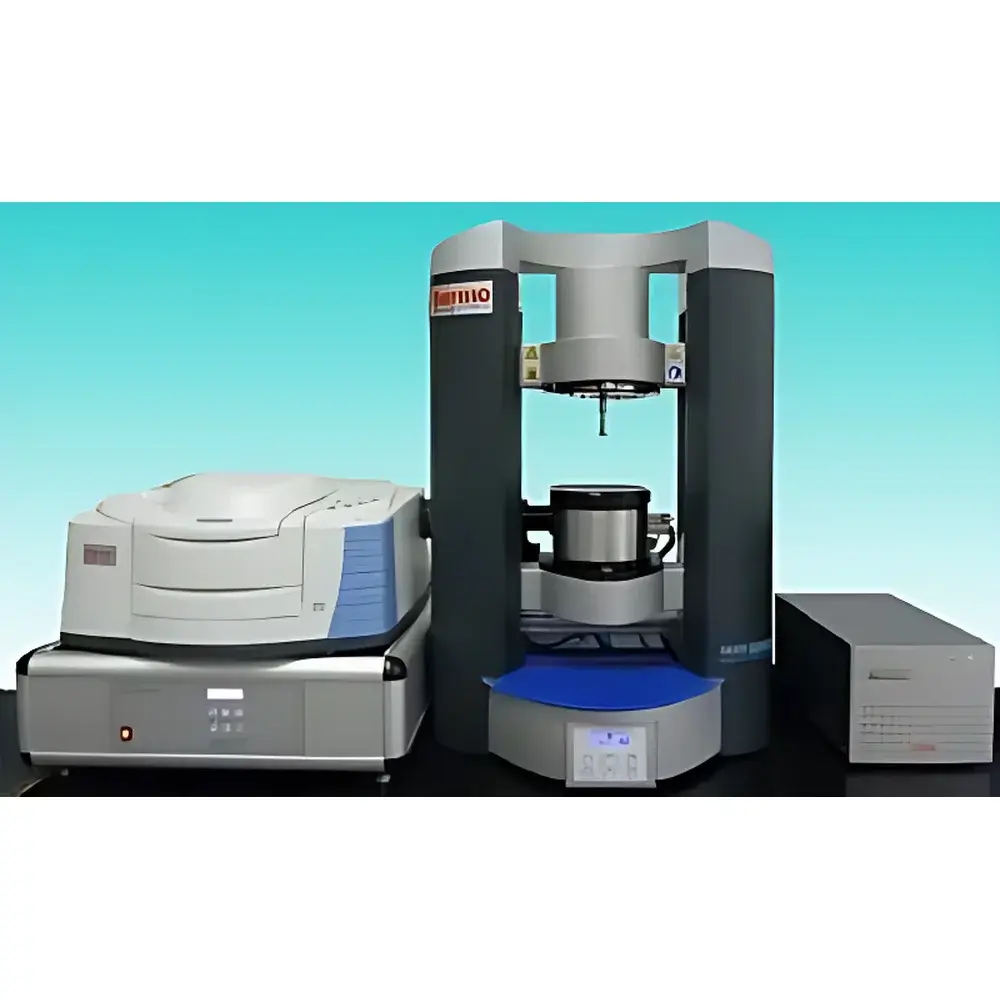
Thermo Scientific HAAKE Rheonaut FTIR-Rheology Coupling Unit
| Brand | Thermo Fisher |
|---|---|
| Origin | Germany |
| Manufacturer | Thermo Fisher Scientific |
| Product Type | Rotational Rheometer Coupling Module |
| Model | Rheonaut |
| Motor Bearing | Air Bearing |
| Minimum Rotational Speed | 1 × 10⁻⁸ rpm |
| Frequency Range | 10⁻⁶ – 100 Hz |
| Maximum Rotational Speed | 4500 rpm |
| Maximum Torque | 200 mN·m |
| Torque Resolution | 0.1 nN·m |
| ATR Crystal Material | Diamond (Single-Reflection) |
| Temperature Control Options | Peltier (0–120 °C) or Electric Heating (RT–400 °C) |
| Detector | DTGS |
| Polarization Options | Manual/Automatic Dual-Axis Polarizers |
| Compliance | ASTM D3835, ISO 6721-10, USP <1043>, GLP/GMP-ready data audit trail support |
Overview
The Thermo Scientific HAAKE Rheonaut FTIR-Rheology Coupling Unit is an engineered interface module designed for real-time, in situ molecular-structure–rheological property correlation. It integrates the HAAKE MARS rotational rheometer with a Thermo Scientific Nicolet FTIR spectrometer via a dedicated attenuated total reflection (ATR) optical path embedded directly into the rheometer’s lower measuring geometry. Unlike conventional off-line or sequential measurements, the Rheonaut enables simultaneous acquisition of dynamic mechanical response (e.g., G′, G″, η*, δ) and mid-infrared spectral signatures (4000–400 cm⁻¹) under identical thermal, shear, and deformation history. This co-localized measurement architecture relies on a diamond ATR crystal mounted flush within the stationary plate—ensuring optical transparency across the IR range while maintaining mechanical integrity under high-torque oscillatory and steady-shear conditions. The system operates on the principle of evanescent wave penetration, eliminating dependence on sample thickness and enabling reproducible spectral collection from viscous melts, gels, pastes, and soft solids without film preparation.
Key Features
- Air-bearing motor drive delivering ultra-low torque noise (<0.1 nN·m resolution) and exceptional low-frequency stability down to 10⁻⁶ Hz—critical for linear viscoelastic region (LVR) mapping and time–temperature superposition (TTS) studies.
- Diamond single-reflection ATR crystal integrated into the rheometer’s lower plate, providing chemical inertness, thermal stability up to 400 °C, and broadband IR transmission without spectral artifacts.
- Modular temperature control: Peltier stage (0–120 °C) for rapid cooling/heating cycles and precise sub-ambient stabilization; electrically heated stage (RT–400 °C) for high-temperature polymer melt characterization and crosslinking kinetics.
- Integrated dual-axis polarization optics—manually or motorized—enabling controlled s- and p-polarized IR irradiation for orientation-sensitive analysis of anisotropic materials (e.g., liquid crystalline polymers, stretched films).
- Patented HAAKE MARS firmware synchronization ensures microsecond-level temporal alignment between rheological waveform triggers and FTIR interferogram acquisition—essential for LAOS (Large Amplitude Oscillatory Shear) spectral decomposition and nonlinear structure–property modeling.
Sample Compatibility & Compliance
The Rheonaut accommodates bulk, undiluted samples—including thermoplastics, thermosets, elastomers, hydrogels, pharmaceutical excipients, emulsions, and cosmetic formulations—without solvent dilution or pelletization. Its ATR geometry eliminates pathlength variability and supports measurements on non-uniform or heterogeneous systems (e.g., phase-separated blends, filled composites). All hardware and software modules comply with ISO 17025 calibration traceability requirements. Data acquisition and processing meet FDA 21 CFR Part 11 criteria for electronic records and signatures when deployed with Thermo Scientific™ OMNIC™ Paradigm Software configured for audit-trail-enabled workflows. Routine operation aligns with ASTM D3835 (standard test method for dynamic mechanical properties of thermoplastics), ISO 6721-10 (plastics—determination of dynamic mechanical properties—Part 10: Principles), and USP (assessment of viscoelastic behavior in parenteral dosage forms).
Software & Data Management
Control and analysis are unified within Thermo Scientific OMNIC Paradigm Software, which provides synchronized instrument orchestration, real-time spectral–rheological overlay, and batch-processing templates for time-resolved chemorheology. Raw interferograms and rheological time-series are stored in vendor-neutral HDF5 format, supporting third-party post-processing (e.g., Python-based LAOS harmonic analysis, PCA of spectral evolution). Built-in reporting tools generate GLP-compliant PDF reports with full metadata embedding (operator ID, instrument serial numbers, calibration certificates, environmental logs). Audit trails record all parameter changes, file exports, and user actions with timestamped digital signatures—fully auditable during regulatory inspections.
Applications
- Tracking real-time chemical evolution during polymer curing (epoxy, polyurethane) via carbonyl and amine band intensity shifts correlated with gel point and vitrification onset.
- Resolving strain-induced conformational transitions in biopolymers (e.g., gelatin, alginate) through amide I/II band deconvolution alongside Payne effect quantification.
- Characterizing temperature-dependent crystallinity development in polyolefins using CH₂ scissoring and rocking modes synchronized with storage modulus inflection points.
- Monitoring surfactant micellization and interfacial restructuring in complex fluids under shear via C–H stretching region dynamics.
- Validating structure–function relationships in topical formulations (creams, ointments) by correlating ester hydrolysis rates (observed in IR) with yield stress decay profiles.
FAQ
What FTIR spectrometers are compatible with the Rheonaut?
The Rheonaut is validated exclusively with Thermo Scientific Nicolet iS50, iS20, and iS50R FTIR platforms equipped with external beam ports and OMNIC Paradigm software v11.3 or later.
Can the Rheonaut be used with non-diamond ATR crystals?
No—the system is mechanically and optically optimized for the proprietary diamond crystal; alternative materials (e.g., ZnSe, Ge) are not supported due to thermal expansion mismatch and insufficient hardness under high-torque conditions.
Is vacuum or purging required during IR acquisition?
Yes—continuous dry-air or nitrogen purge is mandatory to suppress atmospheric CO₂ and H₂O vapor absorption bands that would otherwise obscure key spectral regions (e.g., 2300–2400 cm⁻¹, 1300–1500 cm⁻¹).
How is sample loading performed without disrupting optical alignment?
A precision-machined sample containment ring ensures repeatable positioning over the ATR crystal surface; no manual focusing or alignment is needed after initial system qualification.
Does the Rheonaut support extensional rheology modes?
No—it is designed strictly for rotational (shear) geometries (cone-plate, parallel-plate, serrated plate); extensional capabilities require separate fixtures not optically coupled to FTIR.



