
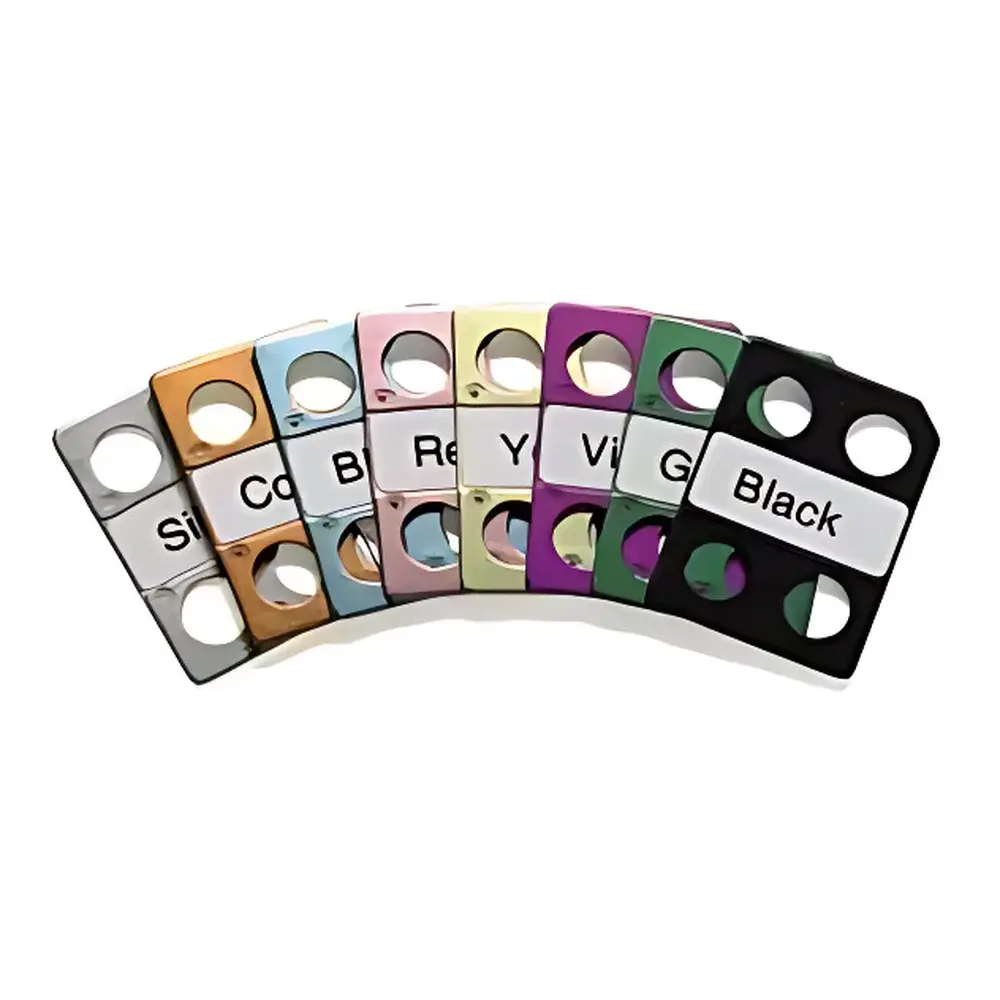
Thermo Scientific Harshaw TLD Thermoluminescent Dosimeter Elements
| Brand | Thermo Fisher |
|---|---|
| Origin | USA |
| Manufacturer | Thermo Fisher Scientific |
| Product Type | Imported |
| Model | Harshaw TLD |
| Instrument Category | Radiation Dosimetry / Dose Rate Meter |
| Form Factor | Personal/Environmental Wearable |
| Measured Radiation Types | Photons, Beta Particles, Thermal Neutrons, Fast Neutrons |
| Detector Material | LiF:Mg,Cu,P |
| LiF | Mg,Ti |
| Dosimetric Quantities | Hp(10), Hp(3), Hp(0.07), H*(10), H′(0.07), Neutron Fluence-to-Dose Conversion |
| Window Thickness | 3.3 mg/cm² (beta), 42 mg/cm² (photon), 7 mg/cm² (TLD-100/H/700H), 100 mg/cm² (TLD-100 for high-energy photon attenuation) |
| Element Dimensions | 3 mm × 0.4 mm (neutron-sensitive chips) |
| Compliance | ANSI N545-1993, ANSI N13.32-1995, ANSI N13.37 (draft), DOELAP, NVLAP-accredited testing protocols |
| Software | Integrated dose calculation software with ANSI/ISO traceable algorithms |
| Packaging | Hermetically sealed, barcoded, contamination-resistant encapsulation |
Overview
The Thermo Scientific Harshaw TLD Thermoluminescent Dosimeter Elements are precision-engineered passive radiation dosimeters designed for personal and environmental monitoring of ionizing radiation exposure across diverse operational environments—including nuclear power facilities, medical radiotherapy departments, research laboratories, and decommissioning sites. Based on thermoluminescence principles, these dosimeters utilize crystalline phosphors (primarily lithium fluoride doped with magnesium, copper, and phosphorus—LiF:Mg,Cu,P—or magnesium and titanium—LiF:Mg,Ti) that store energy from incident radiation in metastable electron traps. Upon controlled heating in a calibrated TLD reader, the stored energy is released as visible light proportional to the absorbed dose. This fundamental solid-state physics mechanism ensures high reproducibility, long-term stability, and negligible signal fading over typical wear periods (up to 3 months under controlled storage). Unlike active electronic dosimeters, Harshaw TLD elements require no batteries or real-time electronics, making them inherently robust, maintenance-free, and suitable for deployment in extreme thermal, electromagnetic, or humid conditions where electronic reliability may be compromised.
Key Features
- Multi-quantity dosimetry capability: Simultaneous assessment of Hp(10) (deep dose equivalent), Hp(3) (lens dose equivalent), Hp(0.07) (shallow/skin dose equivalent), H*(10) (ambient dose equivalent), and H′(0.07) (directional dose equivalent) per ANSI and ICRP recommendations.
- Neutron-specific configurations: Dual-isotope ⁶Li/⁷Li TLD elements enable discrimination between thermal neutron (via ⁶Li(n,α)³H reaction) and fast neutron (via recoil proton interactions in polyethylene moderators) contributions—validated per ANSI N13.37 draft criteria.
- Optimized filtration architecture: Strategically layered metal and plastic filters—including 3.3 mg/cm² thin beryllium-equivalent windows for beta detection and 42 mg/cm² aluminum-equivalent filters for photon energy response flattening—ensure accurate dose estimation across broad spectral ranges (20 keV–7 MeV photons; 0.1–10 MeV beta; thermal to 14 MeV neutrons).
- NVLAP-accredited performance: All Harshaw TLD badge assemblies undergo rigorous testing per ANSI N13.32-1995 and are routinely validated under DOE Laboratory Accreditation Program (DOELAP) and National Voluntary Laboratory Accreditation Program (NVLAP) requirements, ensuring metrological traceability to NIST standards.
- Human-factor optimized design: Lightweight, low-profile badges with adjustable clips and optional finger-ring holders (available in four color-coded variants) minimize wearer interference while maintaining consistent angular response (< ±15% variation over ±60° incidence).
Sample Compatibility & Compliance
Harshaw TLD elements are compatible with all Thermo Scientific Harshaw TLD readers (e.g., Model 6600, Model 8800) and third-party ISO/IEC 17025-compliant readout systems supporting standardized glow-curve analysis. The dosimeters meet or exceed requirements specified in multiple regulatory frameworks: ANSI N545-1993 (Radiation Protection Instrumentation – Personnel Dosimeters), draft ANSI N13.37 (Performance Criteria for Neutron Personal Dosimeters), and IEC 62387-1:2012 (Radiation protection instrumentation – Passive integrating dosimetry systems for personal and environmental monitoring). For regulated industries, the complete system—including badge assembly, reader calibration, and dose calculation software—is structured to support GLP and GMP audit readiness, with full 21 CFR Part 11-compliant electronic record and signature functionality available through optional software modules.
Software & Data Management
Dose evaluation is performed using Thermo Scientific’s proprietary TLD Analysis Software, which implements ANSI N13.29-2013–based algorithms for energy compensation, fading correction, and background subtraction. The software supports batch processing of up to 1,000 elements per run, automatic assignment of calibration coefficients based on element lot numbers, and generation of ANSI-compliant dose reports (including uncertainty budgets per ISO/IEC Guide 98-3). Raw glow-curve data is archived in vendor-neutral ASCII format, enabling integration with enterprise radiation safety information systems (RSIS) via HL7 or XML interfaces. Audit trails log all user actions—including calibration updates, dose re-evaluations, and report exports—with time-stamped, non-erasable entries compliant with ALARA program documentation requirements.
Applications
- Occupational monitoring of nuclear medicine technologists, radiopharmacists, and cyclotron operators exposed to mixed gamma/beta fields.
- Neutron dose assessment for reactor maintenance personnel, fuel handling crews, and accelerator facility staff.
- Environmental surveillance around nuclear installations, waste repositories, and uranium mining sites—deployed in weatherproof housings for extended outdoor exposure (up to 12 months).
- Lens dose monitoring for interventional cardiologists and fluoroscopically guided surgery teams, leveraging Hp(3)–optimized badge configurations.
- Reference dosimetry in radiotherapy QA programs, where TLDs serve as secondary standard transfer instruments for beam output verification per AAPM TG-51 and IAEA TRS-398 protocols.
FAQ
What is the shelf life of unirradiated Harshaw TLD elements?
Unirradiated elements retain calibration stability for ≥24 months when stored at ≤25°C and <50% RH in original sealed packaging.
Can Harshaw TLDs be reused after annealing?
Yes—elements undergo standardized pre-readout annealing (e.g., 400°C for 1 hr + 100°C for 2 hrs for LiF:Mg,Cu,P) to erase residual signal; lifetime exceeds 100 readout cycles with <3% sensitivity drift.
How is neutron/gamma discrimination achieved?
Through paired-element configurations: one ⁶Li-enriched chip (high thermal neutron sensitivity) and one ⁷Li-enriched chip (neutron-insensitive reference), enabling differential analysis via ratio-based algorithms.
Is calibration traceable to national standards?
Yes—each production lot is calibrated against NIST-traceable ¹³⁷Cs, ⁶⁰Co, and ²⁵²Cf reference fields, with certificates of calibration issued per ISO/IEC 17025.
Do Harshaw TLD badges comply with IEC 61526 for personal dosimetry?
While IEC 61526 applies primarily to active electronic dosimeters, Harshaw TLD systems satisfy the metrological and performance criteria outlined in IEC 62387-1 for passive dosimetry systems used in equivalent regulatory contexts.







