
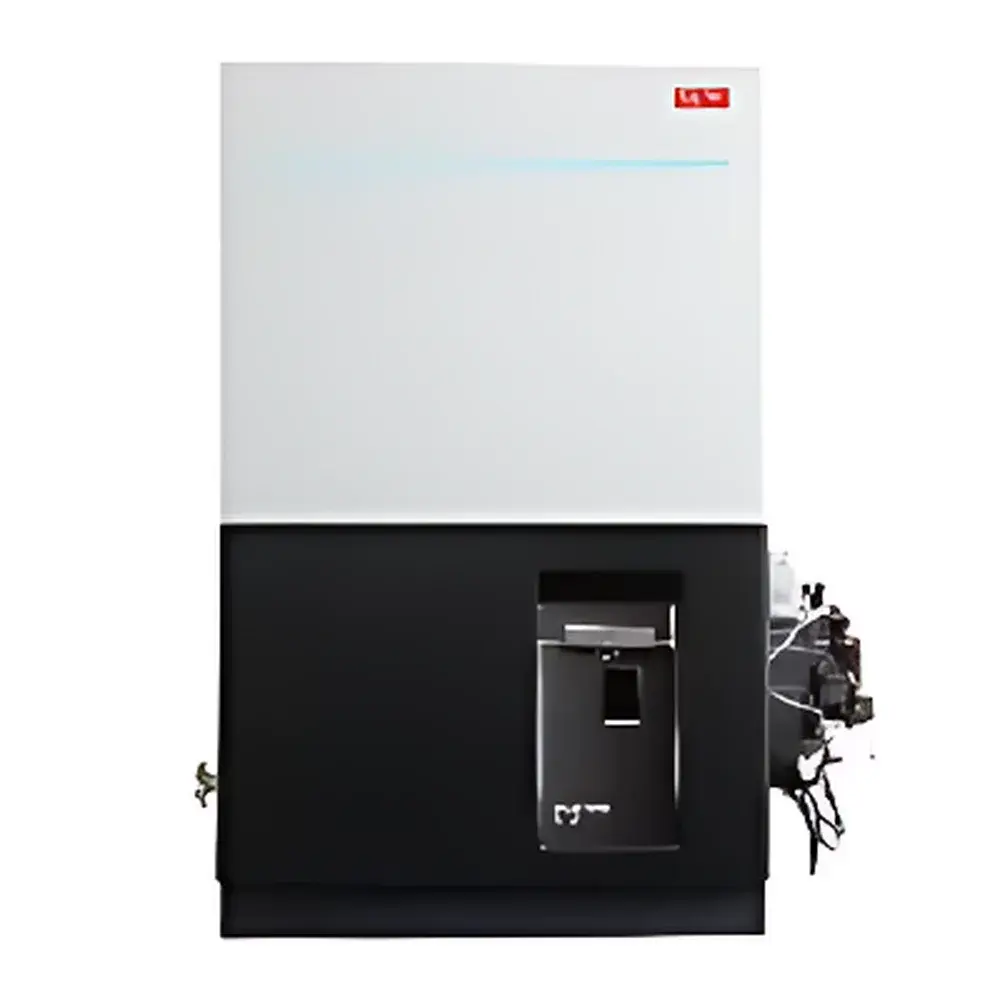
Thermo Scientific iCAP MTX Inductively Coupled Plasma Mass Spectrometer
| Brand | Thermo Fisher |
|---|---|
| Origin | Germany |
| Manufacturer Type | Original Equipment Manufacturer (OEM) |
| Origin Category | Imported Instrument |
| Model | iCAP MTX ICP-MS |
| Application | Laboratory-based elemental and isotopic analysis |
| Mass Range (amu) | 2–290 u (m/z >225 available only with intelligent Mass Resolution [iMR] enabled) |
| Resolution (Unit Mass Resolution, amu) | User-configurable |
| Detection Limits (ng·L⁻¹) | ⁹Be <0.3, ¹¹⁵In <0.1, ²⁰⁹Bi <0.1 |
| TQ-O₂ mode | ³²S (as SO⁺) <50, ³¹P (as PO⁺) <15, ⁷⁸Se (as SeO⁺) <1, ²⁸Si (as SiO⁺) <50 |
| Sensitivity (Mcps/mg·L⁻¹) | Standard Mode: ⁷Li 65, ⁵⁹Co 180, ¹¹⁵In 400, ²⁰⁹Bi 340, ²³⁸U 550 |
| KED Mode | ⁵⁹Co 60 |
| Short-term Stability (RSD, 10 min) | <2% |
| Long-term Stability (RSD, 2 h) | <3% |
Overview
The Thermo Scientific iCAP MTX Inductively Coupled Plasma Mass Spectrometer (ICP-MS) is a high-performance, laboratory-grade instrument engineered for ultra-trace elemental and isotopic analysis across environmental, clinical, geochemical, nuclear, and materials science applications. It operates on the fundamental principle of ionizing sample atoms in a high-temperature argon plasma (~7,000–10,000 K), followed by mass separation and detection of resulting ions using a double-focusing magnetic sector or quadrupole mass analyzer—depending on configuration—and quantification via pulse-counting or analog detection electronics. The iCAP MTX integrates advanced plasma interface design, collision/reaction cell (CRC) technology with optional triple-quadrupole (TQ) architecture, and intelligent mass resolution (iMR) capability to deliver robust interference removal, high mass fidelity, and extended dynamic range without compromising throughput.
Key Features
- Optimized sample introduction system featuring high-efficiency nebulizers, chilled spray chambers, and integrated peristaltic pumping—designed to maximize analyte transport efficiency while minimizing oxide and doubly charged ion formation.
- Enhanced matrix tolerance through adaptive plasma stabilization, real-time RF impedance matching, and dynamic background correction algorithms—enabling reliable analysis of complex samples including seawater, biological digests, and high-salt industrial effluents.
- Modular hardware architecture supporting field-upgradable configurations: standard quadrupole, single-collector magnetic sector, or triple-quadrupole (TQ) modes—including O₂, H₂, He, NH₃, and CH₃F reaction gases for selective polyatomic interference mitigation.
- Reduced operator intervention via automated tuning routines, self-diagnostic subsystems, and predictive maintenance alerts—minimizing downtime and ensuring consistent performance across shifts.
- Integrated consumables management with RFID-tagged torches, cones, and skimmer assemblies—enabling automatic usage tracking, lifetime logging, and proactive replacement scheduling aligned with GLP/GMP documentation requirements.
Sample Compatibility & Compliance
The iCAP MTX accepts liquid samples introduced via direct aspiration, micro-flow systems, or laser ablation (with compatible LA module). It supports both aqueous and organic matrices (e.g., dilute nitric acid, methanol, isopropanol), subject to appropriate plasma gas flow optimization and interface conditioning. The system complies with ISO/IEC 17025:2017 for testing laboratories and meets key regulatory benchmarks including ASTM D5673 (water analysis), EPA Method 200.8 and 6020B (trace metals in environmental media), and USP / (elemental impurities in pharmaceuticals). Full audit trail functionality, electronic signature support, and 21 CFR Part 11–compliant software modules are available for regulated environments requiring data integrity assurance.
Software & Data Management
Controlled by Thermo Scientific Qtegra Intelligent Scientific Data Solution (ISDS) software, the iCAP MTX provides end-to-end workflow automation—from method setup and instrument calibration to raw data acquisition, interference correction (including mathematical correction, on-mass, and reaction-cell-based), isotope ratio calculation, and report generation. Qtegra ISDS supports multi-user role-based access control, version-controlled method libraries, and secure database archiving with SHA-256 hashing. Raw data files (.raw) are stored in vendor-neutral formats compliant with ASTM E2524 and are exportable to LIMS platforms via ODBC or HL7 interfaces. All processing steps—including integration windows, background subtraction models, and drift correction parameters—are fully traceable and reproducible.
Applications
- Environmental monitoring: Quantification of ultra-trace heavy metals (e.g., As, Cd, Pb, Hg) and radionuclides (e.g., ²³⁸U, ²³⁴U, ²³⁰Th) in groundwater, soil leachates, and airborne particulates.
- Clinical and toxicological research: Multi-element profiling in serum, urine, and tissue homogenates for biomonitoring and exposure assessment (e.g., essential elements, neurotoxicants).
- Geochemistry and cosmochemistry: High-precision isotope ratio measurements (e.g., Sr, Nd, Hf, Pb) for provenance studies and age dating using MC-ICP-MS–compatible configurations.
- Pharmaceutical quality control: Elemental impurity screening per ICH Q3D guidelines, including catalyst residue analysis (e.g., Pd, Pt, Rh) in active pharmaceutical ingredients (APIs).
- Materials science: Depth-resolved compositional mapping of thin films, semiconductors, and battery cathode materials via coupling with fs-laser ablation systems.
FAQ
What plasma gas configurations does the iCAP MTX support?
The system operates with standard Ar plasma but accommodates mixed-gas plasmas (e.g., Ar–He, Ar–N₂) and reactive gases (O₂, H₂, NH₃, CH₃F) in the triple-quadrupole collision/reaction cell for targeted polyatomic interference removal.
Is the iCAP MTX compatible with laser ablation systems?
Yes—when equipped with the optional LA interface module and synchronization hardware, it supports time-resolved analysis of solid samples with spatial resolution down to ~5 µm and detection limits in the low-attogram range.
How is data integrity ensured during long-duration analyses?
Qtegra ISDS enforces automatic internal standard normalization, real-time signal drift correction, and periodic recalibration checks—all logged with timestamped metadata and user authentication for full auditability.
Can the instrument be operated remotely in unattended mode?
Yes—via secure HTTPS-based web interface or VPN-connected desktop client, enabling overnight batch runs, email alert notifications, and remote diagnostics without physical presence.
What service and support options are available globally?
Thermo Fisher offers factory-certified installation, application-specific training, preventive maintenance contracts, and 24/7 technical hotline support—with spare parts logistics aligned to regional distribution hubs in North America, EMEA, and APAC.





