
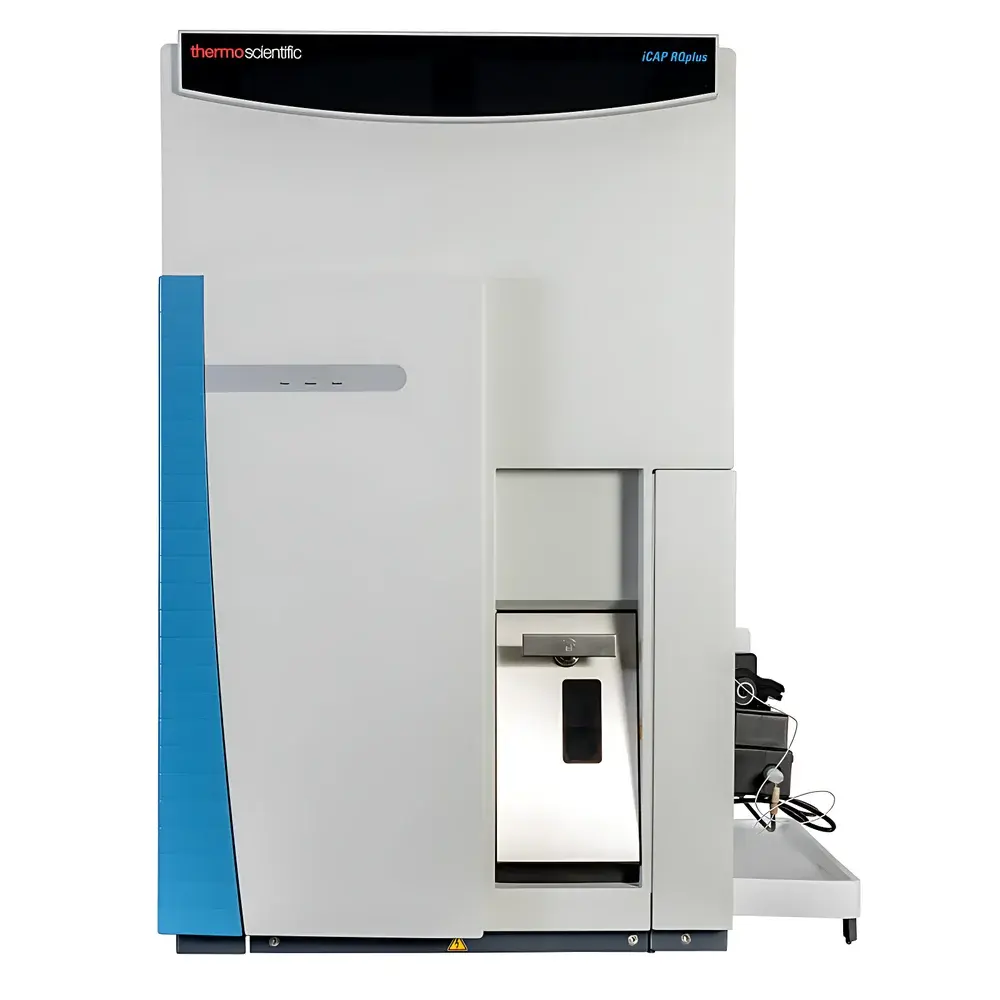
Thermo Scientific iCAP RQplus Inductively Coupled Plasma Mass Spectrometer
| Brand | Thermo Fisher |
|---|---|
| Origin | Germany |
| Manufacturer Type | Original Equipment Manufacturer (OEM) |
| Import Status | Imported |
| Model | iCAP RQplus ICP-MS |
| Price | Upon Request |
| Application Environment | Laboratory |
| Mass Range (amu) | 2–290 |
| Unit Mass Resolution (amu) | 2–290 |
| Instrument Detection Limits (ng·L⁻¹) | Be < 0.5, In < 0.1, Bi < 0.1 |
| Sensitivity (Mcps / mg·L⁻¹) | Li > 65, Co > 110, In > 270, U > 400 |
| Short-Term Stability (RSD, 10 min) | < 2% |
| Long-Term Stability (RSD, 2 h) | < 3% |
Overview
The Thermo Scientific iCAP RQplus ICP-MS is a high-performance, quadrupole-based inductively coupled plasma mass spectrometer engineered for routine trace element analysis across complex, multi-matrix sample types—including environmental waters, geological digests, clinical biofluids, semiconductor-grade reagents, and high-purity materials. It operates on the fundamental principle of ion generation via high-temperature argon plasma (≈7,000–10,000 K), followed by mass separation using a robust RF-only quadrupole mass filter and detection via a high-gain electron multiplier. Unlike sector-field or time-of-flight instruments, the iCAP RQplus prioritizes analytical robustness, operational simplicity, and long-term reproducibility over ultra-high mass resolution—making it ideally suited for regulated QC/QA laboratories requiring consistent daily throughput without compromise in data integrity.
Key Features
- Integrated active performance monitoring system continuously tracks critical parameters—including plasma stability, vacuum integrity, detector voltage, and cone condition—enabling predictive maintenance and minimizing unplanned downtime.
- Dual-cone interface with optimized nickel sampling and skimmer cones ensures stable ion transmission and reduced polyatomic interferences, particularly for challenging matrices such as seawater or high-salinity brines.
- High-efficiency collision/reaction cell (CRC) with helium and hydrogen gas modes mitigates oxide and argide interferences (e.g., 40Ar16O+ on 56Fe+, 40Ar40Ar+ on 80Se+) while preserving sensitivity for isotopes across the full mass range (2–290 amu).
- Automated tuning and calibration routines reduce operator dependency; instrument setup, mass calibration, and sensitivity optimization are executed in under 5 minutes via Qtegra ISDS software.
- Robust vacuum architecture featuring dual-stage turbomolecular pumping maintains base pressure < 1 × 10⁻⁷ mbar, ensuring stable ion beam transmission and low background noise even during extended unattended operation.
Sample Compatibility & Compliance
The iCAP RQplus accommodates liquid samples introduced via standard nebulizers (e.g., MicroMist, PFA-ST) and desolvation systems (e.g., Aridus III), as well as laser ablation solid sampling when coupled with compatible LA systems (e.g., Excite, NWR). Its design conforms to ISO/IEC 17025 requirements for testing laboratories and supports full audit trails, electronic signatures, and secure user access control per FDA 21 CFR Part 11 guidelines when deployed with validated Qtegra ISDS configurations. Routine operation meets ASTM D5673 (trace metals in water), ISO 17294-2 (water quality — ICP-MS methods), and USP / (elemental impurities in pharmaceuticals) compliance frameworks.
Software & Data Management
Controlled exclusively through Thermo Scientific Qtegra Intelligent Scientific Data Solution (ISDS) v3.5+, the iCAP RQplus delivers a unified workflow from method development and acquisition to reporting and raw data archiving. The software includes built-in interference correction algorithms (e.g., mathematical interference correction, CRC gas optimization wizards), automated internal standardization, and customizable QC flagging logic. All raw spectral data, tuning logs, and sequence metadata are stored in a relational SQL database with version-controlled backups, supporting GLP/GMP traceability and retrospective data reprocessing without loss of original acquisition context.
Applications
- Environmental monitoring: Quantification of sub-pg/g levels of As, Cd, Pb, and U in drinking water, wastewater, and soil leachates per EPA Method 6020B.
- Geochemical research: Isotopic ratio measurement (e.g., 87Sr/86Sr, 206Pb/204Pb) in rock digests with precision ≤ 0.01% RSD (n = 10).
- Pharmaceutical quality control: Elemental impurity screening in active pharmaceutical ingredients (APIs) and excipients against ICH Q3D thresholds.
- Electronics materials: Detection of metallic contaminants (e.g., Na, K, Fe, Ni) in ultrapure acids and photoresists at sub-part-per-trillion levels.
- Clinical and nutrition labs: Multi-element quantification in serum, urine, and tissue homogenates for biomonitoring studies.
FAQ
What is the typical warm-up time required before analytical use?
The instrument achieves thermal and plasma equilibrium within 30 minutes of ignition; full performance validation (tuning, sensitivity check, oxide ratio) is completed in ≤ 45 minutes.
Does the iCAP RQplus support hyphenated techniques such as HPLC-ICP-MS?
Yes—it features fully synchronized external trigger inputs and analog/digital I/O ports compatible with third-party chromatography systems for elemental speciation workflows.
How often are consumables like cones or torches replaced under normal usage?
With routine daily operation (8 h/day), nickel cones typically last ≥ 6 months and the quartz torch ≥ 12 months—monitored automatically via Qtegra’s consumables tracking module.
Is remote diagnostics supported?
Yes—via Thermo Connect cloud-enabled service platform, authorized engineers can perform real-time health checks, firmware updates, and diagnostic troubleshooting with customer consent and encrypted TLS 1.3 communication.
Can the system be upgraded to include a high-mass option or enhanced detection electronics?
The iCAP RQplus platform is field-upgradable to support optional high-mass extension (up to 300 amu) and advanced pulse-counting electronics for improved low-level signal fidelity in demanding regulatory environments.




