
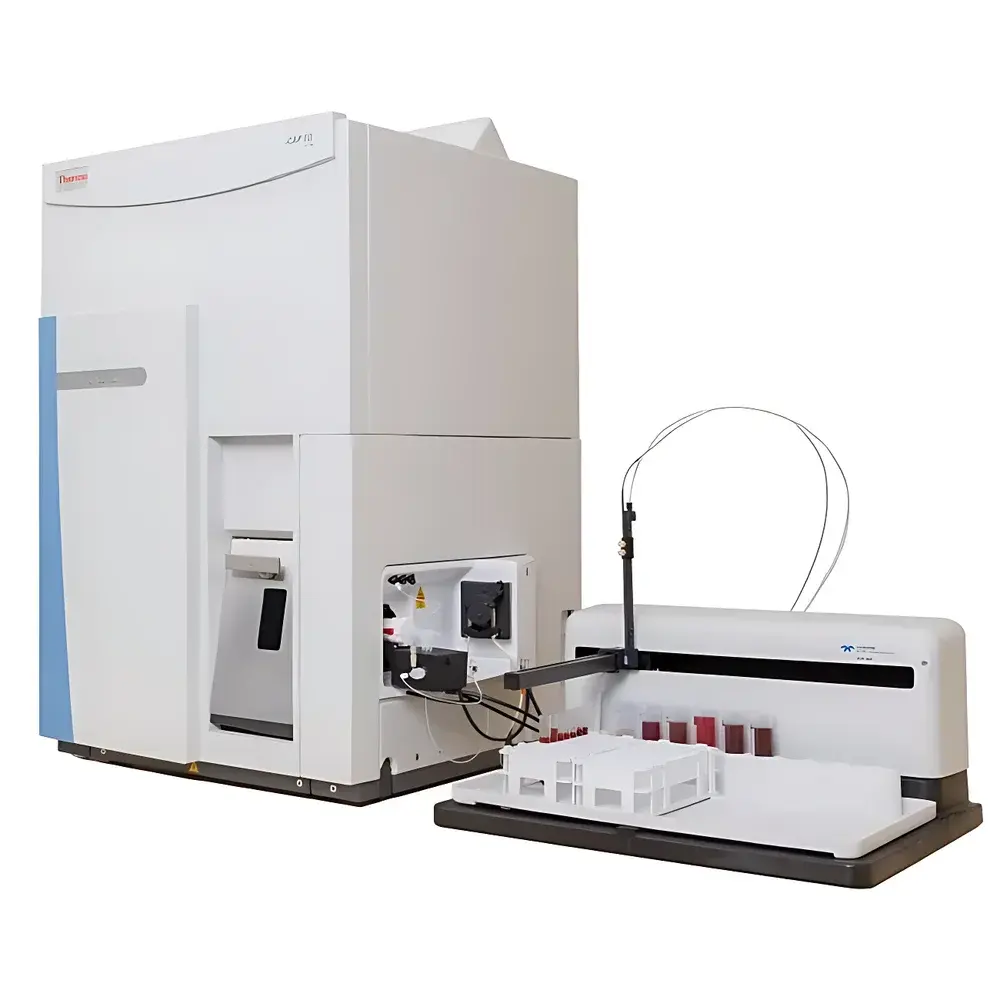
Thermo Scientific iCAP TQ ICP-MS
| Brand | Thermo Fisher |
|---|---|
| Origin | USA |
| Manufacturer Type | Original Equipment Manufacturer (OEM) |
| Product Origin | Imported |
| Model | Thermo Scientific™ iCAP™ TQ ICP-MS |
| Instrument Type | Triple Quadrupole ICP-MS |
| Price Range | USD 420,000 – 700,000 (approx. based on exchange rate and configuration) |
| Software Platform | Thermo Scientific Qtegra ISDS v3.x or later |
Overview
The Thermo Scientific iCAP TQ ICP-MS is a triple quadrupole inductively coupled plasma mass spectrometer engineered for ultra-trace elemental analysis with unparalleled interference control. Unlike conventional single-quadrupole ICP-MS systems, the iCAP TQ employs a tandem mass spectrometry architecture—comprising Q1 (mass filter), Q2 (collision/reaction cell), and Q3 (mass analyzer)—to enable highly selective ion transmission and reactive gas–assisted removal of polyatomic interferences (e.g., 40Ar16O+, 40Ar12C+, 35Cl16O+) in complex matrices. This design supports both on-mass and mass-shift acquisition modes, delivering robust quantification across environmental, clinical, geochemical, nuclear, and semiconductor applications where regulatory compliance and method ruggedness are critical. The instrument integrates seamlessly into GLP- and GMP-regulated laboratories through hardware-level audit trail support and software alignment with FDA 21 CFR Part 11 requirements via Qtegra ISDS.
Key Features
- Triple quadrupole architecture with pressurized, multi-gas reaction cell (He, H2, O2, NH3, CH4) enabling dynamic interference suppression without compromising sensitivity
- High-transmission interface optimized for stable plasma coupling and reduced oxide/carbon-based adduct formation (CeO+/Ce+ < 1.5%, BaO+/Ba+ < 1.8%)
- Integrated autosampler compatibility with standard 13 mm × 100 mm vial formats and optional high-throughput robotic platforms
- Real-time mass calibration and automated tuning routines minimizing operator dependency during daily startup and method validation
- Rugged RF generator with adaptive impedance matching for stable operation across variable sample introduction conditions (e.g., high-salt, organic, or HF-containing digests)
- Modular vacuum system with dual-stage turbomolecular pumps ensuring long-term stability and low background noise (e.g., 89Y background < 0.1 cps at m/z 89)
Sample Compatibility & Compliance
The iCAP TQ accommodates liquid samples introduced via nebulization (e.g., microflow PFA, concentric glass, or desolvating systems), laser ablation solids (with compatible LA-ICP-MS interfaces), and hydride/gas-phase generation sources. It meets ISO/IEC 17025:2017 analytical competence requirements when operated under documented SOPs and calibrated per ASTM D5673 (trace metals in water) or EPA Method 6020B (elemental analysis by ICP-MS). Full traceability is supported through Qtegra ISDS’s electronic lab notebook (ELN) module, which logs all acquisition parameters, calibration history, user actions, and instrument status events with time-stamped, non-erasable records compliant with 21 CFR Part 11 Annex 11 and EU GMP Annex 11 guidelines.
Software & Data Management
Qtegra Intelligent Scientific Data Solution (ISDS) serves as the unified control and data processing environment. It provides method wizards for rapid development of triple-quad methods—including reaction gas optimization, dwell time allocation, and collision energy ramping—alongside statistical tools for uncertainty propagation (k=2), detection limit estimation (3σ), and QC charting (Levey-Jennings, Shewhart). Raw data files (.raw) are stored in vendor-neutral formats compatible with third-party chemometrics packages. Audit trails are encrypted and archived separately from result files, supporting retrospective review during regulatory inspections. Optional modules include Isotope Ratio Module (IRM) for high-precision ratio measurements and Trace Element Profiling (TEP) for multivariate pattern recognition in forensic or geological fingerprinting workflows.
Applications
- Environmental monitoring: Quantification of U, Pu, Am isotopes in soil/water at sub-fg g−1 levels per EPA 6020B revision 4
- Clinical research: Multi-element biomonitoring of essential/toxic elements (e.g., Se, Cd, As, Pb) in serum, urine, and whole blood with matrix-matched calibration
- Geochemistry: High-precision Lu–Hf and Sm–Nd isotope ratio analysis using mass bias correction algorithms validated against NIST SRM 610/612
- Pharmaceuticals: Residual catalyst screening (e.g., Pd, Pt, Rh) in active pharmaceutical ingredients (APIs) per ICH Q3D guidelines
- Semiconductor industry: Detection of metallic contaminants (e.g., Fe, Cu, Ni, Na) on silicon wafers at ≤1010 atoms/cm2 surface density
FAQ
What distinguishes the iCAP TQ from single-quadrupole ICP-MS instruments?
The triple quadrupole architecture enables targeted interference removal via mass-resolved reaction pathways, eliminating reliance on mathematical corrections or high-resolution magnetic sector instrumentation.
Is the iCAP TQ suitable for regulated pharmaceutical testing?
Yes—when deployed with Qtegra ISDS configured for 21 CFR Part 11 compliance, including electronic signatures, role-based access control, and full audit trail retention.
Can the system perform isotope ratio measurements?
Yes, with the optional Isotope Ratio Module (IRM) and appropriate calibration standards, it achieves internal precision of ≤0.05% RSD for 143Nd/144Nd ratios over 10-minute integrations.
What maintenance intervals are recommended for routine operation?
Daily: Torch inspection and cone cleaning; Weekly: Reaction cell gas line leak check; Quarterly: Vacuum pump oil replacement and detector gain calibration.
Does the system support remote diagnostics and service dispatch?
Yes—via Thermo Fisher Connect platform, which provides secure remote connectivity for predictive maintenance alerts, firmware updates, and technician-assisted troubleshooting.





