
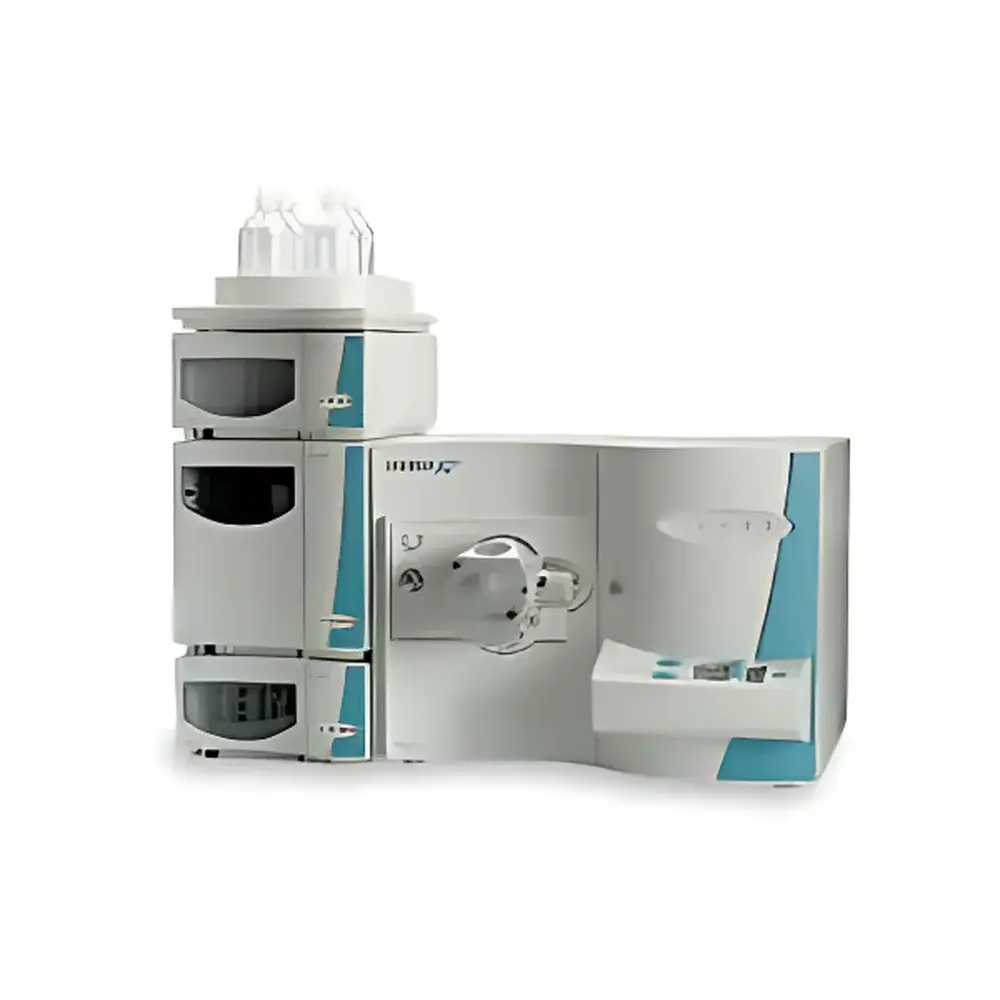
Thermo Scientific LCQ Fleet Ion Trap Liquid Chromatography Mass Spectrometer
| Brand | Thermo Fisher |
|---|---|
| Origin | USA |
| Manufacturer Type | Original Equipment Manufacturer (OEM) |
| Origin Category | Imported |
| Model | LCQ Fleet Ion Trap LC-MS |
| Instrument Type | Ion Trap |
| Price Range | USD 650,000 – 980,000 (converted at ~1:7.7 exchange rate, FOB US port) |
Overview
The Thermo Scientific LCQ Fleet is a high-performance, benchtop ion trap liquid chromatography mass spectrometer engineered for robust, high-sensitivity structural characterization of small molecules and peptides in complex matrices. Built upon the proven architecture of the LCQ platform, it employs electrospray ionization (ESI) or atmospheric pressure chemical ionization (APCI) coupled with quadrupole ion optics and a 3D radiofrequency (RF) ion trap mass analyzer. Its core measurement principle relies on sequential ion isolation, resonant excitation, collision-induced dissociation (CID), and mass-selective ejection—enabling true MSn capability up to n = 4. Designed for routine laboratory environments, the system delivers reproducible spectral quality, high duty cycle acquisition, and seamless integration with UHPLC systems such as the Thermo Scientific UltiMate 3000 series—making it particularly suited for targeted screening, natural product dereplication, and discovery-phase proteomics workflows.
Key Features
- Patented Automatic Gain Control (AGC): Dynamically adjusts ion injection time to maintain optimal ion population in the trap across all scan modes—ensuring consistent signal intensity and quantitative linearity without manual tuning.
- Dynamic Exclusion™: Temporarily excludes previously fragmented precursor ions from subsequent MS/MS events, increasing sequence coverage and detection of low-abundance species in complex mixtures.
- WideBand Activation™ (WBA): Applies broadband resonant excitation to enhance fragmentation efficiency across a wide m/z range—improving structural elucidation for labile or non-covalent adducts.
- Normalized Collision Energy (NCE): Compensates for mass-dependent energy deposition during CID, enabling cross-instrument comparability of MS/MS spectra—critical for method transfer and regulatory submissions.
- Pulsed Q Dissociation (PQD): Utilizes short-duration RF pulses on the q-axis to retain low-mass fragment ions (< m/z 50) that are typically lost in conventional resonance excitation—essential for iTRAQ® and TMT® reporter ion quantification.
- Ion Max-S API Source: Features interchangeable spray probes with adjustable tilt angle, heated capillary with removable metal liner (enabling maintenance without venting the vacuum system), and optimized desolvation gas flow to minimize chemical noise and maximize ion transmission efficiency.
Sample Compatibility & Compliance
The LCQ Fleet supports multiple ionization modalities—including ESI, APCI, and APPI—allowing broad analyte polarity coverage from polar metabolites to non-polar lipids and small organic molecules. Its robust ion optics and trap geometry accommodate samples introduced via reversed-phase, HILIC, or ion-exchange chromatography. The system complies with GLP and GMP-aligned data integrity requirements: audit trails, user access controls, and electronic signatures are supported through Thermo Scientific Chromeleon CDS software (v7.3+), which conforms to FDA 21 CFR Part 11 and Annex 11 guidelines. All MS/MS methods may be validated per ICH Q2(R2) and ASTM E2603-22 for qualitative identification confidence.
Software & Data Management
Data acquisition and processing are managed via Xcalibur™ 2.2 or later—a Windows-based platform offering real-time instrument control, automated data-dependent acquisition (DDA), and integrated spectral library searching against NIST, Wiley, and MassBank databases. Structural annotation is enhanced by MassFrontier™ software, which provides in silico fragmentation prediction, neutral loss filtering, and customizable reporting templates—including one-page compound identification reports with retention time alignment, spectral match scores, and confidence metrics. Raw data files (.RAW) are stored in vendor-neutral formats compatible with open-source tools (e.g., ProteoWizard, OpenMS) for secondary reprocessing and metadata export in mzML.
Applications
- Unknown Compound Screening: Intelligent DDA triggers MSn events based on intensity thresholds and dynamic exclusion windows—enabling rapid de novo identification of unknowns in environmental, forensic, or pharmaceutical impurity profiling studies.
- Natural Product Analysis: Combines high-speed LC separation with multi-stage fragmentation to bypass extensive sample cleanup—facilitating direct infusion or LC-coupled analysis of crude plant extracts, fermentation broths, or marine-derived compounds.
- Discovery Proteomics: Delivers high sequence coverage for tryptic digests using ZoomScan™ for charge state determination and TurboScan™ for rapid survey scans—supporting label-free quantitation, PTM mapping, and cross-linking MS workflows when paired with appropriate search engines (e.g., Sequest HT, Mascot).
- Metabolite Identification: Resolves isobaric interferences via high-resolution zoom scans and distinguishes isotopic fine structure—critical for distinguishing endogenous metabolites from drug-related biotransformation products in ADME studies.
FAQ
What is the maximum MSn level supported by the LCQ Fleet?
The LCQ Fleet supports true MSn experiments up to n = 4, with full control over isolation width, activation time, and collision energy at each stage.
Does the system support quantitative analysis?
Yes—it enables targeted quantitation via selected ion monitoring (SIM), selected reaction monitoring (SRM), and extracted ion chromatogram (XIC) integration—with demonstrated precision (RSD 0.995) across three orders of magnitude.
Can the LCQ Fleet be operated under 21 CFR Part 11-compliant conditions?
When configured with Chromeleon CDS v7.3+ and appropriate IT infrastructure (e.g., domain authentication, backup policies), the system meets core technical requirements for electronic records and signatures in regulated environments.
Is hardware maintenance possible without breaking vacuum?
Yes—the removable metal transfer capillary and modular Ion Max-S source design allow routine cleaning and replacement of spray needles, capillaries, and skimmer cones without venting the mass spectrometer vacuum chamber.
What chromatography systems are certified for use with the LCQ Fleet?
Thermo Scientific UltiMate 3000 RSLC, UHPLC, and nanoLC systems are fully integrated and validated; third-party HPLC/UHPLC systems with analog/digital I/O compatibility may also be interfaced via standard TTL triggers and voltage outputs.




