
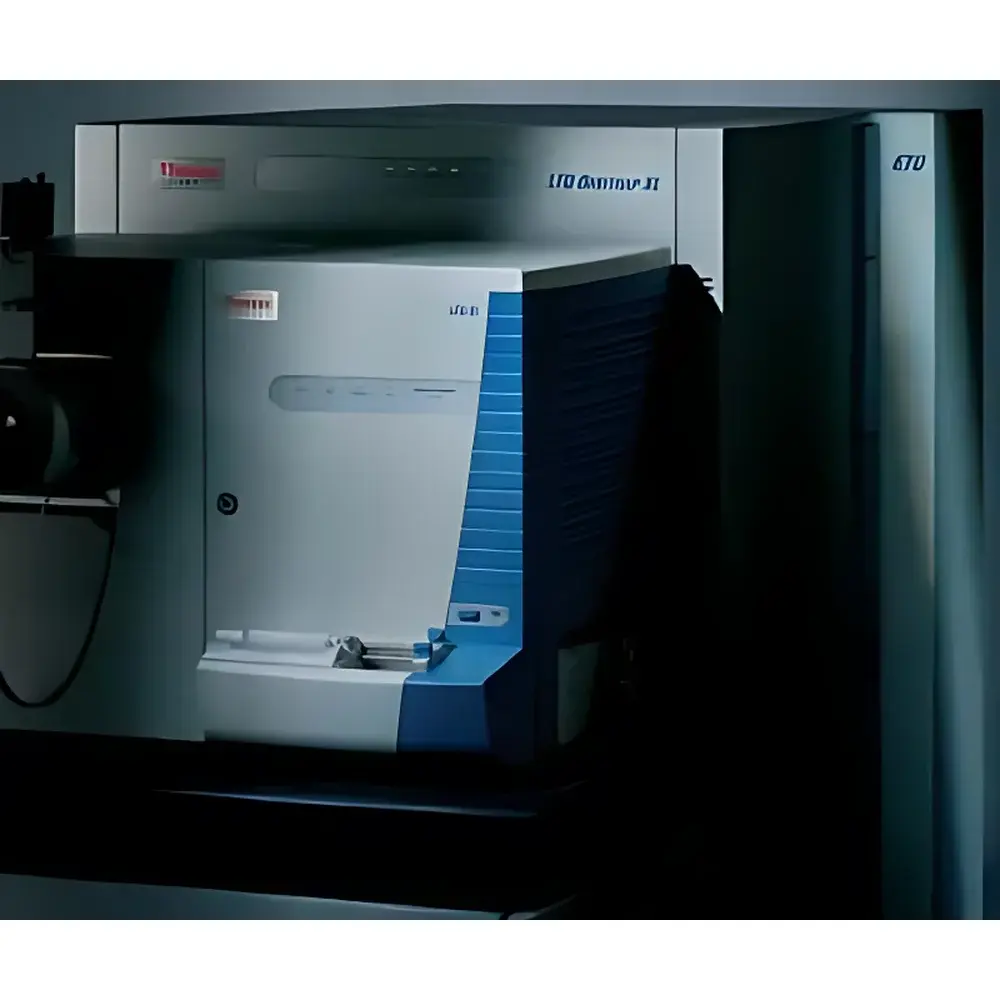
Thermo Scientific LTQ Orbitrap XL ETD Hybrid Fourier Transform Mass Spectrometer
| Brand | Thermo Fisher |
|---|---|
| Origin | Germany |
| Manufacturer | Thermo Fisher Scientific |
| Instrument Type | Orbitrap Hybrid Mass Spectrometer |
| Model | LTQ Orbitrap XL ETD |
| Mass Range | 50–4000 m/z |
| Sensitivity | S/N ≥ 100:1 for 2 pg reserpine (full-scan, MS mode) |
| Resolution | 60,000 at m/z 400 (FWHM) |
| Mass Accuracy | ≤ 2 ppm (internal calibration), ≤ 5 ppm (external calibration) |
| Activation Methods | CID, HCD, ETD |
| Software Platforms | Proteome Discoverer, ProSightPC, Xcalibur |
Overview
The Thermo Scientific LTQ Orbitrap XL ETD is a hybrid Fourier transform mass spectrometer engineered for high-resolution, high-mass-accuracy analysis in complex proteomics and small-molecule applications. It integrates a linear ion trap (LTQ) with an Orbitrap mass analyzer — a configuration that leverages complementary strengths: rapid ion trapping, multi-stage MSn capability, and ultra-high resolution mass measurement based on orbital ion motion detection. Ions generated at atmospheric pressure (e.g., via electrospray ionization) are first accumulated and isolated in the LTQ, where they undergo low-energy collision-induced dissociation (CID) or data-dependent selection. Selected precursors are then transferred axially through a C-trap into the Orbitrap analyzer, where electrostatic fields confine ions in stable orbits around a central spindle electrode. The resulting image current from axial oscillations is digitized and converted to a mass spectrum via fast Fourier transform (FFT), delivering sub-ppm mass accuracy and resolving power up to 60,000 at m/z 400.
Key Features
- Hybrid architecture combining LTQ linear ion trap and Orbitrap mass analyzer for simultaneous high-speed MSn and high-resolution MS1 acquisition
- Triple fragmentation modalities: CID (low-energy), HCD (high-energy collisional dissociation), and ETD (electron-transfer dissociation) — enabling comprehensive coverage of labile post-translational modifications (PTMs), intact proteins, and highly charged peptides
- Enhanced dynamic range and sensitivity: capable of detecting sub-picomole quantities of peptides (e.g., ≥100:1 S/N for 2 pg reserpine in full-scan mode)
- Mass accuracy ≤2 ppm with internal calibration; supports external calibration workflows compliant with ISO/IEC 17025 and FDA 21 CFR Part 11 requirements
- Modular design supporting field-upgradable ETD and MALDI sources — extending platform utility across bottom-up, middle-down, and top-down proteomics
- Robust C-trap interface enabling efficient ion transfer between LTQ and Orbitrap analyzers with minimal signal loss
Sample Compatibility & Compliance
The LTQ Orbitrap XL ETD is compatible with standard LC-MS interfaces including nanoESI, microESI, and HPLC-coupled electrospray sources. It supports direct infusion, capillary LC, and nanoflow chromatography configurations. Its performance meets analytical criteria defined in key regulatory frameworks: mass accuracy and reproducibility align with ASTM E2918 (Standard Practice for Mass Spectrometry Data Quality Assessment), while software audit trails, user access controls, and electronic signature support in Xcalibur and Proteome Discoverer satisfy GLP/GMP and 21 CFR Part 11 compliance requirements. Routine operation adheres to ISO 13485 principles for medical device-related biomarker discovery and USP <1225> validation guidelines for method qualification in biopharmaceutical characterization.
Software & Data Management
Data acquisition and processing are managed through Thermo Scientific Xcalibur (v2.8+), providing real-time instrument control, automated calibration, and customizable data-dependent acquisition (DDA) methods. Proteome Discoverer (v2.5+) delivers integrated qualitative and quantitative workflows — including label-free quantitation (LFQ), TMT/iTRAQ multiplexing, PTM localization scoring (e.g., phosphorylation, glycosylation), and spectral library searching. ProSightPC enables top-down and middle-down protein identification using accurate mass constraints and ETD-specific fragment interpretation. All software modules generate ALCOA+ compliant metadata, including timestamped acquisition logs, instrument parameter snapshots, and version-controlled processing nodes — essential for traceability in regulated environments.
Applications
- Comprehensive identification and quantification of low-abundance phosphopeptides and glycopeptides in cell lysates
- De novo sequencing of monoclonal antibody fragments and engineered proteins using ETD/HCD complementarity
- Top-down characterization of intact histones and their combinatorial PTM patterns
- Small-molecule metabolite identification in pharmacokinetic studies with in-source and MS2 filtering
- High-confidence peptide mapping for biosimilar comparability assessments per ICH Q5E guidelines
- Discovery of novel proteoforms in clinical tissue biopsies using label-free differential expression analysis
FAQ
What fragmentation techniques are supported on the LTQ Orbitrap XL ETD?
CID, HCD, and ETD — all accessible within a single run via intelligent data-dependent decision trees.
Can the system perform both bottom-up and top-down proteomics?
Yes. Its high mass range (up to m/z 4000), ETD compatibility, and Orbitrap resolution enable confident analysis of intact proteins >20 kDa and proteolytic peptides alike.
Is the instrument compliant with FDA 21 CFR Part 11?
Yes — when operated with validated versions of Xcalibur and Proteome Discoverer, including electronic signatures, audit trails, and role-based access control.
What is the typical mass accuracy under routine LC-MS/MS conditions?
≤2 ppm with lock-mass correction using polydimethylcyclosiloxane (PCM) or internal calibrants; ≤5 ppm without internal reference.
How does ETD improve PTM analysis compared to CID/HCD?
ETD preserves labile modifications (e.g., O-GlcNAc, phosphorylation) during fragmentation, yielding sequence-informative c/z•-type ions instead of neutral-loss dominant spectra.
Can the system be upgraded post-purchase?
Yes — ETD source, MALDI source, and advanced software licenses (e.g., Proteome Discoverer Quantitation Module) are available as field-installable options.




