
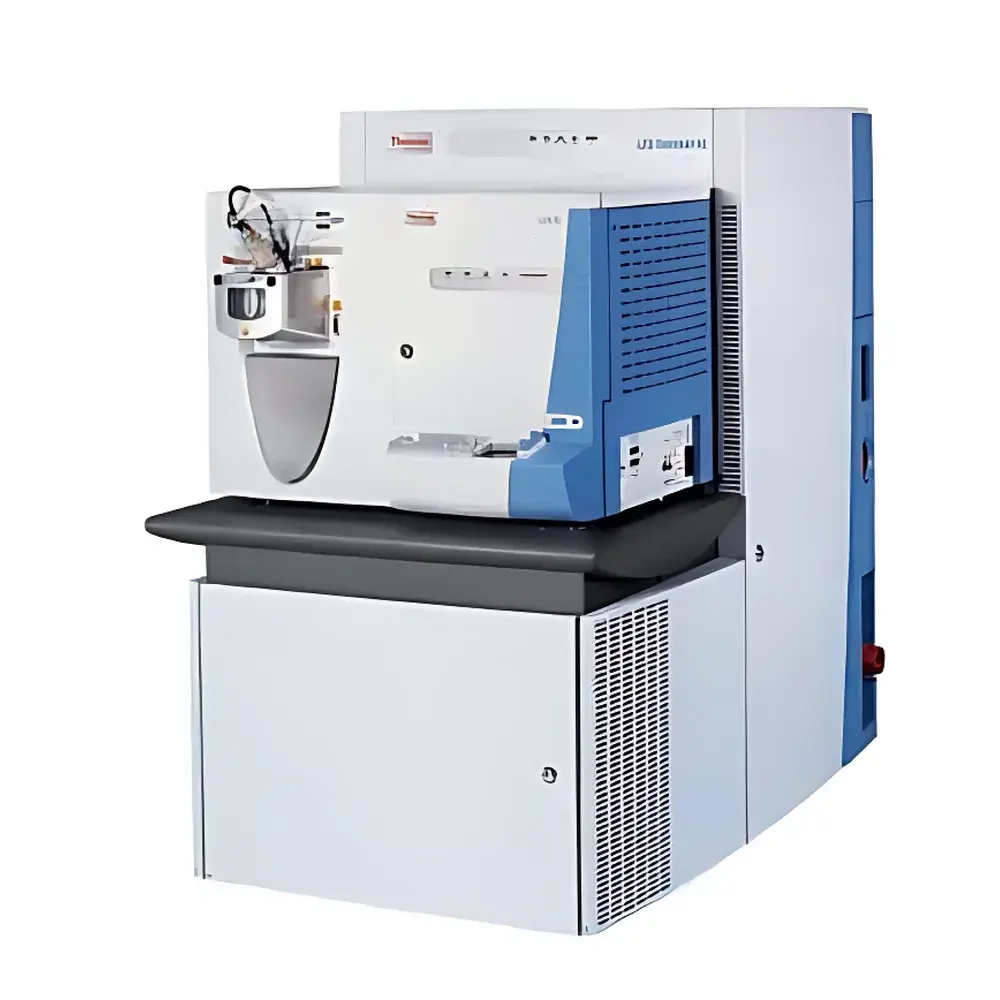
Thermo Scientific LTQ Orbitrap XL™ Hybrid Mass Spectrometer
| Brand | Thermo Fisher |
|---|---|
| Origin | USA |
| Manufacturer Type | Original Equipment Manufacturer (OEM) |
| Origin Category | Imported |
| Model | LTQ Orbitrap XL |
| Instrument Type | Orbitrap Hybrid Mass Spectrometer |
| Resolution (at m/z 400) | 30,000 (FWHM) |
| Scan Speed | Up to 10 MS/MS spectra per second |
| Mass Accuracy | < 5 ppm (internal calibration), < 3 ppm (external calibration) |
| MSⁿ Capability | Up to MS⁵ |
| Fragmentation Methods | CID, HCD, ETD |
| Optional Ion Source | MALDI Source (compatible) |
Overview
The Thermo Scientific LTQ Orbitrap XL™ is a hybrid linear ion trap–Orbitrap mass spectrometer engineered for high-resolution, accurate-mass (HRAM) analysis in complex biological and chemical matrices. It integrates a dual-pressure linear ion trap (LTQ) with a high-field Orbitrap mass analyzer—leveraging electrostatic trapping and Fourier-transform detection principles to deliver sub-ppm mass accuracy, 30,000 resolution (at m/z 400), and robust MSn capability up to MS5. Designed specifically for discovery-driven proteomics and metabolomics workflows, the system enables label-free differential expression profiling, intact protein characterization, post-translational modification (PTM) mapping, and small-molecule identification without reliance on spectral libraries. Its architecture supports both bottom-up and middle-down proteomics strategies, making it suitable for laboratories requiring orthogonal fragmentation pathways (CID, HCD, and ETD) within a single platform.
Key Features
- Hybrid design combining a high-sensitivity linear ion trap with a high-field Orbitrap analyzer for simultaneous high-speed MS and high-resolution MS/MS acquisition
- Resolution up to 30,000 (FWHM at m/z 400) with mass accuracy better than 3 ppm using external calibration and <5 ppm with internal lock mass correction
- High-speed scanning: capable of acquiring up to 10 data-dependent MS/MS spectra per second while maintaining sensitivity and dynamic range
- Triple fragmentation modalities—Collision-Induced Dissociation (CID), Higher-Energy Collisional Dissociation (HCD), and Electron Transfer Dissociation (ETD)—enabling complementary sequence coverage and PTM preservation (e.g., phosphorylation, glycosylation)
- Integrated HCD cell optimized for quantitative applications including iTRAQ™ and TMT™ multiplexed labeling workflows
- Expandable architecture supporting optional MALDI source integration for solid-phase sample analysis, tissue imaging, and 2D-gel spot identification
- Full MSn capability (up to MS5) for structural elucidation of small molecules and confirmation of metabolic biotransformation pathways
Sample Compatibility & Compliance
The LTQ Orbitrap XL accommodates samples introduced via electrospray ionization (ESI), nanospray, or optional MALDI sources—supporting liquid chromatography (LC), capillary electrophoresis (CE), and direct infusion workflows. It is routinely deployed in regulated environments where traceability and audit readiness are required. The instrument complies with key analytical validation frameworks including ICH Q2(R2), USP , and ISO/IEC 17025. When operated with Thermo Scientific Chromeleon™ CDS software configured for 21 CFR Part 11 compliance, the system supports electronic signatures, secure user authentication, and full audit trails—meeting GLP and GMP documentation standards for pharmaceutical QC/QA and clinical biomarker development.
Software & Data Management
Data acquisition and processing are managed through Thermo Scientific Tune™ and Xcalibur™ software platforms, which provide method development tools, real-time spectral visualization, and automated peak detection. Quantitative workflows—including label-free, iTRAQ, TMT, and SWATH-like data-independent acquisition (DIA)—are supported via integrated algorithms in Proteome Discoverer™ 2.5+ and Compound Discoverer™. All raw data files (.raw) adhere to the open mzML standard, ensuring interoperability with third-party tools such as MaxQuant, Skyline, and OpenMS. Metadata tagging, project-based organization, and export to LIMS-compatible formats (e.g., CSV, XML) facilitate laboratory-wide data governance and long-term archival in accordance with FAIR (Findable, Accessible, Interoperable, Reusable) principles.
Applications
- Deep-proteome profiling in human cell lines, tissues, and biofluids using label-free or isobaric tagging approaches
- Comprehensive PTM analysis—including site-specific phosphorylation, ubiquitination, acetylation, and O-GlcNAcylation—with ETD-enabled retention of labile modifications
- Top-down and middle-down characterization of monoclonal antibodies, histones, and other intact proteins (up to ~50 kDa)
- Metabolite identification and pathway mapping in pharmacokinetic and toxicological studies
- MALDI-based spatial omics: peptide/protein imaging from tissue sections and 2D-gel excised spots
- Small-molecule confirmation and impurity profiling in synthetic chemistry and natural product isolation
FAQ
What fragmentation techniques does the LTQ Orbitrap XL support?
It natively supports CID and HCD in the linear ion trap and HCD cell, respectively; ETD functionality requires optional hardware installation and is controlled via Xcalibur software.
Can the system be used for quantitative proteomics?
Yes—it is validated for both label-free quantitation and multiplexed isobaric tagging (iTRAQ, TMT) with HCD-based reporter ion detection and high reproducibility across technical replicates.
Is MALDI source compatibility factory-installed or field-upgradable?
The MALDI source is an optional accessory that can be installed post-purchase; mechanical and electrical interfaces are pre-engineered into the LTQ Orbitrap XL chassis.
Does the instrument meet regulatory requirements for pharmaceutical analysis?
When paired with compliant software configurations (e.g., Chromeleon CDS with 21 CFR Part 11 modules), it supports audit-ready operation in FDA-regulated environments for method validation and release testing.
What is the typical mass range for intact protein analysis?
While optimal performance is observed below 50 kDa, successful top-down analyses have been reported up to ~70 kDa under optimized conditions, depending on charge state distribution and signal-to-noise ratio.





