
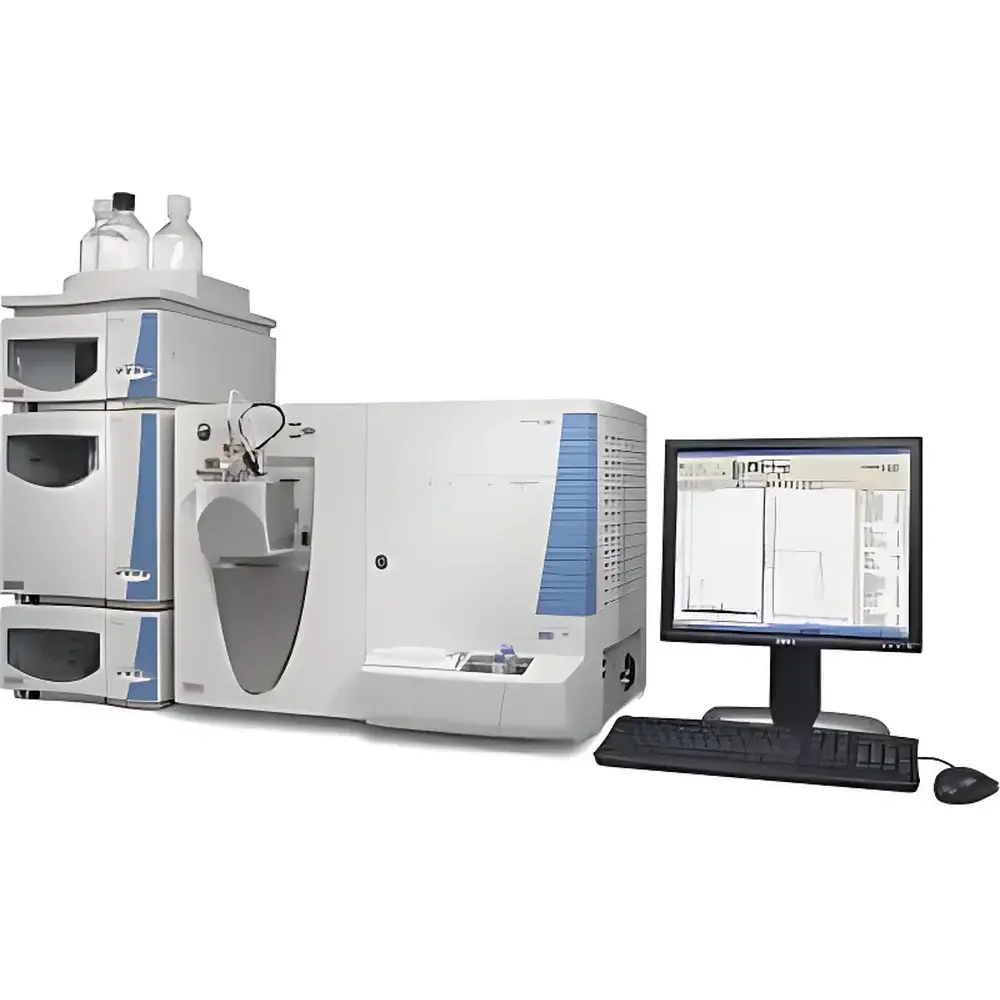
Thermo Scientific LXQ Linear Ion Trap Mass Spectrometer
| Origin | USA |
|---|---|
| Manufacturer Type | Authorized Distributor |
| Origin Category | Imported |
| Model | LXQ Linear Ion Trap Mass Spectrometer |
| Price Range | USD 140,000 – 280,000 (FOB) |
| Instrument Type | Linear Ion Trap |
Overview
The Thermo Scientific LXQ Linear Ion Trap Mass Spectrometer is a robust, high-throughput benchtop mass spectrometer engineered for routine and discovery-oriented LC-MS/MS applications. It operates on the principle of ion trapping and resonant ejection within a linear quadrupole geometry—distinct from traditional 3D Paul traps—enabling higher ion storage capacity, improved duty cycle, and enhanced MSn capability up to n = 5. The LXQ integrates seamlessly with standard HPLC and UHPLC systems, delivering reliable electrospray ionization (ESI) and atmospheric pressure chemical ionization (APCI) performance. Designed for laboratories requiring rapid method development and reproducible quantitative and qualitative analysis, the LXQ supports both targeted and untargeted workflows without compromising spectral fidelity or acquisition speed.
Key Features
- Linear ion trap architecture with dual RF/DC control for efficient ion accumulation, isolation, and fragmentation
- High-sensitivity detection enabled by optimized ion optics and low-noise electronics—capable of sub-femtomole-level detection for peptides and small molecules
- Fast scan speeds (up to 10,000 Da/sec) and short cycle times (< 1 sec per full MS/MS scan), supporting high-throughput screening in drug metabolism and pharmacokinetic (DMPK) studies
- Advanced Data-Dependent Acquisition (DDA) algorithm that dynamically selects precursor ions based on intensity, charge state, and exclusion lists—ideal for complex biological matrices
- Integrated hardware support for collision-induced dissociation (CID) with adjustable collision energy, enabling consistent and reproducible fragmentation patterns across runs
- Benchtop footprint with minimal infrastructure requirements—no external cooling water or high-power electrical circuits needed
Sample Compatibility & Compliance
The LXQ accommodates a broad range of sample types, including but not limited to small-molecule pharmaceuticals, metabolites, endogenous lipids, post-translationally modified peptides, and forensic toxicology analytes. Its ESI and APCI sources support direct infusion, microflow, nanoflow, and conventional LC flow rates (5–1000 µL/min). The system complies with key regulatory frameworks relevant to analytical laboratories: data integrity features align with FDA 21 CFR Part 11 requirements (including user authentication, electronic signatures, and audit trail logging); instrument control software adheres to GLP/GMP documentation standards; and method validation protocols are compatible with ICH Q2(R2), USP , and ISO/IEC 17025 guidelines.
Software & Data Management
Controlled by Thermo Scientific Xcalibur software (v2.2 or later), the LXQ provides a unified platform for instrument operation, real-time data visualization, peak integration, and spectral interpretation. Quantitation is supported via extracted ion chromatogram (XIC) integration with internal standard normalization. Structural elucidation leverages built-in MSn spectral libraries and compatibility with third-party tools such as Proteome Discoverer (for proteomics) and Compound Discoverer (for small-molecule profiling). All raw data files (.raw) are stored in an open, vendor-neutral format compliant with mzML 1.1 specifications, ensuring long-term archival and interoperability with open-source analysis pipelines.
Applications
- Drug discovery: simultaneous qualitative identification and semi-quantitative assessment of drug candidates and their Phase I/II metabolites
- Metabolic stability assays using hepatocyte or microsomal incubations, with automated peak area ratio calculations for intrinsic clearance estimation
- Forensic toxicology: multi-analyte screening of opioids, stimulants, and novel psychoactive substances (NPS) in blood or urine with library-matching confidence scores
- Proteomics: bottom-up identification of proteins from gel bands or digests, including phosphorylation, acetylation, and ubiquitination site mapping via diagnostic fragment ions
- Quality control of biologics: characterization of charge variants, deamidation, and oxidation products in monoclonal antibodies under non-denaturing conditions
FAQ
What is the maximum MSn level supported by the LXQ?
The LXQ supports MSn up to n = 5, with full retention of resolution and signal-to-noise ratio at each stage due to its linear trap geometry and optimized ion ejection dynamics.
Does the LXQ support scheduled MRM acquisition?
No—the LXQ is not configured for triple-quadrupole-style scheduled multiple reaction monitoring (sMRM); it is optimized for data-dependent and data-independent (via optional firmware upgrades) scanning modes suitable for discovery and semi-targeted workflows.
Is the system compatible with nanoLC and capillary LC systems?
Yes—standard ESI source configurations support flow rates down to 200 nL/min when coupled with nanospray emitters and appropriate interface kits.
Can raw data be reprocessed with updated search parameters or algorithms?
Yes—all .raw files retain full centroided and profile-mode spectra, enabling retrospective reprocessing with newer database versions, scoring algorithms, or customized fragmentation rules without reacquisition.
What maintenance intervals are recommended for routine operation?
Ion source cleaning is advised every 2–4 weeks depending on sample load; mass calibration verification should be performed daily; and vacuum system inspection (turbo pump oil level, roughing pump operation) is recommended quarterly.
Related Products




