
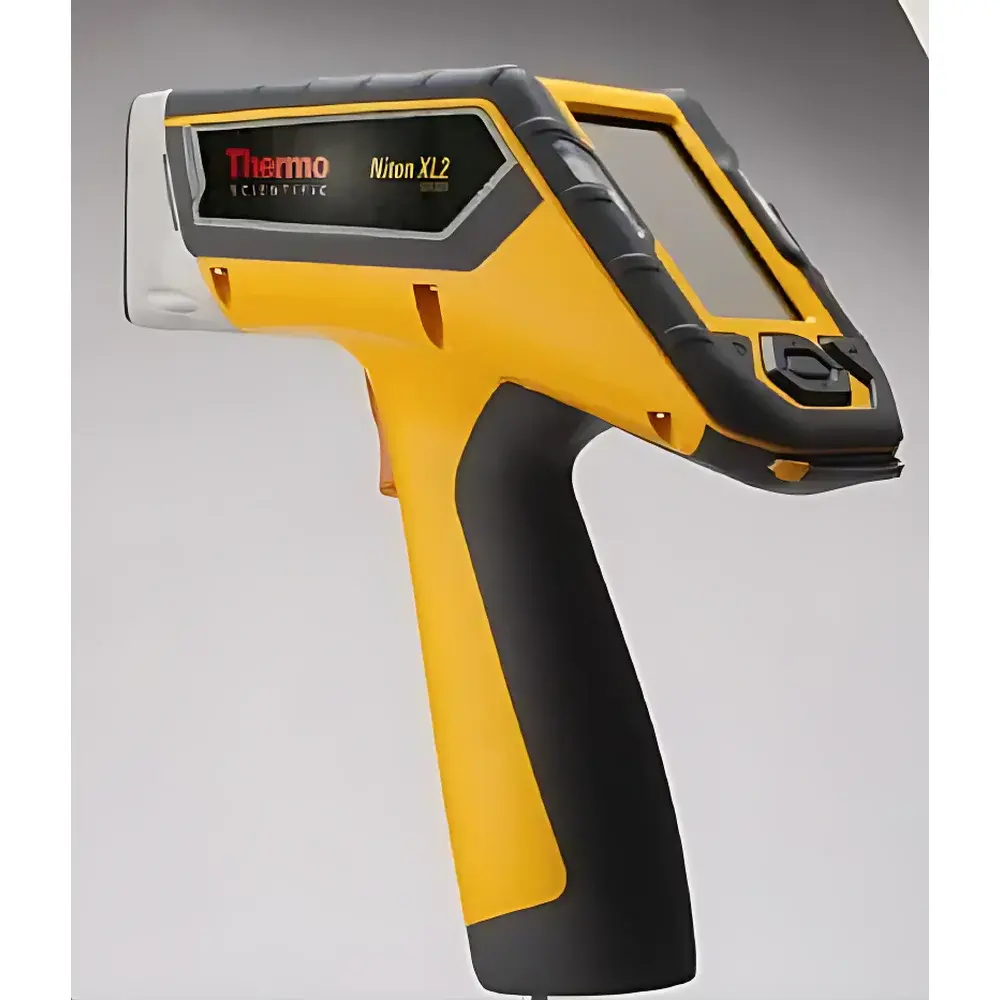
Thermo Scientific Niton XL2 GOLDD Handheld Energy Dispersive X-Ray Fluorescence (ED-XRF) Analyzer
| Brand | Thermo Fisher |
|---|---|
| Origin | USA |
| Manufacturer | Thermo Fisher Scientific |
| Type | Imported |
| Model | XL2 GOLDD |
| Application | Handheld / Portable |
| Industry-Specific Use | Geological & Mining |
| Elemental Range | Mg (12) to U (92), >30 elements |
| Quantification Range | 5 ppm – 99 wt% |
| Energy Resolution | <185 eV (at Mn Kα) |
| Repeatability | ≤0.5% RSD (for major elements under standardized conditions) |
Overview
The Thermo Scientific Niton XL2 GOLDD Handheld Energy Dispersive X-Ray Fluorescence (ED-XRF) Analyzer is engineered for high-precision, field-deployable elemental analysis across geoscience, mining, environmental, and industrial applications. Operating on the fundamental principle of energy-dispersive X-ray fluorescence, the instrument irradiates a sample with a focused X-ray beam (45 kV Ag-anode tube, up to 100 µA), inducing characteristic secondary X-ray emission from constituent atoms. The emitted photons are resolved by a geometrically optimized large-area Silicon Drift Detector (SDD) — enhanced by proprietary GOLDD™ (Geometry Optimized Large-area Drift Detector) technology — enabling simultaneous detection and quantification of elements from magnesium (Z = 12) to uranium (Z = 92). Unlike vacuum- or helium-purged systems, the XL2 GOLDD achieves reliable light-element performance (Mg, Al, Si, P, S) in ambient air, eliminating auxiliary gas requirements and reducing operational complexity without compromising detection limits.
Key Features
- GOLDD™ detector architecture: Delivers up to 10× faster count rates and ~3× improved peak resolution compared to conventional Si-PIN detectors, resulting in lower limits of detection (LODs) and enhanced precision for trace and major elements.
- Ambient-air light-element analysis: No helium purge or vacuum pump required — enables rapid, on-site Mg–S quantification with reproducible accuracy.
- Integrated 2 MP fixed-focus camera: Captures co-registered visual images aligned with analytical measurement spots; images are embedded in spectral reports for spatial traceability and QA/QC documentation.
- Rugged, ergonomic design: IP54-rated enclosure; drop-tested to 1.5 m onto concrete; operating temperature range: –10 °C to 50 °C; weight: 1.53 kg (3 lb 5.8 oz).
- High-fidelity user interface: 5-inch color touchscreen with sunlight-readable graphics; customizable menus; multilingual support (English, Spanish, French, German, Chinese, Japanese, Russian, Arabic); intuitive “point-and-shoot” workflow.
- Onboard computational architecture: 400 MHz ARM11 CPU + dedicated 300 MHz DSP + 4096-channel MCA; 64 MB system memory / 128 MB user storage; >10,000 spectra capacity.
Sample Compatibility & Compliance
The XL2 GOLDD supports direct, non-destructive analysis of heterogeneous solid samples including ores, soils, rocks, drill cores, slag, scrap metal, and coated surfaces. Its geometry-optimized excitation/detection path ensures consistent signal response across irregular topographies. Regulatory compliance includes CE marking per EU Directive 2014/30/EU (EMC) and 2014/35/EU (LVD); RoHS 2011/65/EU conformity; and adherence to IEC 62471 (photobiological safety) and ANSI N43.3 (X-ray equipment safety). While not FDA-cleared as a medical device, its performance aligns with ASTM E1621 (Standard Guide for XRF Analysis of Metals), ASTM D7297 (Polymer Screening), and ISO 12847 (Soil Analysis), supporting GLP-compliant data acquisition when used with audit-trail-enabled software configurations.
Software & Data Management
Data handling is facilitated via Thermo Scientific Niton Data Transfer (NDT©) PC software — a validated platform supporting operator-level permissions, customizable report templates (with corporate logo embedding), certificate-of-analysis generation, and remote instrument control over USB or Bluetooth®. NDT implements secure, timestamped audit trails compliant with 21 CFR Part 11 principles (electronic signatures, data integrity controls) when deployed in regulated environments. Spectral files (NDF format) include full metadata: GPS coordinates (optional), operator ID, time/date stamp, exposure parameters, calibration status, and image thumbnails. Export options include CSV, PDF, and XML for LIMS integration. Firmware updates and method deployment are performed directly through NDT without requiring third-party tools.
Applications
- Geological exploration: Real-time grade estimation of Cu, Zn, Pb, Au, Ni, Co, and REEs in outcrops, trenches, and core trays; rapid lithological discrimination using elemental ratios (e.g., Si/Al, Fe/Ti).
- Mining & processing: Feed/concentrate/product assay verification; slag composition monitoring; contamination screening in stockpiles.
- Environmental site assessment: In-situ soil screening for As, Cd, Cr, Hg, Pb, and U per EPA Method 6200; sediment and waste characterization.
- Industrial QA/QC: Alloy verification (stainless steels, superalloys, Al/Mg alloys); RoHS-compliant screening of Br, Cd, Pb, Hg, Cr(VI) in electronics and plastics; coating thickness and composition analysis.
- Archaeometry & forensics: Provenance studies of ceramics, metals, and pigments; non-invasive artifact authentication.
FAQ
Does the XL2 GOLDD require helium or vacuum for light-element analysis?
No. GOLDD™ technology enables robust Mg–S detection in ambient air without gas purging or mechanical vacuum systems.
What regulatory standards does the instrument support for reporting?
It complies with ASTM E1621, ASTM D7297, ISO 12847, and EU RoHS directives; NDT software supports 21 CFR Part 11–aligned audit trails.
Can the analyzer be calibrated for custom matrices (e.g., specific ore types)?
Yes — Thermo Fisher offers application-specific calibrations developed using certified reference materials; users may also create limited custom calibrations via NDT.
How is data security maintained during wireless transmission?
Bluetooth® communication uses AES-128 encryption; all stored spectra are digitally signed and timestamped within the NDF file structure.
Is the instrument suitable for use in explosive atmospheres?
No — it is not ATEX or IECEx certified. For hazardous locations, consult Thermo Fisher’s intrinsically safe (IS) variants such as the XL3t GOLDD IS series.






