
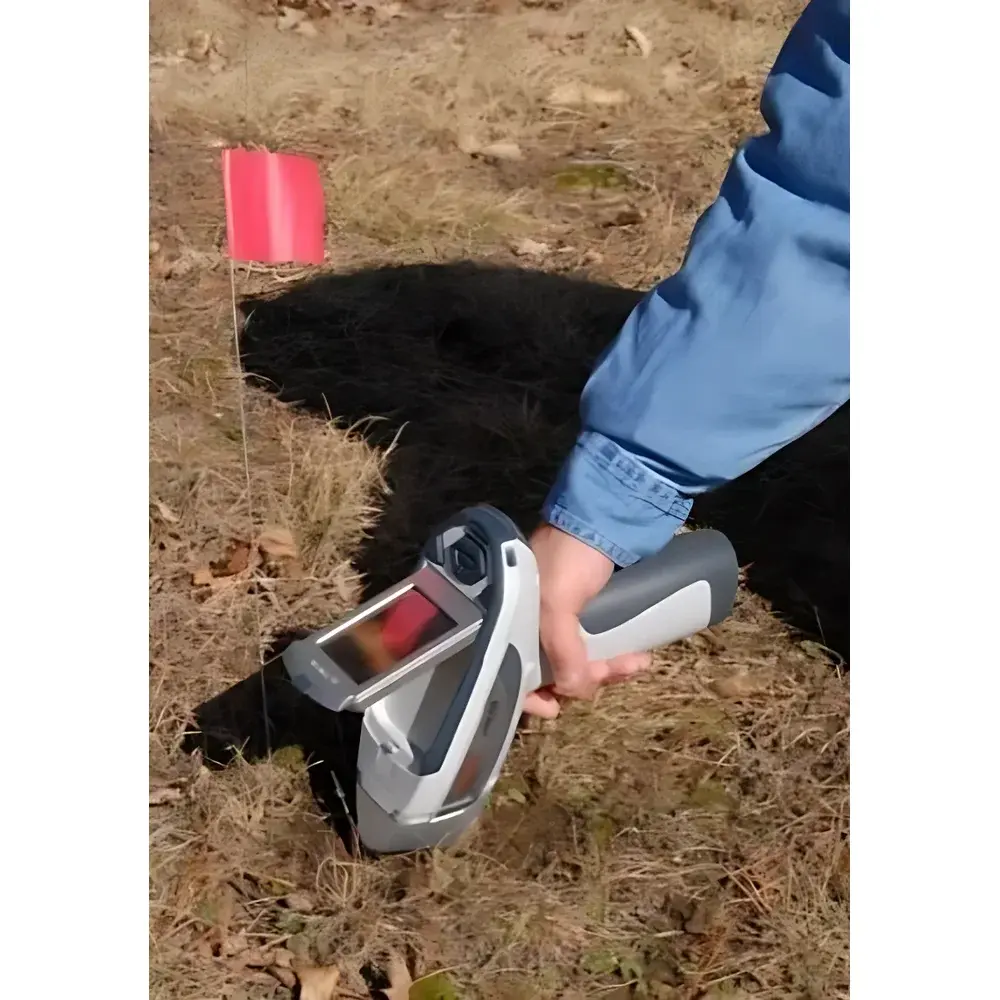
Thermo Scientific Niton XL3t 500 Handheld Energy Dispersive X-Ray Fluorescence (ED-XRF) Spectrometer
| Brand | Thermo Fisher Scientific |
|---|---|
| Origin | USA |
| Manufacturer | Thermo Fisher Scientific |
| Type | Imported |
| Model | XL3t 500 |
| Form Factor | Handheld / Portable |
| Detector Options | Si-PIN or High-Performance SDD with Peltier cooling |
| Excitation Source | Rhodium or Silver anode micro-X-ray tube (50 kV / 40 µA max) |
| Analyzable Elements | Mg–U (with He purge: Mg, Al, Si, P, S, Cl, K, Ca, and beyond) |
| Measurement Window | 8 mm or 3 mm (optional) |
| Display | Adjustable-angle VGA color touchscreen (0–90°) |
| Dimensions | 95.5 × 244 × 230 mm |
| Weight | <1.3 kg |
| Battery Life | Up to 10 hours (hot-swappable Li-ion with thermal management) |
| Data Storage | >10,000 spectra + results |
| Connectivity | USB, Bluetooth, RS-232 |
| Calibration Methods | Fundamental Parameters (FP) and empirical coefficient algorithms |
| Compliance | Meets IEC 61000-4 electromagnetic immunity standards |
Overview
The Thermo Scientific Niton XL3t 500 is a field-deployable, handheld energy dispersive X-ray fluorescence (ED-XRF) spectrometer engineered for rapid, non-destructive elemental quantification in geological and mining applications. Operating on the principle of X-ray fluorescence emission—where primary X-rays from a micro-focus tube excite atoms in the sample, inducing characteristic secondary X-ray emission—the instrument delivers laboratory-grade precision under real-world conditions. Its compact architecture integrates a high-stability X-ray source (Rh or Ag anode), selectable detector technology (Si-PIN or silicon drift detector, SDD), and real-time spectral deconvolution firmware. Designed specifically for mineral exploration, grade control, ore sorting, and environmental geochemical screening, the XL3t 500 enables quantitative analysis of elements from magnesium (Mg) to uranium (U), including critical light elements (e.g., Mg, Al, Si, P, S, Cl) when equipped with optional helium purging. With sub-1.3 kg mass, IP54-rated ingress protection, and shock-absorbing housing, it meets rigorous ASTM D7759 and ISO 18551 requirements for portable analytical instrumentation used in geotechnical field operations.
Key Features
- Rapid deployment: Ready for measurement within 30 seconds of power-on; full spectral acquisition and quantification completed in ≤5 seconds per test.
- High-fidelity detection: Optional high-resolution SDD detector with Peltier-based electronic cooling ensures improved peak separation and counting statistics—critical for low-concentration trace element determination (down to single-digit ppm levels in favorable matrices).
- Adaptive excitation: Dual-anode X-ray tube (Rh standard; Ag optional for enhanced light-element sensitivity) with programmable kV/µA settings and six-position automatic filter wheel for optimized excitation across diverse elemental ranges.
- Robust human interface: Articulating VGA touchscreen (0–90° tilt), integrated alphanumeric keypad, and intuitive icon-driven UI support operation wearing gloves in dusty or wet environments.
- Onboard intelligence: ARM11 CPU (533 MHz) paired with dedicated DSPs (300 MHz + 80 MHz ASICS) and 4096-channel MCA enable real-time spectrum processing without external computing.
- Secure data governance: Password-protected access, audit-trail-capable NDT software, and configurable user permissions align with FDA 21 CFR Part 11 expectations for regulated field data capture.
Sample Compatibility & Compliance
The XL3t 500 accommodates heterogeneous, irregularly shaped solid samples—including unprepared rock chips, drill core fragments, soil aggregates, and crushed ore—without requiring pelletization or fusion. Its 8 mm standard collimation (3 mm optional) ensures representative micro-area analysis while minimizing matrix effects through geometric normalization. The instrument complies with international safety standards (IEC 62471 for LED display, IEC 61010-1 for electrical safety) and electromagnetic compatibility (IEC 61000-4 series). For regulated environments—such as QA/QC labs supporting ISO/IEC 17025-accredited mineral assays—the system supports traceable calibration using certified reference materials (CRMs) traceable to NIST SRMs. Optional GPS integration enables geotagged spectral logging, facilitating spatial interpolation in GIS platforms per ASTM D6913 and USGS Open-File Report protocols.
Software & Data Management
Thermo Scientific Niton NDT software provides comprehensive post-acquisition capabilities: spectral review, multi-point averaging, limit-of-detection calculation, and customizable report generation (PDF, CSV, XML). Data synchronization occurs via USB 2.0, Bluetooth 4.0, or RS-232 serial link; no proprietary dongles or drivers required. Firmware updates are delivered over-the-air via secure HTTPS channels, ensuring continuous alignment with evolving regulatory guidance (e.g., EPA Method 6200 revisions). All raw spectra and processed results are stored with time/date stamps, operator ID, GPS coordinates (if enabled), and instrument configuration metadata—enabling full chain-of-custody documentation suitable for GLP audits or third-party verification.
Applications
- Exploration geochemistry: Rapid in-field screening of pathfinder elements (e.g., As, Sb, Te) in soil and regolith samples to delineate mineralized zones.
- Ore grade control: Real-time Cu, Fe, Zn, Pb, and Ni concentration mapping during mine face sampling or conveyor belt monitoring.
- Environmental site assessment: Quantification of heavy metals (Pb, Cr, Cd, Hg) in tailings, sediments, and leachates per EPA SW-846 methods.
- Mineral processing optimization: Feed/product assay comparison for flotation circuit tuning and recovery rate modeling.
- Archaeometric provenance studies: Multi-element fingerprinting of lithic artifacts using statistically robust PCA or hierarchical clustering in NDT.
FAQ
Does the XL3t 500 require annual recalibration?
No scheduled annual recalibration is mandated; however, daily verification using a check standard (e.g., Niton Certified Check Sample) is recommended per ISO 17025 Clause 7.7. Instrument self-diagnostic routines validate detector resolution, tube output stability, and energy calibration drift before each session.
Can the XL3t 500 quantify sulfur in sulfide ores?
Yes—when configured with helium purge and silver anode tube, the XL3t 500 achieves reliable S Kα detection at concentrations ≥100 ppm in silicate- and carbonate-rich matrices.
Is spectral data export compatible with third-party chemometric tools?
Raw .nds files contain fully calibrated intensity counts per channel and can be converted to ASCII format via NDT; spectral matrices are importable into MATLAB, Unscrambler, or R packages for multivariate regression or PLS modeling.
What regulatory frameworks does the XL3t 500 support for auditable field data?
NDT software includes electronic signature capability, immutable audit logs, and role-based access controls—meeting baseline requirements for FDA 21 CFR Part 11, EU Annex 11, and ISO/IEC 17025:2017 Clause 7.5.2 on data integrity.
How is light-element performance validated across different geological matrices?
Thermo provides application-specific method templates (e.g., “Ore-FeS” or “Soil-Light”) pre-validated against CRMs such as NIST 2710a and CANMET MRG-N, with documented RMSE values published in Technical Note TN-EDXRF-004.





