
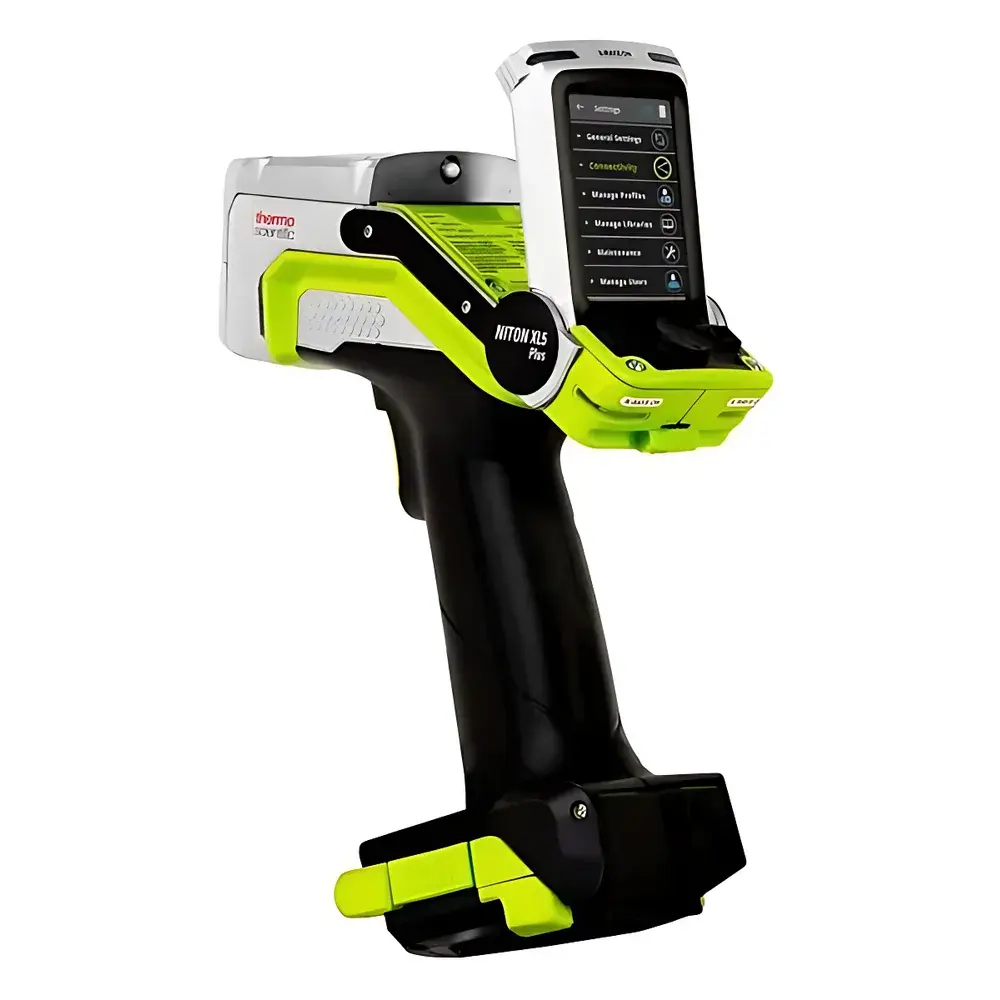
Thermo Scientific Niton XL5 Plus Handheld Energy Dispersive X-Ray Fluorescence (ED-XRF) Spectrometer
| Brand | Thermo Fisher |
|---|---|
| Origin | USA |
| Manufacturer | Thermo Fisher Scientific |
| Product Type | Imported |
| Model | Niton XL5 Plus XRF |
| Application | Handheld / Portable |
| Industry Use | General Purpose |
| Elemental Range | Mg–U (with ultra-low-light detection), Na (via spectral detection) |
| Analyzable Elements | >30 common elements |
| Primary Applications | Rapid alloy identification, ultra-trace light-element detection |
| Energy Resolution | 150–185 eV |
| Detector | High-count-rate, high-resolution, large-area silicon drift detector (SDD) with 1 µm graphene window and integrated detector protection |
Overview
The Thermo Scientific™ Niton™ XL5 Plus is a handheld energy dispersive X-ray fluorescence (ED-XRF) spectrometer engineered for field-deployable elemental analysis with laboratory-grade reliability. Based on fundamental ED-XRF physics—where primary X-rays from a 5 W microfocus tube excite characteristic secondary (fluorescent) X-rays from sample atoms—the instrument quantifies elemental composition by measuring the energy and intensity of emitted photons. Its optimized excitation geometry, combined with a large-area silicon drift detector (SDD) featuring a 1 µm graphene entrance window, enables exceptional sensitivity across the full Mg–U range—and extends detectability to sodium (Na) through enhanced low-energy spectral response. Designed for industrial environments demanding speed, repeatability, and regulatory traceability, the XL5 Plus delivers quantitative and qualitative results in seconds without sample preparation or destruction.
Key Features
- Ultra-Lightweight Ergonomic Design: Weighing only 1.3 kg (2.8 lbs), it remains the lightest commercially available handheld ED-XRF analyzer certified for industrial use—reducing operator fatigue during extended shift work or overhead inspections.
- Graphene-Window SDD Detector: The 1 µm graphene detector window provides superior transmission efficiency for low-energy X-rays (e.g., Mg, Al, Si, P, S), enabling reliable detection and quantification of light elements previously inaccessible in conventional handheld systems.
- Robust Field-Ready Architecture: IP54-rated enclosure, reinforced shock-absorbing housing, and integrated detector protection guard against mechanical impact—critical when analyzing sharp edges, weld seams, or irregular geometries in refineries, pipelines, or scrap yards.
- Intuitive Dual-Input Interface: A resistive touchscreen supports gloved operation, while a physical keypad offers tactile feedback and redundancy in dusty, wet, or high-vibration conditions.
- Hot-Swappable Battery System: Enables uninterrupted operation during multi-hour surveys; battery replacement requires no power-down or data loss.
- Integrated Microscope Camera: A 5 MP macro camera with real-time overlay assists precise targeting of sub-5 mm features—essential for coating thickness measurement, inclusion analysis, or small-part verification.
Sample Compatibility & Compliance
The Niton XL5 Plus analyzes solid, powdered, and coated samples across diverse matrices—including ferrous/non-ferrous alloys, geological specimens, soil, consumer goods, and electroplated components. It complies with IEC 62471 (photobiological safety), ANSI N43.3 (radiation safety for portable XRF), and meets CE marking requirements for electromagnetic compatibility (EMC) and radio equipment (RED). For regulated industries, its firmware supports audit-ready data logging—including operator ID, GPS coordinates, time stamps, measurement duration, and system health diagnostics—aligning with GLP/GMP documentation expectations and facilitating 21 CFR Part 11 compliance when deployed with Thermo’s optional Traceable Data Management Suite.
Software & Data Management
Built on Thermo’s proprietary Niton Data Transfer (NDT) software platform, the XL5 Plus supports customizable method libraries, grade-matching algorithms (e.g., ASTM E2922 for alloy verification), and statistical process control (SPC) export. All spectra, calibration files, and metadata are stored locally in encrypted SQLite databases. Wi-Fi connectivity enables automatic synchronization to networked PCs or cloud-based LIMS via secure TLS 1.2 protocols. Raw spectral data (.spc format) and processed reports (.pdf/.csv) are exportable for third-party validation or archival per ISO/IEC 17025 requirements.
Applications
- Metal manufacturing: Positive material identification (PMI) per ASTM E2922, ASME B31.3, and API RP 578
- Scrap recycling: Real-time sorting of stainless steels, aluminum grades, and copper alloys based on multi-element fingerprinting
- Surface engineering: Quantitative measurement of single/multi-layer coating thickness (e.g., Zn, Cr, Ni, Sn) using fundamental parameter (FP) algorithms
- Geosciences: In-situ geochemical screening for exploration (e.g., Cu, Pb, Zn, Au pathfinders) and environmental site assessment (As, Cd, Hg, Pb in soils)
- Jewelry & precious metals: Karat verification and hallmark authentication per ISO 11211 and ASTM B962
- Consumer product safety: Screening for restricted substances (Pb, Cd, Hg, Cr⁶⁺, Br) under RoHS, CPSIA, and EU REACH Annex XVII
FAQ
Is the Niton XL5 Plus suitable for light-element analysis below magnesium?
No—it detects elements from sodium (Na) upward. While Mg–U detection is routine, Na requires optimized vacuum/purge conditions and is not guaranteed in ambient-air mode.
Does the instrument require annual recalibration?
No scheduled recalibration is mandated; however, daily system health checks (including tube output stability and detector resolution verification) are recommended and automated within the startup sequence.
Can the XL5 Plus quantify coating thickness on complex substrates?
Yes—using FP-based models validated against certified reference materials (CRMs) for common layer-substrate combinations (e.g., Zn/Fe, Sn/Cu, Cr/Ni/Fe), with typical precision ±5% relative for layers ≥0.5 µm.
What radiation safety certifications does it hold?
It is certified to ANSI N43.3-2022 and IEC 62471:2006 Class 1 Exempt, with dose rates <1 µSv/h at 5 cm—ensuring safe operation without licensing in most jurisdictions.
Related Products





