
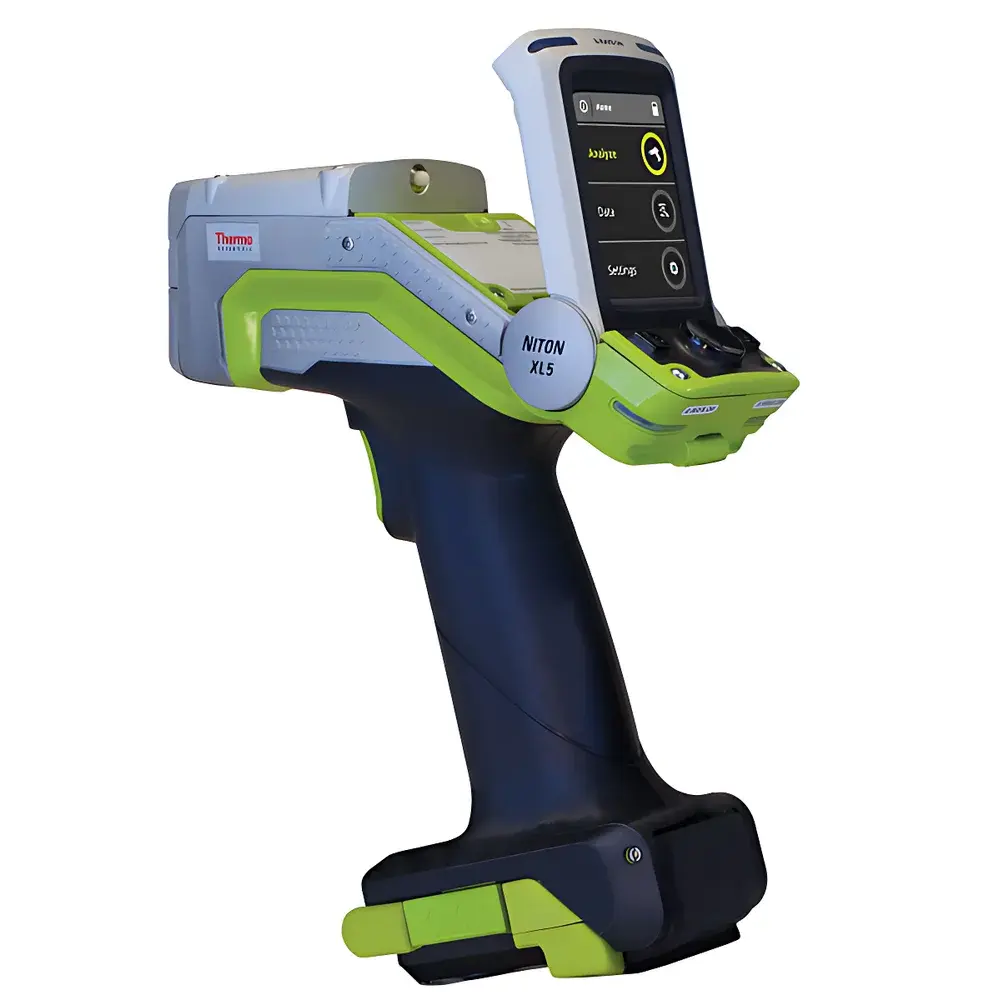
Thermo Scientific Niton XL5 Handheld Energy Dispersive X-Ray Fluorescence (EDXRF) Spectrometer
| Brand | Thermo Fisher Scientific |
|---|---|
| Origin | USA |
| Manufacturer | Thermo Fisher Scientific |
| Product Type | Imported Handheld EDXRF Analyzer |
| Model | Thermo Scientific Niton XL5 |
| Element Range | Mg (12) to U (92) |
| Detectable Elements | >30 common elements for alloy identification |
| Light Element Performance | Enhanced detection of low-Z elements (e.g., Mg, Al, Si, P, S) |
| Energy Resolution | 150–185 eV (FWHM, dependent on pulse processing time) |
| Weight | 1.3 kg (2.8 lbs) with battery |
| Dimensions | 242.6 × 208.2 × 67.9 mm (9.54 × 8.19 × 2.67 in) |
| X-ray Tube | Ag anode, 6–50 kV, up to 500 µA, max 5 W, dynamically adjustable current |
| Detector | Geometry-optimized large-area Silicon Drift Detector (GOLDD™), count rate up to 180,000 cps |
| Electronics | 800 MHz i.MX6 Quad-core ARM A9, 80 MHz ADC ASIC, 4096-channel MCA, 512 MB RAM / 4 GB industrial-grade flash storage |
| Display | Tilt-adjustable color touchscreen (glove-compatible) |
| Data Storage | >20,000 spectra (2 GB internal, ~100 kB/spectrum) |
| Connectivity | USB 2.0, Bluetooth 4.2, integrated GPS |
| Software | NitonConnect PC software, user-programmable menus, alloy mode with touch keyboard |
| Standard Accessories | Integrated CCD camera, rugged carrying case, dual Li-ion batteries, AC charger, USB cable, safety lanyard, calibration standards |
| Optional Accessories | 3-mm collimator, portable test stand, HotFoot thermal barrier, protective holster |
| Certifications | CE, RoHS, FCC, Industry Canada, IEC 61010-1:2010 |
Overview
The Thermo Scientific Niton XL5 is a handheld energy dispersive X-ray fluorescence (EDXRF) spectrometer engineered for rapid, non-destructive elemental analysis in demanding industrial environments. Based on fundamental XRF physics—where primary X-rays excite atoms in a sample, inducing characteristic secondary (fluorescent) X-ray emission—the XL5 quantifies elemental composition by measuring the energy and intensity of emitted photons. Its optimized Ag-anode X-ray tube (6–50 kV, dynamically adjustable current) and patented Geometry-Optimized Large-Area Silicon Drift Detector (GOLDD™) deliver high photon throughput (up to 180,000 counts per second) and superior spectral resolution (150–185 eV FWHM), enabling reliable detection across the periodic table from magnesium (Z = 12) to uranium (Z = 92). Designed specifically for alloy verification, scrap sorting, and in-service material identification, the XL5 operates without sample preparation and maintains analytical integrity under variable field conditions—including elevated temperatures, confined spaces, and outdoor exposure—making it integral to quality control, asset integrity programs, and regulatory compliance workflows.
Key Features
- Ultra-portable form factor: Weighing only 1.3 kg (2.8 lbs) with battery and measuring just 242.6 × 208.2 × 67.9 mm, the XL5 sets industry benchmarks for ergonomic handling and operator endurance during extended shift use.
- Glove-compatible capacitive touchscreen with intuitive icon-based navigation—designed for use with standard industrial PPE and harsh-environment operation.
- Tilt-adjustable high-brightness color display ensures readability in direct sunlight and low-light inspection scenarios.
- Integrated CCD camera captures geotagged visual documentation synchronized with each spectrum, supporting traceable, auditable reporting per ISO/IEC 17025 and ASTM E1621 requirements.
- Real-time elemental quantification with dynamic current optimization: The system automatically adjusts tube current per measurement to maximize signal-to-noise ratio for light elements (Mg, Al, Si, P, S) while preserving detector linearity for heavy metals.
- Onboard data management: Stores over 20,000 full-spectrum readings (2 GB flash memory), each embedded with GPS coordinates, timestamp, operator ID, and acquisition parameters.
Sample Compatibility & Compliance
The Niton XL5 analyzes solid metallic samples—including castings, forgings, welds, pipes, fasteners, and scrap fragments—without surface polishing or vacuum requirements. It supports both positive material identification (PMI) and grade verification against pre-loaded alloy libraries compliant with ASTM E572, ASTM E1508, and ISO 18115-2. The instrument meets IEC 61010-1:2010 for electrical safety, carries CE marking for EMC and LVD, and complies with RoHS, FCC Part 15, and Industry Canada RSS-102. For regulated industries, NitonConnect software supports 21 CFR Part 11-compliant audit trails, electronic signatures, and role-based user access control—facilitating GLP/GMP-aligned deployment in pharmaceutical manufacturing support, nuclear component verification, and aerospace supply chain QA.
Software & Data Management
NitonConnect desktop software enables post-acquisition spectral review, statistical batch reporting, custom report generation (PDF/CSV/XLSX), and firmware updates. All measurements include embedded metadata: GPS location, tilt angle, ambient temperature, tube settings, and detector live time. Data export supports integration with LIMS and ERP systems via standardized XML schema. The onboard operating system features configurable user profiles, password-protected security modes (including alloy-only restricted access), and customizable quick-access menus for recurring test protocols—reducing operator training burden and minimizing procedural deviation.
Applications
- Manufacturing QA/QC: Real-time validation of incoming raw materials and finished components against ASTM, SAE, UNS, and EN alloy specifications.
- Scrap metal recycling: High-throughput sorting of ferrous/non-ferrous streams, including stainless steel grades (e.g., 304 vs. 316), aluminum alloys (e.g., 6061 vs. 7075), and nickel-based superalloys.
- Oil & gas and power generation: In-field PMI of piping, valves, flanges, and pressure vessels per ASME B31.3 and API RP 578 requirements.
- Construction and infrastructure: Verification of rebar, structural steel, and architectural cladding to meet EN 10027 or ASTM A653 standards.
- Forensic metallurgy and failure analysis: Rapid compositional screening prior to lab-based SEM-EDS or OES confirmation.
FAQ
What regulatory standards does the Niton XL5 support for audit-ready reporting?
The instrument and NitonConnect software support 21 CFR Part 11 compliance, including electronic signatures, audit trails, and secure user authentication—enabling use in FDA-regulated environments and ISO 17025-accredited labs.
Can the XL5 detect light elements such as magnesium and aluminum in aluminum alloys?
Yes—the optimized GOLDD detector, low-noise electronics, and dynamic current control enable robust Mg and Al quantification at concentrations down to 0.01–0.05 wt%, critical for distinguishing 5xxx and 6xxx series aluminum grades.
Is GPS data embedded in exported reports?
Yes—each spectrum file contains geotagged metadata, and NitonConnect allows batch export of location-aware reports for spatial analytics and site-specific compliance documentation.
How is measurement reproducibility ensured across operators and shifts?
The XL5 employs factory-calibrated fundamental parameters algorithms, automatic drift correction, and built-in reference checks; routine verification using certified standards (e.g., NIST SRM 2581) ensures long-term stability meeting ASTM E2857 precision requirements.
What safety certifications apply to field use in hazardous locations?
While the XL5 itself is not intrinsically safe, its IEC 61010-1:2010 certification and optional HotFoot thermal barrier allow safe operation on hot surfaces up to 400 °C; regional hot-work permits and local regulatory approvals must be obtained separately per jurisdiction.
Related Products






