
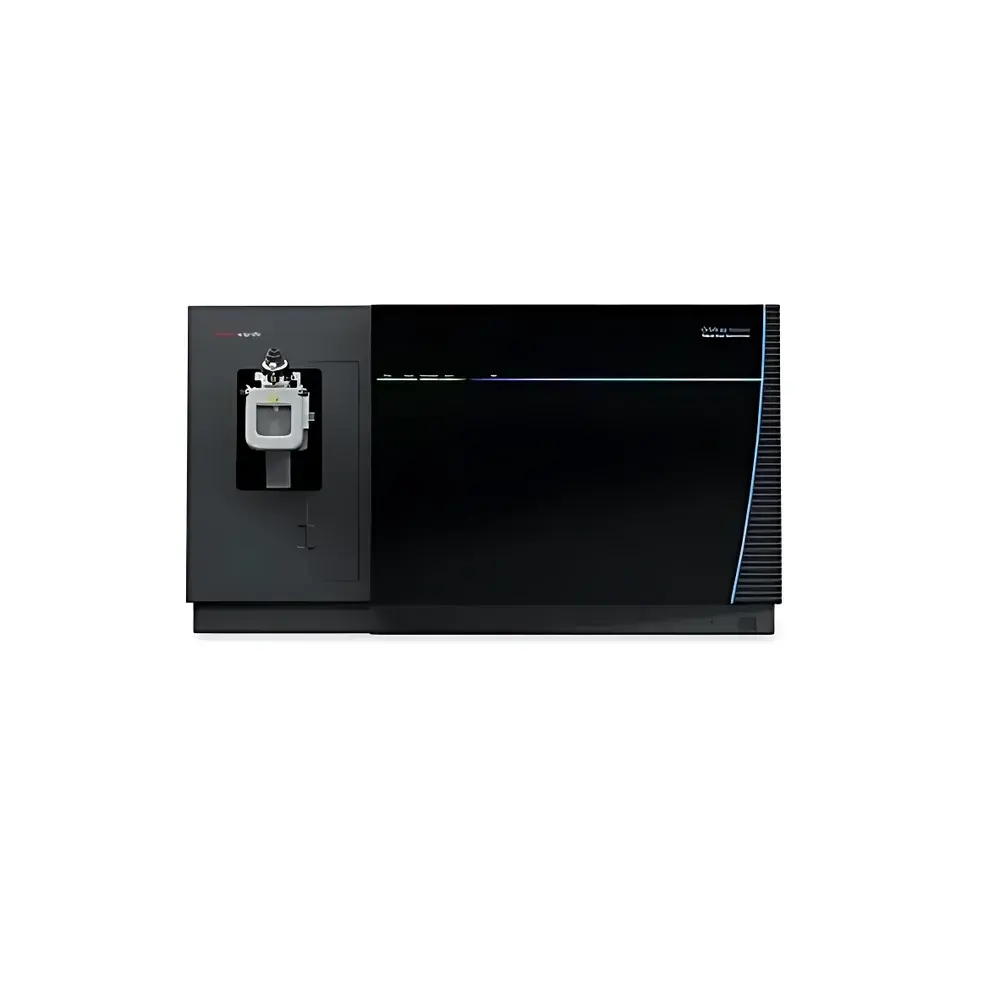
Thermo Scientific Orbitrap Ascend Tribrid Mass Spectrometer
| Brand | Thermo Fisher |
|---|---|
| Origin | USA |
| Manufacturer Type | Original Equipment Manufacturer (OEM) |
| Origin Category | Imported |
| Model | Thermo Scientific™ Orbitrap Ascend Tribrid Mass Spectrometer |
| Instrument Type | Orbitrap-based Tribrid MS |
| Application Scope | Universal |
| Mass Range | m/z 40–6000 (extendable to m/z 16,000 with optional high-mass configuration) |
| Resolution | 7,500–480,000 FWHM at m/z 200 |
| Mass Accuracy | <3 ppm RMS with external calibration |
| Optional Features | Dual IRM (Ion Routing Multipole), Auto-Ready Ion Source, Real-Time Library Search, AcquireX Data Acquisition Workflow, UVPD (Ultraviolet Photodissociation), PTCR (Protein Topography and Migration Analysis), Easy-ETD, EASY-IC (Internal Calibration), Preconfigured Application-Specific Method Templates |
Overview
The Thermo Scientific Orbitrap Ascend Tribrid Mass Spectrometer represents the third-generation Tribrid architecture, integrating a quadrupole mass filter, linear ion trap (LIT), and high-field Orbitrap mass analyzer in a single vacuum system. Engineered for precision and versatility, it operates on the principle of electrostatic trapping and Fourier-transform detection, delivering high-resolution, high-mass-accuracy spectra with robust MSn capability. Its hybrid design enables simultaneous or sequential use of multiple fragmentation techniques—including HCD, CID, ETD, UVPD, and PTCR—within a single acquisition cycle. This architecture supports both bottom-up and top-down proteomics, intact protein analysis, oligonucleotide characterization, lipidomics, metabolomics, and small-molecule structural elucidation. The instrument is designed for laboratories requiring reproducible, high-throughput qualitative and quantitative workflows under regulated and non-regulated environments.
Key Features
- Extended mass range up to m/z 16,000 (optional configuration), enabling confident analysis of large biomolecules including monoclonal antibodies, viral capsids, and multi-subunit complexes.
- Dual Ion Routing Multipole (IRM) system improves duty cycle efficiency and enhances peptide/protein identification rates by increasing precursor selection fidelity and scan speed without sacrificing sensitivity.
- Auto-Ready ion source automates source alignment, lens tuning, and mass calibration—reducing operator dependency and ensuring consistent performance across shifts and users.
- EASY-IC internal calibration delivers sub-1 ppm mass accuracy without external standards, supporting long-duration unattended runs and GLP-compliant data integrity requirements.
- AcquireX intelligent data acquisition dynamically adjusts isolation windows and fragmentation energy based on real-time spectral feedback, maximizing coverage for low-abundance analytes in complex matrices.
- UVPD and PTCR options provide orthogonal fragmentation pathways essential for characterizing post-translational modifications (PTMs), sequence variants, higher-order structure perturbations, and nucleic acid backbone cleavage patterns.
Sample Compatibility & Compliance
The Orbitrap Ascend Tribrid MS interfaces seamlessly with ultra-high-performance liquid chromatography (UHPLC), nanoLC, capillary electrophoresis (CE), and direct infusion platforms. It accommodates diverse sample types—from crude cell lysates and plasma digests to synthetic oligonucleotides and formulated biopharmaceuticals. The system complies with international regulatory frameworks including ISO/IEC 17025 for testing laboratories, ASTM E2687 for mass spectrometric data quality, and USP for analytical instrument qualification. Software audit trails, electronic signatures, and 21 CFR Part 11–compliant user access controls are fully supported via Thermo Scientific Chromeleon CDS and Compound Discoverer platforms. Routine operation meets GLP and GMP documentation standards when deployed with validated method templates and instrument qualification packages.
Software & Data Management
Control and data processing are managed through Thermo Scientific Tune and Xcalibur software, featuring preloaded, application-optimized methods for proteomics, metabolomics, and small-molecule screening. Real-time library searching integrates spectral matching against UniProt, NIST, and custom databases during acquisition—enabling immediate confidence assessment for peptide identifications and small-molecule annotations. Raw data files (.raw) are compatible with open-source tools (e.g., MaxQuant, Proteome Discoverer, Skyline, LipidSearch) and commercial platforms (e.g., SimGlycan, Byonic). All acquisitions support metadata tagging, version-controlled method storage, and automated report generation compliant with LIMS integration protocols.
Applications
- Single-cell proteomics and spatial omics: High sensitivity and dynamic range enable quantification of ≤1,000 proteins per cell with label-free or TMT-based workflows.
- Top-down and native MS: Intact mass measurement of proteins >100 kDa with sub-ppm accuracy; conformational stability assessment via hydrogen-deuterium exchange (HDX) coupling.
- Biopharmaceutical characterization: Comprehensive analysis of charge variants, glycoforms, oxidation, deamidation, and disulfide scrambling in mAbs and fusion proteins.
- Oligonucleotide therapeutics: Sequence confirmation, impurity profiling, and backbone modification mapping using UVPD and ETD fragmentation.
- Environmental and forensic toxicology: Non-targeted screening of emerging contaminants with accurate mass filtering and retrospective data mining capabilities.
FAQ
What is the maximum achievable resolution at m/z 200?
Resolution is user-selectable from 7,500 to 480,000 FWHM at m/z 200, depending on transient length, AGC target, and acquisition mode.
Does the system support internal calibration without external standards?
Yes—the optional EASY-IC module enables continuous internal mass calibration with sub-1 ppm accuracy over multi-hour acquisitions.
Can the Orbitrap Ascend perform real-time database searching during acquisition?
Yes—Real-Time Library Search executes spectral matching on-the-fly using MS2 and MS3 data for peptides and small molecules.
Is the instrument qualified for GxP environments?
Yes—when deployed with validated IQ/OQ/PQ protocols, 21 CFR Part 11–enabled software, and documented change control procedures.
How does dual IRM improve proteome depth?
Dual IRM increases precursor transmission efficiency and reduces co-isolation interference, resulting in higher-quality MS2 spectra and improved identification rates in complex samples.



