
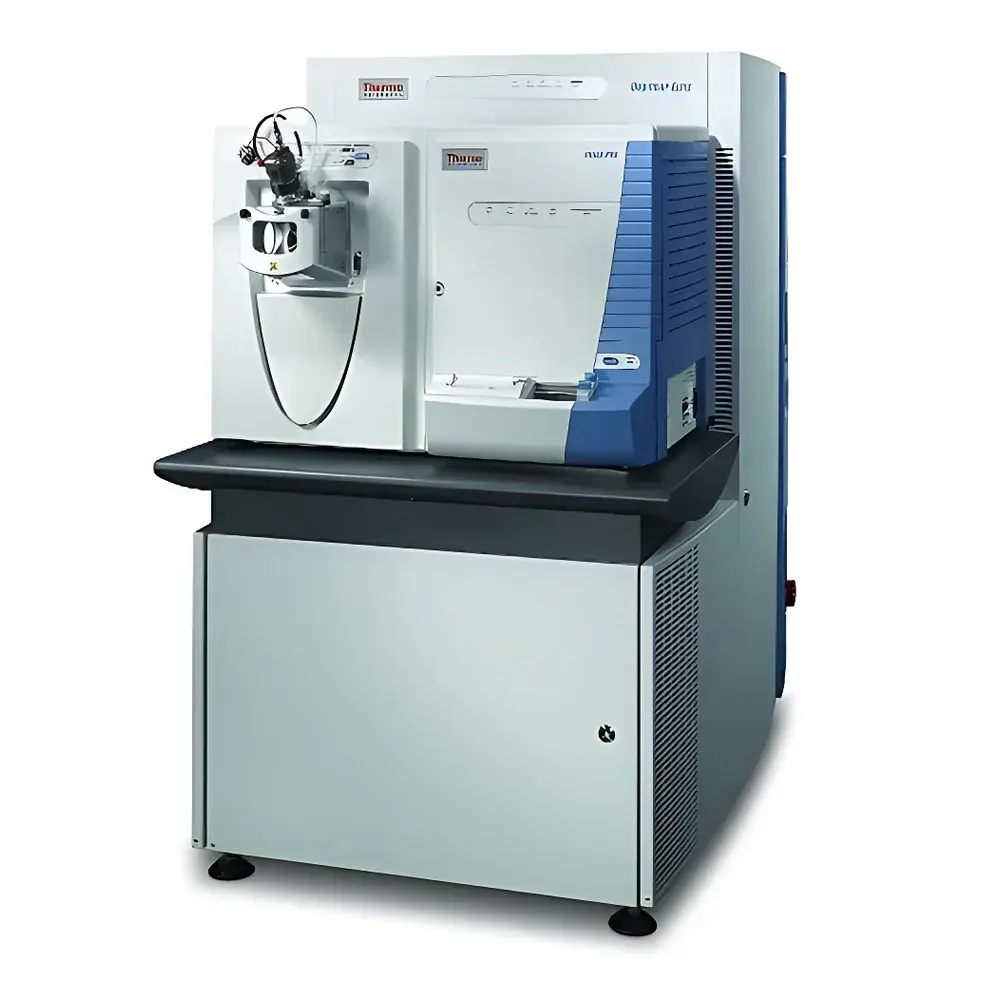
Thermo Scientific Orbitrap Elite™ Hybrid Ion Trap–Orbitrap Mass Spectrometer
| Brand | Thermo Fisher |
|---|---|
| Origin | Germany |
| Manufacturer | Thermo Fisher Scientific |
| Origin Category | Imported |
| Model | Orbitrap Elite™ |
| Instrument Type | Hybrid Orbitrap Mass Spectrometer |
| Mass Analyzer | High-Field Orbitrap + Dual-Pressure Linear Ion Trap (Velos Pro™) |
| Key Capabilities | High-Resolution Accurate-Mass (HRAM) Detection, MS/MS and MSⁿ with CID/ETD/HCD, Top-Down & Bottom-Up Proteomics, Untargeted Metabolomics, Lipidomics |
Overview
The Thermo Scientific Orbitrap Elite™ Hybrid Ion Trap–Orbitrap Mass Spectrometer is an advanced high-resolution accurate-mass (HRAM) platform engineered for comprehensive molecular characterization across proteomics, metabolomics, lipidomics, and structural biology applications. At its core lies a high-field Orbitrap mass analyzer—capable of resolving power exceeding 240,000 at m/z 200—combined with a dual-pressure linear ion trap (Velos Pro™) enabling rapid, sensitive MSn sequencing. The system operates on the principle of electrostatic ion trapping and Fourier-transform detection: ions are radially confined in a compact orbit around a central spindle electrode under ultra-high vacuum, and their image current signals are digitized and transformed into high-fidelity mass spectra. This architecture delivers sub-ppm mass accuracy, exceptional dynamic range, and robust reproducibility—critical for confident identification and quantification in complex biological matrices.
Key Features
- High-Field Orbitrap Analyzer: Delivers ultra-high resolution (>240,000 FWHM at m/z 200) and sub-3 ppm mass accuracy without internal calibration, enabling unambiguous distinction of isobaric species (e.g., lipid isomers, PTM variants).
- Velos Pro™ Dual-Pressure Linear Ion Trap: Features enhanced ion storage capacity, neutral-loss blocking front-end optics, and linear detection electronics—improving MS/MS duty cycle, quantitative precision, and compatibility with UHPLC gradients down to 5-min runtimes.
- Multi-Modal Fragmentation Suite: Seamless integration of collision-induced dissociation (CID), electron-transfer dissociation (ETD), and higher-energy collisional dissociation (HCD) within a single acquisition method—supporting complementary sequence coverage, labile PTM preservation, and rich structural fragmentation trees.
- Advanced Ion Optics & Signal Processing: Includes redesigned ion transfer optics for improved transmission efficiency into the Orbitrap cell, and a new mirror-image current preamplifier that reduces noise and extends signal fidelity across wide mass ranges.
- Top-Down & Middle-Down Readiness: Optimized for intact protein analysis up to ~50 kDa, delivering high-mass accuracy (<5 ppm RMS error) and extensive sequence coverage via ETD/HCD hybrid workflows—enabling confident mapping of mutations, truncations, and heterogeneous PTMs including glycosylation.
Sample Compatibility & Compliance
The Orbitrap Elite™ supports direct infusion, nanoLC, microLC, and UHPLC-coupled analyses across diverse sample types—including cell lysates, tissue digests, plasma fractions, biofluids, and plant extracts. Its robust vacuum architecture and low-noise electronics ensure stable performance under high-salt or high-lipid loading conditions common in bottom-up proteomics and untargeted metabolomics. The instrument complies with ISO/IEC 17025 requirements for analytical testing laboratories and supports audit-ready operation under GLP and GMP frameworks. Data acquisition and processing adhere to FDA 21 CFR Part 11 principles through optional secure user authentication, electronic signatures, and full audit-trail logging in Thermo Scientific™ Tune™ and QualBrowser™ software environments.
Software & Data Management
Controlled via Thermo Scientific™ Tune™ software (v3.0+), the system integrates seamlessly with Thermo Scientific™ Proteome Discoverer™ (v2.5+) for proteomics and Compound Discoverer™ (v3.3+) for small-molecule workflows. All raw data files (.raw) are natively compatible with open-source platforms including MaxQuant, Skyline, XCMS, and MZmine. The instrument supports vendor-neutral metadata export (mzML format) and enables automated recalibration, retention time alignment, and batch normalization—essential for large-scale comparative studies. Raw data integrity is preserved via checksum validation and time-stamped acquisition logs; processed results include full traceability from chromatogram to spectral annotation to quantification table.
Applications
- Deep Proteome Profiling: Achieves >10,000 peptide identifications per LC-MS/MS run in HeLa digest; enables TMT-16plex quantification with CVs <12% across technical replicates.
- PTM Mapping: Resolves phosphorylation, acetylation, ubiquitination, and O-GlcNAcylation with site-localization confidence (Ascore ≥20) using ETD-HCD decision tree workflows.
- Lipid Isomer Differentiation: Distinguishes sn-position and double-bond location in phospholipids and glycerolipids via HCD-MS² and ozone-induced dissociation (OzID) coupling.
- Untargeted Metabolite Identification: Generates diagnostic fragment ions and retention index-aligned features for library matching against HMDB, METLIN, and LIPID MAPS databases.
- Intact Protein Characterization: Measures deconvoluted masses of monoclonal antibodies (mAbs) and fusion proteins with ≤10 ppm error and detects clipped variants at ≤0.5% relative abundance.
FAQ
What distinguishes the Orbitrap Elite™ from earlier Orbitrap systems like the LTQ Orbitrap XL?
The Orbitrap Elite™ introduces a high-field Orbitrap analyzer, Velos Pro™ ion trap electronics, and redesigned ion optics—delivering 2× higher resolution, 3× faster scan speeds, and significantly improved sensitivity for low-abundance analytes.
Is the system compatible with label-free and isobaric tagging quantification strategies?
Yes—it supports both label-free quantification (LFQ) and multiplexed isobaric tagging (TMT, iTRAQ) with optimized duty cycles for reporter ion detection and reduced ratio compression artifacts.
Can it perform real-time, data-dependent MS³ for phosphopeptide enrichment workflows?
Yes—its dual-pressure ion trap enables synchronous precursor selection (SPS) MS³, improving specificity and quantitative accuracy in TiO₂- or IMAC-enriched samples.
Does the instrument support method transfer from legacy Thermo platforms?
All acquisition methods, calibration files, and processing templates are backward-compatible with Thermo Scientific™ Xcalibur™ v2.2+ and forward-compatible with newer Orbitrap platforms via standardized .raw file architecture.
What maintenance protocols are required to sustain long-term mass accuracy?
Daily lock-mass correction using ambient air ions or internal calibrant (e.g., polysiloxane) is recommended; full system calibration is performed semi-annually per Thermo’s Preventive Maintenance Guide (P/N 08 011 100).




