
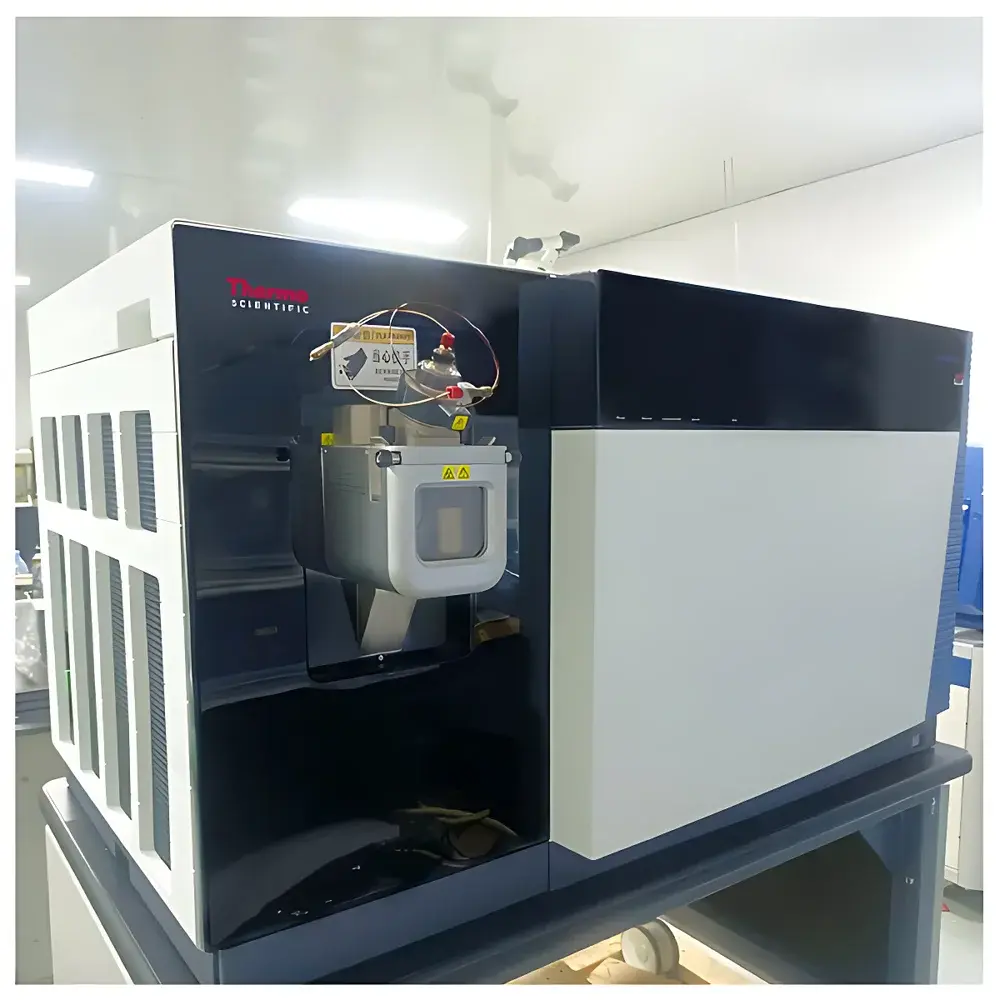
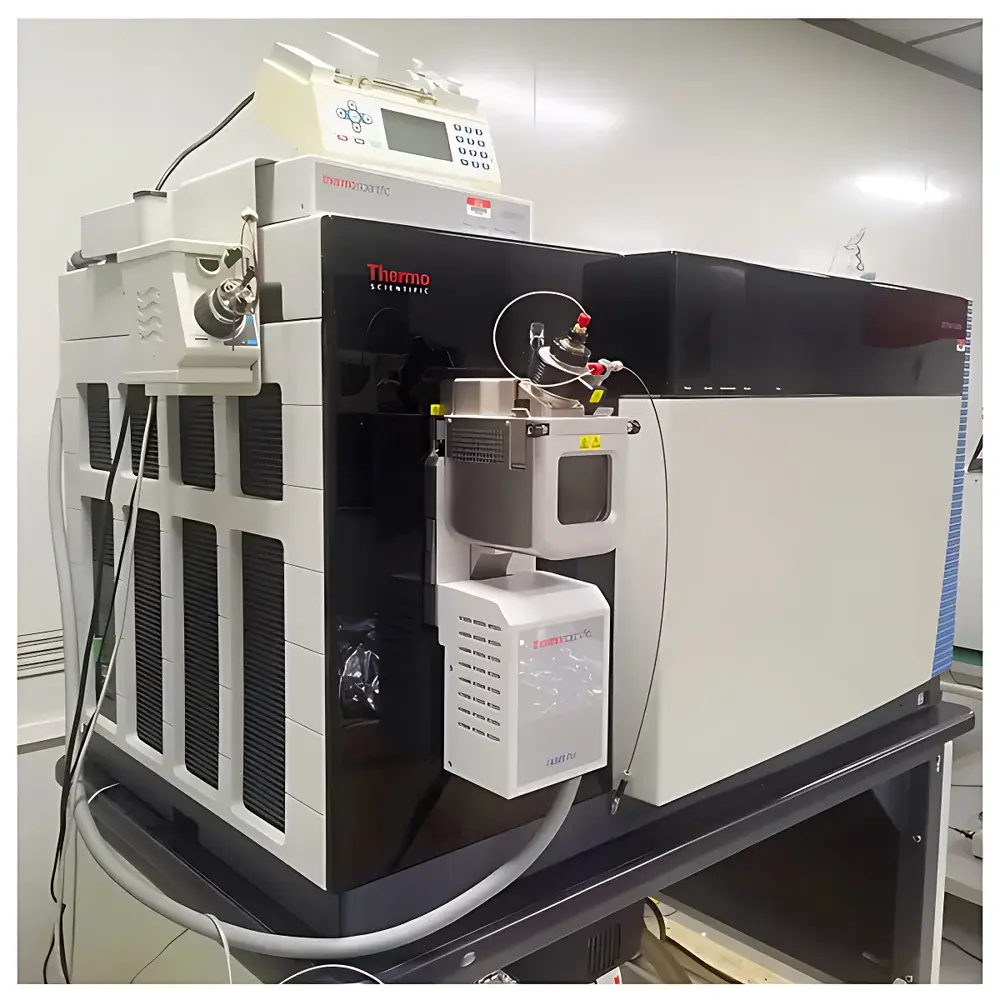
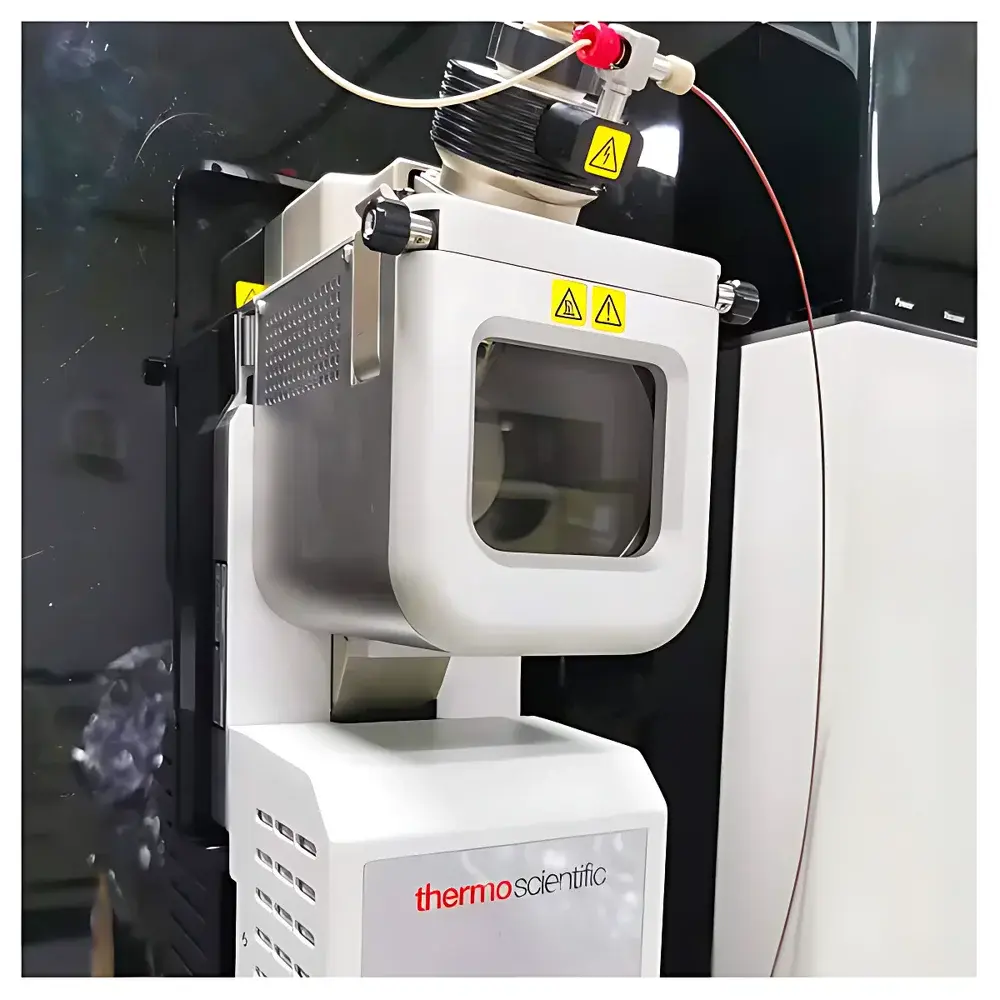
Thermo Scientific Orbitrap Fusion Lumos Tribrid Mass Spectrometer
| Brand | Thermo Fisher |
|---|---|
| Origin | USA |
| Instrument Type | Orbitrap Tribrid |
| Model | Fusion Lumos |
| Resolution | 30,000 (at m/z 200, MS1) |
| Mass Accuracy | ≤10 ppm (internal calibration) |
| Sensitivity | 10.1 (fmol-level S/N for standard peptides) |
| Stability | ≤10 ppm RMS mass drift over 24 h |
| Acquisition Rate | 50 Hz (MS/MS in parallel mode) |
| Mass Range | m/z 50–6,000 |
Overview
The Thermo Scientific Orbitrap Fusion Lumos Tribrid Mass Spectrometer is a high-performance, triple-stage hybrid mass spectrometry platform engineered for demanding structural proteomics, intact protein characterization, low-abundance post-translational modification (PTM) analysis, and comprehensive small-molecule MSn. It integrates three complementary mass analyzers—quadrupole mass filter, linear ion trap (LIT), and Orbitrap mass analyzer—within a single vacuum architecture to enable true parallelization of MS and MSn operations. The system operates on the principle of electrostatic trapping and Fourier-transform detection in the Orbitrap cell, delivering high-resolution, accurate-mass (HRAM) spectra with exceptional mass fidelity and dynamic range. Its tribrid architecture supports simultaneous precursor selection, fragmentation, and detection across multiple analyzers, significantly increasing duty cycle efficiency and spectral acquisition throughput—critical for deep proteome coverage, quantitative multiplexing (e.g., TMT, iTRAQ), and complex biotherapeutic characterization.
Key Features
- Tribrid Architecture: Combines quadrupole precursor selection, LIT for rapid MSn and ETD/HCD/CID fragmentation, and Orbitrap for high-resolution, accurate-mass detection—enabling full parallelization of acquisition cycles.
- Ultra-High Resolution: Up to 500,000 FWHM (m/z 200) in Orbitrap mode; isotopic resolution up to 240,000 FWHM (m/z 200); optional 1M resolution upgrade (1,000,000 FWHM) for isobaric compound differentiation.
- Advanced Ion Optics: High-capacity transfer tube, segmented quadrupole with improved transmission efficiency, and active beam shaping components minimize neutral contamination and enhance ion flux across broad m/z ranges (50–6,000).
- Enhanced Fragmentation Flexibility: Supports CID, HCD, ETD, EthcD, and UV Photodissociation (UVPD, 213 nm)—with ETD HD enabling broader fragment ion coverage for highly charged species including intact proteins and glycans.
- Intelligent Data Acquisition: Advanced Peak Detection (APD) algorithm improves precursor selection confidence in data-dependent acquisition (DDA); Smart ADAPT™ dynamically allocates scan time across parallel detectors to maximize sequence coverage and quantification accuracy.
- High-Throughput Quantitation: Synchronous Precursor Selection (SPS)-MS3 enables multiplexed TMT quantification with reduced ratio compression and improved precision across ≥16-plex experiments.
Sample Compatibility & Compliance
The Orbitrap Fusion Lumos is compatible with nanoflow and microflow LC systems, direct infusion, MALDI sources (via optional interface), and integrated coupling to IC, CE, and 2D-LC platforms. It supports native MS workflows for intact protein and complex assembly analysis under non-denaturing conditions. From a regulatory perspective, the instrument complies with key analytical validation frameworks: it supports audit-trail-enabled operation per FDA 21 CFR Part 11 when used with Thermo Scientific Chromeleon CDS or Compound Discoverer software; method parameters and raw data are fully traceable under GLP/GMP environments. Instrument performance meets ASTM E2987 (mass accuracy), ISO/IEC 17025 (method validation), and USP <621> (chromatographic system suitability) requirements when configured with appropriate calibration standards and QC protocols.
Software & Data Management
Data acquisition and processing are managed through Thermo Scientific Xcalibur 4.5+ and Compound Discoverer 3.3+, both supporting vendor-neutral export (mzML, mzXML) and integration with open-source tools (e.g., MaxQuant, FragPipe, Skyline). The system supports automated internal calibration using Easy-IC for sub-ppm mass accuracy without external lock mass. All acquisition methods, calibration files, and audit logs are stored in a secure, timestamped database with role-based access control. Raw data integrity is preserved via SHA-256 checksum generation upon acquisition, ensuring compliance with electronic record retention policies. Batch processing workflows—including DDA/DIA search, PTM localization, spectral library matching, and label-free or isobaric quantification—are scriptable and reproducible across instrument platforms.
Applications
- Deep Proteomics: Identification and quantification of >10,000 proteins per run from mammalian cell lysates; robust detection of low-stoichiometry PTMs (phosphorylation, ubiquitination, acetylation) at sub-fmol sensitivity.
- Top-Down & Intact Protein Analysis: Characterization of monoclonal antibodies, ADCs, and fusion proteins with mass accuracy <5 ppm and charge-state deconvolution up to 100+ kDa.
- Metabolomics & Lipidomics: Structural elucidation of isomeric lipids and metabolites via UVPD and ETD-enabled MS2/MS3, supported by retention-time-aligned spectral libraries.
- Biopharma QC: Peptide mapping, deamidation/oxidation monitoring, glycan profiling, and host-cell protein identification aligned with ICH Q5E and Q5B guidelines.
- Clinical & Forensic Toxicology: Targeted and untargeted screening of drugs-of-abuse, biomarkers, and novel psychoactive substances with HRAM confirmation and retrospective data mining capability.
FAQ
What distinguishes the Fusion Lumos from the Q Exactive HF-X?
The Fusion Lumos is a tribrid platform with LIT + Orbitrap + quadrupole, enabling true parallel MS/MS and advanced fragmentation (ETD, UVPD); the Q Exactive HF-X is a quadrupole-Orbitrap system optimized for speed and sensitivity in bottom-up proteomics but lacks LIT-based MSn and ETD/UVPD capabilities.
Is UVPD available as a field-upgradeable option?
Yes—UVPD requires installation of the 213 nm laser module and associated optics, and is only available on Fusion Lumos systems equipped with the 1M resolution upgrade and ETD HD hardware.
Does the system support real-time data-independent acquisition (DIA)?
Yes—supported via Thermo Scientific AcquireX workflow and compatible with Spectronaut and Skyline for spectral library generation and targeted extraction.
Can the Fusion Lumos be operated in regulated GxP environments?
Yes—when deployed with validated software (Chromeleon CDS v7.3+), electronic signatures, audit trails, and 21 CFR Part 11-compliant user management, it meets GMP/GLP data integrity requirements.
What is the typical mass accuracy under routine LC-MS/MS operation?
With internal calibration and standard peptide mixtures, mass accuracy remains ≤3 ppm RMS for MS1 and ≤5 ppm for MS2 scans over 24-hour continuous operation.






