
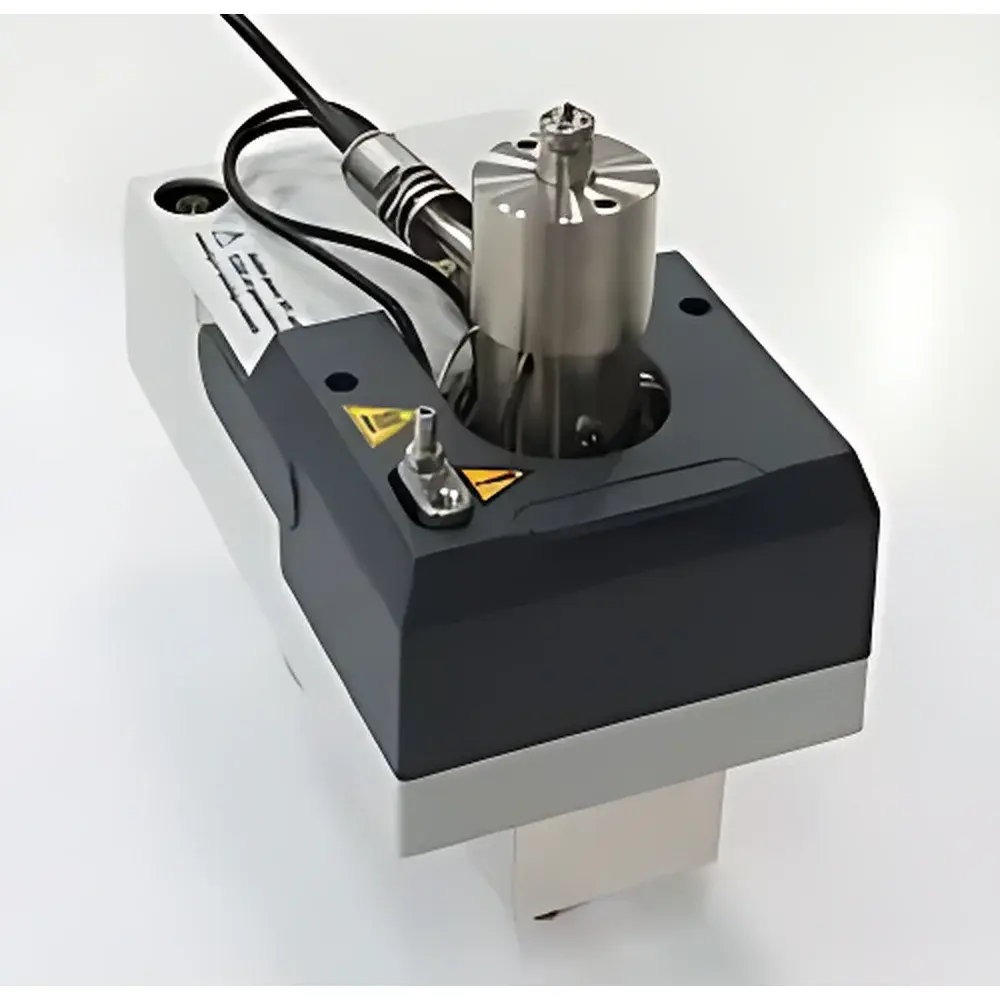
Thermo Scientific PDD Instant Connect Pulse Discharge Detector for Gas Chromatography
| Brand | Thermo Fisher |
|---|---|
| Origin | Italy |
| Manufacturer Type | Original Equipment Manufacturer (OEM) |
| Product Category | Imported Instrument |
| Model | PDD Detector |
| Instrument Type | Universal Selective Detector for GC |
| Operating Temperature Range | Up to 400 °C |
| Linear Dynamic Range | 10⁵ |
| Method Detection Limit (MDL) | Low-picogram level |
Overview
The Thermo Scientific PDD Instant Connect Pulse Discharge Detector is a high-performance, modular chromatographic detector engineered for gas chromatography (GC) and GC–mass spectrometry (GC–MS) systems. Based on pulsed discharge helium ionization detection (PDHID) principles, the PDD operates by generating a stable, low-power plasma in high-purity helium carrier gas—enabling universal, non-destructive detection of virtually all organic and inorganic compounds except helium and hydrogen. Its core innovation lies in the patented Instant Connect mechanical and electrical interface, which eliminates the need for manual wiring, gas line reconfiguration, or software recalibration during detector swaps. This architecture supports true hot-swap capability under ambient conditions, allowing full detector replacement—including thermal equilibration—in under two minutes without system venting or column baking.
Key Features
- Instant Connect Interface: Tool-free, alignment-free mechanical coupling with integrated pneumatic, electrical, and thermal connections—validated for >500 repeated insertions with sub-micron repeatability.
- Pulsed Discharge Detection Technology: Stable microplasma generation at up to 400 °C operating temperature; optimized for trace-level analysis across volatile and semi-volatile compounds.
- Linear Dynamic Range of 10⁵: Maintains quantitative accuracy from low-picogram to microgram injection levels without range switching or signal attenuation.
- Modular Scalability: Designed to integrate seamlessly into Thermo Scientific Trace 1300/1600 GC platforms, supporting dual- or triple-detector configurations (e.g., PDD + FID + TCD) via shared oven and electronics bus.
- Reduced Downtime Architecture: Field-replaceable detector cartridges allow preventive maintenance without GC oven cooldown; dirty modules are swapped while the system remains operational in standby mode.
Sample Compatibility & Compliance
The PDD detector delivers consistent response factors for permanent gases (O₂, N₂, CO, CH₄), hydrocarbons (C₁–C₁₂), halogenated compounds, sulfur species (H₂S, COS, mercaptans), and nitrogen-containing analytes (NH₃, NOₓ). It complies with ASTM D6667 (sulfur in light hydrocarbons), ISO 8573-5 (compressed air purity), and USP residual solvents testing protocols. All firmware and hardware design adhere to IEC 61000-6-3 (EMC emissions) and IEC 61010-1 (safety for laboratory equipment). Audit trails, user access control, and electronic signature support align with FDA 21 CFR Part 11 requirements when operated within Thermo Scientific Chromeleon CDS v7.3 or later.
Software & Data Management
Fully embedded in Thermo Scientific Chromeleon Chromatography Data System (CDS), the PDD detector is auto-recognized upon insertion and requires zero manual configuration. Chromeleon’s method editor includes dedicated PDD parameters: pulse frequency (1–20 Hz), discharge voltage (100–1000 V), and helium flow optimization presets. Real-time baseline noise monitoring, automatic gain adjustment, and peak area reproducibility tracking (<1.5% RSD over 24 h) are logged with timestamped metadata. Raw signal data (32-bit resolution, 100 Hz sampling) is stored in open-format .CDF files compatible with third-party chemometric tools (e.g., MATLAB, Python pandas).
Applications
- Environmental Analysis: Quantification of VOCs and SVOCs in ambient air, soil headspace, and water purge-and-trap extracts per EPA Method 8021B and TO-17.
- Petrochemical QA/QC: Sulfur speciation in gasoline and diesel fuel per ASTM D5453 and D7039; permanent gas profiling in refinery streams.
- Pharmaceutical Residual Solvents: Detection of Class 1–3 solvents in APIs and excipients per ICH Q3C guidelines.
- High-Purity Gas Certification: Trace impurity profiling in semiconductor-grade N₂, Ar, and He per SEMI F63 standards.
- Food & Flavor Volatiles: Sensitive detection of off-flavor compounds (e.g., geosmin, 2-methylisoborneol) without derivatization.
FAQ
Does the PDD require helium purification or additional gas filters?
Yes—high-purity helium (99.999%+, moisture <0.1 ppm, hydrocarbons <0.1 ppm) is mandatory; an in-line oxygen/moisture trap (e.g., Thermo Scientific PurgeGas™) is recommended upstream of the detector.
Can the PDD be used with hydrogen or nitrogen carrier gas?
No—the detector relies on helium-specific plasma generation; alternative carriers disrupt discharge stability and compromise sensitivity and linear range.
Is the Instant Connect interface compatible with legacy Trace GC instruments?
Only Trace 1300 Series (2014 onward) and Trace 1600 Series (2018 onward) support full electrical and thermal handshake; earlier models require retrofit kits (P/N: INST-CONV-KIT-TR1300).
How often should the discharge electrode be cleaned or replaced?
Under typical use (≤100 injections/day), electrode cleaning is required every 3–6 months; replacement is recommended after 2 years or following exposure to silicone-based contaminants.
Does Chromeleon CDS provide automated calibration verification for the PDD?
Yes—Chromeleon’s Calibration Verification module supports scheduled injection of certified standard mixtures (e.g., EPA TO-14A) with pass/fail criteria based on area precision, retention time shift, and MDL confirmation per GLP audit requirements.




