
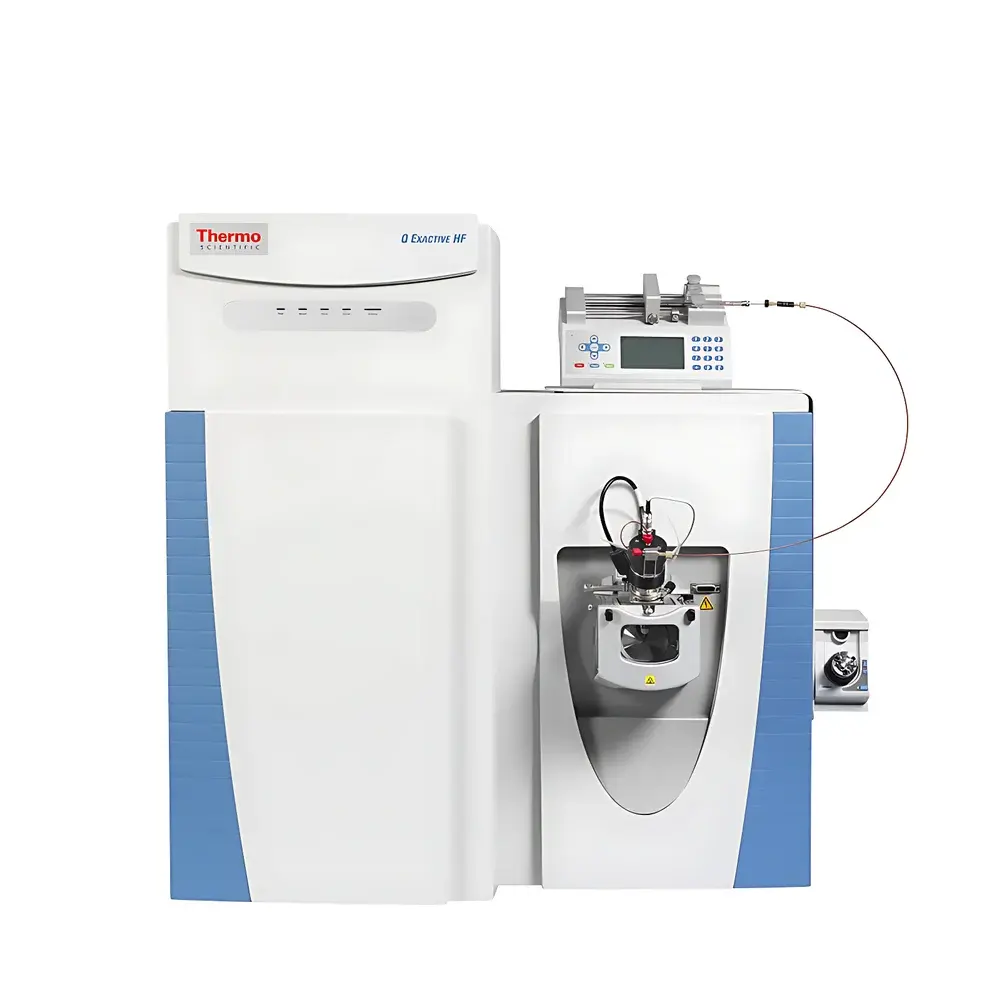
Thermo Scientific Q Exactive HF Hybrid Quadrupole-Orbitrap LC-MS System
| Brand | Thermo Fisher |
|---|---|
| Origin | USA |
| Manufacturer Type | Original Equipment Manufacturer (OEM) |
| Import Status | Imported |
| Model | Q Exactive HF LC-MS System |
| Instrument Type | Orbitrap-based Hybrid Quadrupole-Orbitrap Mass Spectrometer |
| Scan Speed | Up to 12 Hz MS/MS in 1 s |
| Resolution (at m/z 200) | 240,000 FWHM (standard mode), up to 500,000 FWHM (enhanced mode) |
| Mass Accuracy | < 1 ppm RMS (internal calibration), < 3 ppm RMS (external calibration) |
| Mass Range | m/z 50–6,000 |
Overview
The Thermo Scientific Q Exactive HF Hybrid Quadrupole-Orbitrap LC-MS System is a high-performance benchtop mass spectrometer engineered for comprehensive qualitative and quantitative analysis of complex biological and chemical samples. It integrates a high-transmission quadrupole mass filter with an ultra-high-field Orbitrap mass analyzer—operating at 15 Tesla—to deliver simultaneous high resolution, high mass accuracy, and rapid scanning capabilities. The system employs electrostatic orbitrap detection based on image current measurement, enabling Fourier-transform-based mass analysis with exceptional reproducibility and dynamic range. Designed for routine use in regulated and discovery-oriented laboratories, the Q Exactive HF supports robust, high-throughput workflows across proteomics, metabolomics, pharmaceutical development, environmental analysis, and forensic toxicology.
Key Features
- Ultra-high-field Orbitrap analyzer (15 T) delivering up to 500,000 resolving power (FWHM at m/z 200) in enhanced mode, ensuring unambiguous peak separation in crowded spectra.
- Advanced quadrupole design with improved ion transmission efficiency and enhanced precursor selection specificity, reducing chemical noise and improving signal-to-noise ratios.
- Up to 12 Hz MS/MS scan rate—50% faster than its predecessor—enabling deep coverage in data-dependent acquisition (DDA) and data-independent acquisition (DIA) modes without sacrificing resolution or sensitivity.
- Real-time recalibration using lock-mass correction during acquisition ensures long-term mass stability (< 1 ppm RMS internal calibration) across multi-hour runs.
- Integrated HCD (Higher-Energy Collisional Dissociation) cell with adjustable collision energy and dual-pressure gas configuration for optimized fragmentation across diverse analyte classes.
- Rugged, compact benchtop architecture with integrated vacuum system and thermally stabilized optics for minimal maintenance and operational continuity in shared core facilities.
Sample Compatibility & Compliance
The Q Exactive HF accommodates a broad range of sample types—from intact proteins and post-translationally modified peptides to polar small molecules, lipids, and synthetic compounds—when coupled with standard reversed-phase, HILIC, or ion-pairing LC configurations. It is compatible with nano-, micro-, and analytical flow LC systems, including Thermo Scientific Vanquish UHPLC platforms. From a regulatory standpoint, the system supports 21 CFR Part 11-compliant operation when deployed with Thermo Scientific Chromeleon Chromatography Data System (CDS) v7.3 or later, including full audit trail, electronic signatures, and role-based access control. Method validation documentation aligns with ICH Q2(R2), USP <1225>, and ISO/IEC 17025 requirements for accredited testing laboratories.
Software & Data Management
Data acquisition, processing, and reporting are managed via Thermo Scientific Compound Discoverer, Proteome Discoverer, and TraceFinder software suites—each validated for specific application domains. All software packages support vendor-neutral data export (mzML, mzXML) and integration with third-party platforms such as Skyline, MaxQuant, and XCMS Online. Raw data files include embedded metadata compliant with PSI-MZML standards. Instrument control firmware includes built-in method validation checkpoints, automated calibration verification logs, and GLP/GMP-ready reporting templates. Remote monitoring and diagnostic capabilities are accessible through Thermo Fisher Connect cloud infrastructure, enabling secure, auditable instrument status tracking and predictive maintenance alerts.
Applications
- Top-down and bottom-up proteomics: identification and quantification of low-abundance phosphopeptides, glycopeptides, and cross-linked peptides with sub-ppm mass error.
- Small-molecule screening: structural elucidation of unknown metabolites and impurities using accurate-mass MSn and retention time-aligned spectral libraries.
- Biopharmaceutical characterization: intact mass analysis of monoclonal antibodies, charge variant profiling, and forced degradation product identification.
- Environmental residue analysis: multi-residue quantitation of pesticides and pharmaceuticals in water, soil, and food matrices at sub-ng/L levels.
- Clinical research: biomarker discovery and verification in plasma, CSF, and tissue extracts under CLIA- and CAP-aligned protocols.
FAQ
What distinguishes the Q Exactive HF from the Q Exactive Plus?
The Q Exactive HF incorporates an upgraded 15 Tesla Orbitrap analyzer, increased scan speed (up to 12 Hz MS/MS), and enhanced quadrupole transmission—resulting in higher sensitivity, deeper proteome coverage, and improved duty cycle in DIA workflows.
Is the system compatible with non-Thermo LC platforms?
Yes—via standard ESI or APCI interfaces with analog/digital trigger synchronization; however, optimal performance and seamless method transfer are achieved with Vanquish or UltiMate 3000 UHPLC systems.
Does it support real-time data processing during acquisition?
While full spectral deconvolution occurs post-run, real-time base peak chromatogram (BPC) generation, lock-mass correction, and QC metric monitoring (e.g., intensity drift, mass deviation) are supported during acquisition.
Can it be operated in a GxP-regulated environment?
Yes—when configured with Chromeleon CDS v7.3+, validated IQ/OQ/PQ protocols, and appropriate SOPs, the system meets FDA, EMA, and PMDA expectations for regulated bioanalysis.
What maintenance intervals are recommended for routine operation?
Ion source cleaning every 2–4 weeks (depending on sample load), Orbitrap vacuum inspection annually, and full system calibration quarterly—per Thermo Scientific Maintenance Guide Rev. 4.2.
Related Products





