
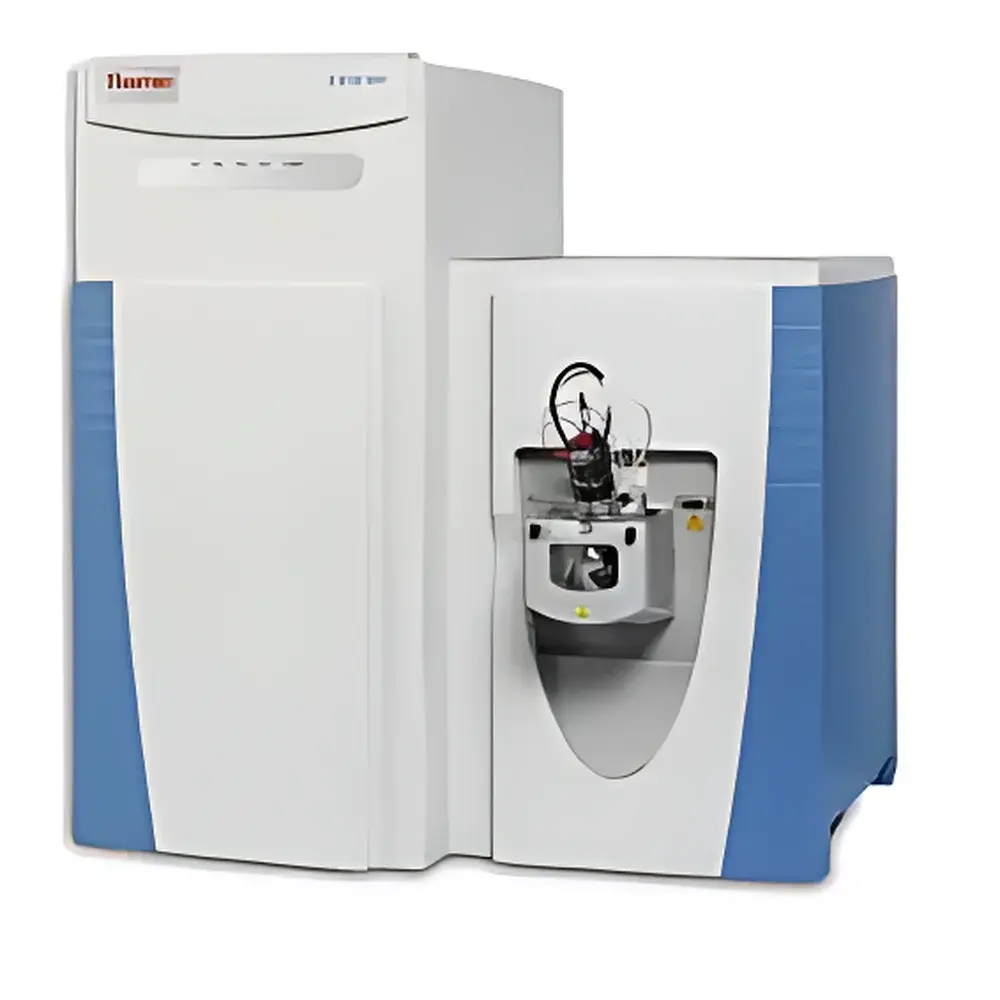
Thermo Scientific Q Exactive Plus LC-MS System
| Brand | Thermo Fisher |
|---|---|
| Origin | USA |
| Manufacturer Type | Original Equipment Manufacturer (OEM) |
| Origin Category | Imported |
| Model | Q Exactive Plus LCMS |
| Instrument Type | Hybrid Quadrupole-Orbitrap Mass Spectrometer |
| Pricing Range | USD 650,000 – 980,000 (FOB USA) |
Overview
The Thermo Scientific Q Exactive Plus LC-MS System is a high-performance hybrid quadrupole-Orbitrap mass spectrometer engineered for demanding quantitative and qualitative analysis in life science research, biopharmaceutical development, and regulatory-compliant laboratories. It operates on the principle of high-resolution accurate-mass (HRAM) measurement, combining a robust RF-only quadrupole for precursor ion selection with an Orbitrap mass analyzer capable of resolving power up to 140,000 (at m/z 200) and mass accuracy < 3 ppm (internal calibration) or < 5 ppm (external calibration). Its architecture supports both data-dependent acquisition (DDA) and targeted workflows—including Parallel Reaction Monitoring (PRM), High-Resolution/Accurate-Mass Selected Ion Monitoring (HR/AM-SIM), and Data-Independent Acquisition (DIA)—enabling seamless integration into discovery, verification, and quantification pipelines across proteomics, metabolomics, lipidomics, and small-molecule bioanalysis.
Key Features
- Advanced Quadrupole Technology (AQT): Enhances precursor ion transmission efficiency and selectivity, particularly critical for low-abundance analytes in complex biological matrices such as plasma, tissue lysates, or cell culture supernatants.
- Active Beam Guide (ABG): A patented ion optics module that improves ion transmission stability while reducing chemical noise and minimizing routine maintenance intervals—contributing to higher instrument uptime and analytical reproducibility.
- Quanfirmation Workflow Integration: Combines quantitative precision with structural confirmation in a single run, supporting regulatory-grade reporting for DMPK studies, biomarker validation, and lot-release testing of biologics.
- Full-Scan HRAM Capability: Delivers simultaneous identification and quantification without sacrificing resolution or sensitivity, enabling retrospective data mining from stored raw files.
- Optional Full-Scan Protein Mode: Optimized for intact protein analysis, supporting charge-state deconvolution and isotopic resolution of species up to 50 kDa—ideal for mAb characterization, subunit analysis, and higher-order structure assessment.
- Enhanced Resolution Option: Increases resolving power beyond standard settings, improving confidence in top-down proteomics and lipid isomer differentiation where mass defects and co-eluting species demand maximal spectral separation.
Sample Compatibility & Compliance
The Q Exactive Plus LC-MS System interfaces seamlessly with Thermo Scientific Vanquish UHPLC systems and third-party HPLC platforms via standard ESI or APCI sources. It accommodates diverse sample types—including peptides, post-translationally modified proteins, glycans, lipids, endogenous metabolites, and synthetic small molecules—across concentration ranges spanning femtomole to picomole levels on-column. The system complies with Good Laboratory Practice (GLP) and Good Manufacturing Practice (GMP) requirements when operated with Thermo Scientific Chromeleon Chromatography Data System (CDS) v7.3 or later, which supports 21 CFR Part 11–compliant audit trails, electronic signatures, and secure user access controls. Method validation protocols align with ICH Q2(R2), ASTM E260, and ISO/IEC 17025 frameworks for analytical instrument qualification.
Software & Data Management
Data acquisition and processing are managed through Thermo Scientific Compound Discoverer, Proteome Discoverer, and TraceFinder software suites—each validated for specific application domains. Compound Discoverer enables untargeted metabolite identification with retention time alignment, isotopic pattern matching, and in silico fragmentation prediction. Proteome Discoverer supports customizable node-based workflows for peptide identification, PTM localization, label-free or TMT/iTRAQ quantitation, and cross-linking analysis. All software modules generate FAIR-compliant (Findable, Accessible, Interoperable, Reusable) metadata and export results in mzML, mzXML, and vendor-neutral formats compatible with open-source tools like OpenMS and Skyline. Raw data files are encrypted at rest and support automated backup to network-attached storage (NAS) or cloud repositories with configurable retention policies.
Applications
- Biopharmaceutical Characterization: Intact mass analysis, subunit mapping, glycosylation profiling, and forced degradation product identification for monoclonal antibodies and fusion proteins.
- Quantitative Proteomics: Label-free, SILAC, or isobaric tag-based workflows for differential expression analysis in disease models, drug response studies, or CRISPR-edited cell lines.
- DMPK & Toxicology: High-sensitivity quantification of drugs and metabolites in biological fluids using PRM, with LODs routinely below 1 pg/mL under optimized conditions.
- Lipidomics & Metabolomics: Structural elucidation of oxidized phospholipids, ceramide isoforms, and polar metabolites leveraging HRAM-driven formula annotation and MSn spectral libraries.
- Clinical Biomarker Discovery: Reproducible detection of low-abundance serum peptides and extracellular vesicle cargo proteins across multi-center cohorts using standardized DIA methods.
FAQ
What distinguishes the Q Exactive Plus from earlier Q Exactive models?
The Q Exactive Plus introduces improved quadrupole transmission efficiency, enhanced ABG ion optics, and expanded dynamic range for intact protein analysis—particularly beneficial for biopharma applications requiring high-confidence top-down characterization.
Is the system compatible with non-Thermo LC platforms?
Yes; it supports standard API interfaces including analog voltage output, digital trigger signals, and RS-232/USB communication for synchronization with Agilent, Waters, and Shimadzu UHPLC systems.
Can the system meet FDA 21 CFR Part 11 requirements?
When deployed with Chromeleon CDS v7.3+ and configured per Thermo’s IQ/OQ documentation, the system satisfies electronic record and signature requirements for regulated environments.
What maintenance intervals are recommended for optimal performance?
Routine source cleaning is advised every 2–4 weeks depending on sample load; full ion optics inspection and calibration are recommended quarterly, with annual preventive maintenance performed by certified field service engineers.
Does the system support real-time data processing during acquisition?
While full spectral processing occurs post-run, real-time peak detection and retention time alignment are enabled via integrated algorithm modules in TraceFinder and Compound Discoverer for immediate QC feedback.





