
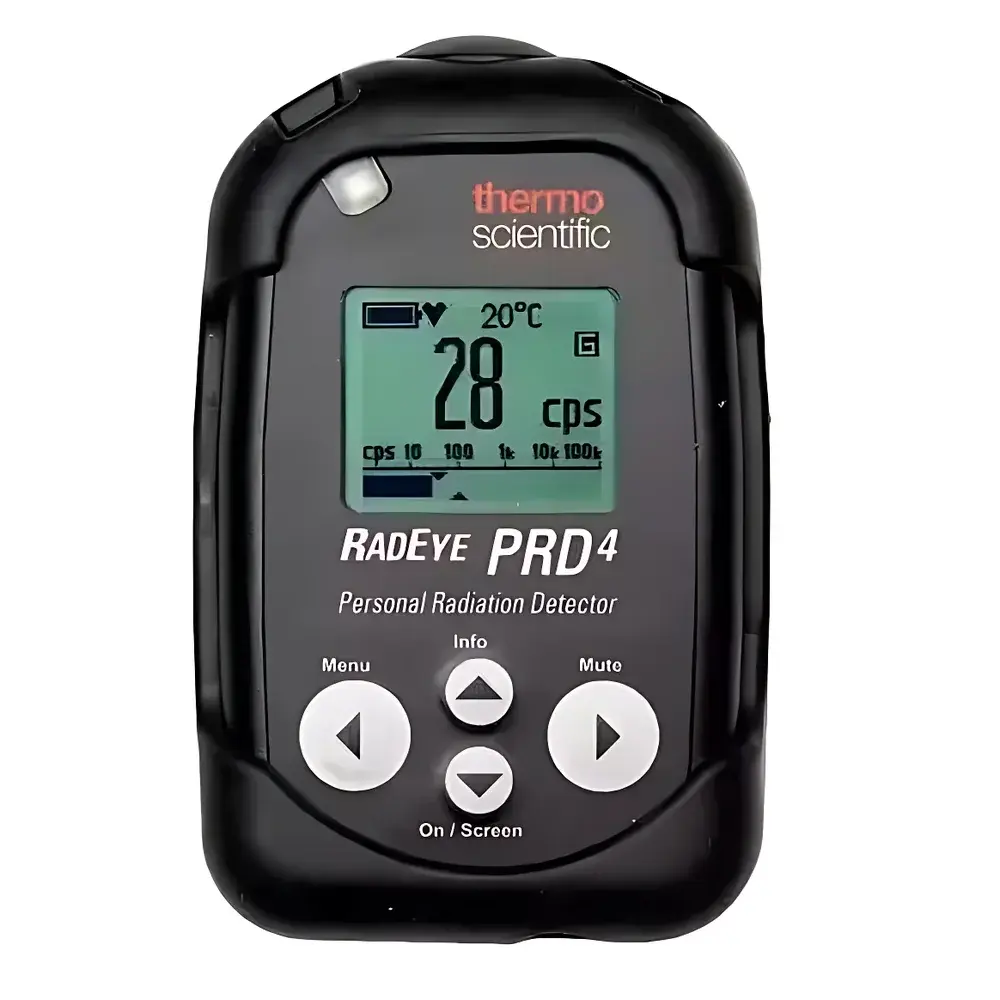
Thermo Scientific RadEye PRD4 Portable High-Sensitivity Radiation Detector
| Brand | Thermo Fisher |
|---|---|
| Origin | USA |
| Manufacturer | Thermo Fisher Scientific |
| Product Type | Imported |
| Model | RadEye PRD4 Portable High-Sensitivity Radiation Detector |
| Instrument Category | Dose/Dose Rate Meter |
| Form Factor | Portable |
| Measured Radiation | Gamma and Neutron |
| Detector Type | NaI(Tl) Scintillation Detector |
| Energy Range | 58 keV – 6 MeV (for dose and dose rate measurement) |
| Sensitivity | 200 cps per µSv/h |
Overview
The Thermo Scientific RadEye PRD4 is a rugged, handheld radiation detection instrument engineered for rapid, reliable identification and quantification of gamma and neutron radiation in field-deployed environmental monitoring, emergency response, border security, and nuclear facility operational support applications. Utilizing a high-efficiency thallium-doped sodium iodide [NaI(Tl)] scintillation detector, the PRD4 operates on pulse-height analysis principles to deliver real-time dose rate (µSv/h), accumulated dose (µSv), and spectral information across an energy range of 58 keV to 6 MeV. Its dual-mode detection architecture enables simultaneous gamma dose rate assessment and neutron-sensitive alarm triggering—enhancing threat discrimination capability without compromising operational simplicity. Designed for use under demanding physical conditions—including extreme ambient temperatures, dust exposure, and mechanical shock—the device complies with IP65 ingress protection and meets MIL-STD-810G drop-test requirements (1.5 m onto concrete). The PRD4 is not a laboratory spectrometer but a purpose-built operational tool optimized for high reproducibility, low false-alarm probability, and immediate situational awareness.
Key Features
- High-sensitivity NaI(Tl) detector with 200 counts per second per µSv/h sensitivity for gamma radiation
- Dual-response capability: integrated thermal neutron detection via optional 3He or 6Li-based proportional counter (factory-configurable)
- Enhanced neutron alarm sensitivity—30% improvement over prior-generation PRD models
- Large, high-contrast OLED display with intuitive icon-driven interface; supports both metric and imperial units
- Four-button ergonomic control layout enabling one-handed operation and minimal user training
- Battery life exceeding 1,000 hours in standby mode; powered by standard AA alkaline or rechargeable NiMH cells
- Ruggedized housing rated IP65 (dust-tight and water-jet resistant); certified for operation from −20 °C to +50 °C
- User-configurable operating modes: simplified 0–9 threat-level scale, dose-rate-only readout, gamma isotope identification (Gamma ID), or full-spectrum acquisition
Sample Compatibility & Compliance
The RadEye PRD4 is designed for direct-field measurement of gamma-emitting radionuclides (e.g., 137Cs, 60Co, 241Am) and neutron-emitting sources (e.g., 252Cf, plutonium-beryllium mixtures). It does not require sample preparation or shielding. Its energy response has been validated against ANSI N42.32–2022 and IEC 62401:2010 standards for personal radiation detectors (PRDs). The instrument conforms to U.S. Department of Homeland Security (DHS) PRD performance specifications and supports compliance with IAEA Nuclear Security Series No. 11-G guidelines. Data logging functionality adheres to ALARA principles and supports traceability under ISO/IEC 17025-accredited quality management systems. While not FDA 21 CFR Part 11-compliant out-of-the-box, audit-ready data export (via USB or Bluetooth) enables integration into GLP/GMP-aligned reporting workflows when paired with validated third-party software.
Software & Data Management
Data capture is managed through the embedded firmware and supported by Thermo Scientific’s RadEye Configuration Utility (RCU), a Windows-based desktop application used for firmware updates, alarm threshold configuration, spectral calibration, and export of CSV-formatted event logs. Each recorded alarm includes timestamp, GPS coordinates (when connected to external GNSS module), dose rate value, spectral snapshot (if enabled), and detector status flags. Raw spectra are stored in industry-standard .SPC format compatible with ORTEC GammaVision and Canberra Genie 2000 for advanced offline analysis. Firmware versioning and configuration history are retained internally for audit purposes. No cloud connectivity or proprietary subscription services are required for core functionality.
Applications
- First-responder screening at incident sites involving suspected radiological dispersal devices (RDDs) or orphan sources
- Border checkpoint and cargo inspection for illicit nuclear materials
- Environmental surveying near legacy nuclear sites, uranium mining areas, or waste repositories
- Health physics technician support during decommissioning or maintenance of nuclear infrastructure
- Training and drills for civil defense and emergency management agencies
- Routine area monitoring in hospitals, research reactors, and industrial radiography facilities
FAQ
What radiation types does the RadEye PRD4 detect?
It detects gamma radiation across 58 keV–6 MeV and, when equipped with the optional neutron sensor, thermal neutrons via 3He or 6Li conversion.
Does it identify specific isotopes?
Yes—using its Gamma ID mode, it performs basic isotope classification based on photopeak energy matching; full nuclide identification requires spectral deconvolution in external software.
Is the device suitable for use in rain or dusty environments?
Yes—it carries an IP65 rating, meaning it is fully protected against dust ingress and low-pressure water jets from any direction.
How is calibration maintained in the field?
The PRD4 supports user-performed energy and dose rate calibration using traceable check sources; factory recalibration is recommended annually or after physical impact.
Can logged data be exported for regulatory reporting?
Yes—event logs, spectra, and configuration records export via USB or Bluetooth to CSV or .SPC files, supporting integration into institutional radiation safety databases and audit documentation.
Related Products







