
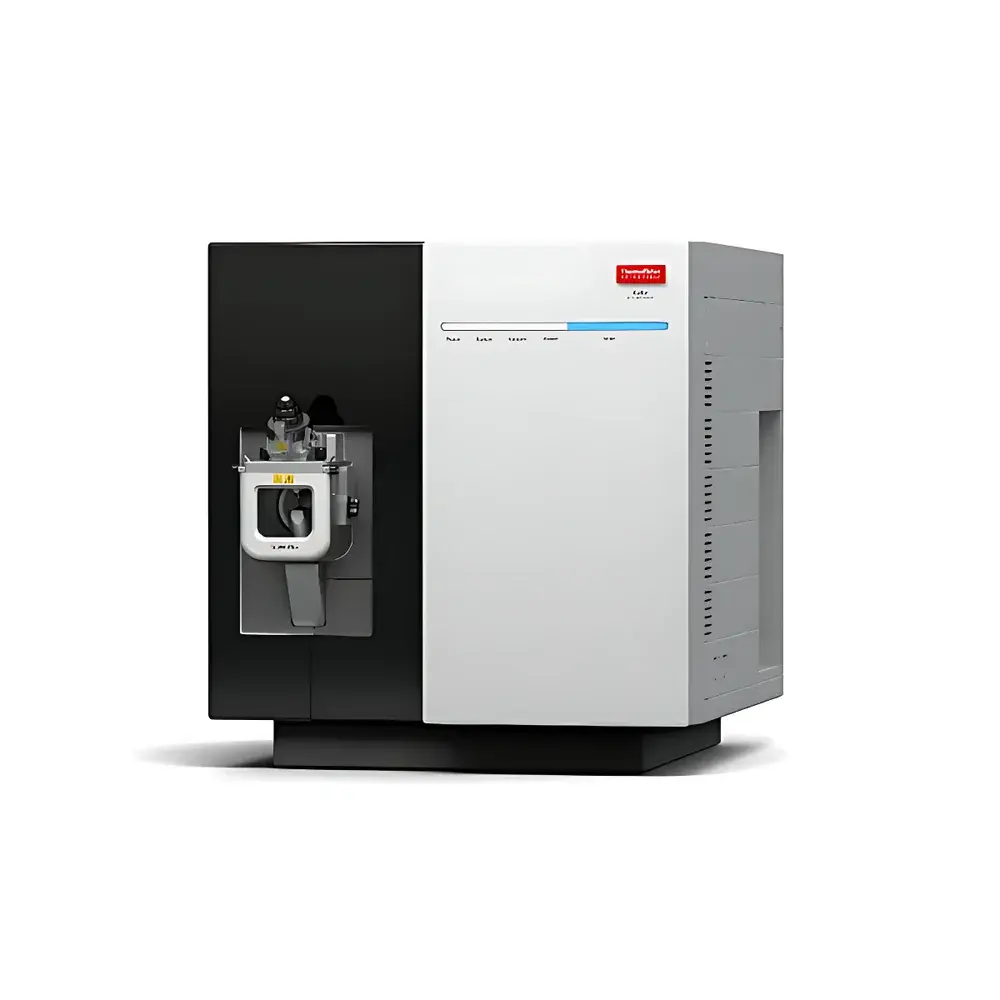
Thermo Scientific™ Stellar™ Liquid Chromatography Tandem Quadrupole-Ion Trap Mass Spectrometer
| Brand | Thermo Fisher Scientific |
|---|---|
| Origin | USA |
| Manufacturer Type | Original Equipment Manufacturer (OEM) |
| Import Status | Imported |
| Model | Thermo Scientific™ Stellar™ |
| Instrument Type | Hybrid Triple Quadrupole–Ion Trap (QqQ-IT) |
| Application Scope | Universal (Small Molecules, Peptides, Post-Translational Modifications, Lipids, Metabolites) |
| Mass Range | Full Scan Mode: m/z 5–2000 |
| MSⁿ Mode | m/z 20–2000 |
| Sensitivity | Targeted MS² (HESI+, SRM/MRM) |
| Resolution | Quadrupole Isolation Width: 0.4 Th |
| Ion Trap Peak Width (Dependent on Scan Rate) | 0.50 Da at 33 kDa/s, 0.60 Da at 67 kDa/s, 0.80 Da at 125 kDa/s, 2.00 Da at 200 kDa/s |
| Mass Accuracy | ≤ ±0.1 Da for m/z 524 over 24 h at 33 kDa/s scan rate |
| Gas Supply Pressure | Sheath/Auxiliary/Sweep Gas: 690 ± 140 kPa (100 ± 20 psig) |
Overview
The Thermo Scientific™ Stellar™ Liquid Chromatography Tandem Quadrupole–Ion Trap Mass Spectrometer is a hybrid high-performance mass spectrometry platform engineered for deep, reproducible, and quantitative analysis across diverse biological and chemical matrices. Combining a triple quadrupole (QqQ) front end with a high-capacity linear ion trap (LIT), the Stellar™ system leverages parallel reaction monitoring (PRM), synchronous precursor selection (SPS) MS³, and data-dependent acquisition (DDA) to deliver exceptional selectivity, dynamic range, and structural characterization capability. Its architecture supports both targeted quantitation—via optimized SRM/MRM and SPS-MS³ workflows—and untargeted discovery—through high-resolution full-scan MS and MSn fragmentation—within a single instrument platform. Designed for integration with ultra-high-performance liquid chromatography (UHPLC), the system operates under controlled vacuum conditions and employs heated electrospray ionization (HESI) as its primary soft ionization source, ensuring robustness across polar and semi-polar analytes.
Key Features
- Hybrid QqQ–LIT architecture enabling simultaneous high-sensitivity targeted quantitation and comprehensive structural elucidation
- Synchronous Precursor Selection (SPS) MS³ acquisition for enhanced specificity in complex biological backgrounds, minimizing co-eluting interferences
- Quadrupole isolation width of 0.4 Th for precise precursor selection and reduced chemical noise
- Scan-rate–dependent ion trap resolution: configurable from 0.50 Da (33 kDa/s) to 2.00 Da (200 kDa/s), balancing speed and spectral fidelity
- Mass accuracy maintained within ±0.1 Da over 24-hour continuous operation at standard acquisition rates, supporting confident compound identification
- Integrated HESI source with independently regulated sheath, auxiliary, and sweep gas pressures (690 ± 140 kPa) for optimal desolvation and ion transmission
- Full mass range coverage from m/z 5 to 2000 in both full-scan and MSn modes, accommodating small molecules, peptides, lipids, and metabolites
Sample Compatibility & Compliance
The Stellar™ system is validated for use with a broad spectrum of sample types—including plasma, serum, tissue homogenates, cell lysates, microbial extracts, and environmental extracts—when prepared via standardized extraction protocols (e.g., protein precipitation, solid-phase extraction, or phospholipid removal). It complies with instrumental requirements outlined in ASTM E2613 (Standard Guide for Mass Spectrometry Data Acquisition and Processing), ISO/IEC 17025:2017 (General Requirements for the Competence of Testing and Calibration Laboratories), and USP (Mass Spectrometry). When operated with Thermo Scientific™ Chromeleon™ CDS software configured for audit trail and electronic signature, the platform meets FDA 21 CFR Part 11 and EU Annex 11 requirements for regulated environments including GLP and GMP laboratories.
Software & Data Management
Data acquisition, processing, and reporting are managed through Thermo Scientific™ Chromeleon™ Chromatography Data System (CDS) v7.3 or later, which provides method templating, automated calibration, real-time QC monitoring, and integrated peak integration for both targeted and untargeted workflows. Quantitative results are traceable via embedded audit trails, user-defined roles, and electronic signatures. Raw data files (.raw) are compatible with third-party open-source tools (e.g., Skyline, MaxQuant, Proteome Discoverer) and commercial platforms (e.g., Compound Discoverer, LipidSearch) for advanced statistical modeling, pathway mapping, and multi-omics correlation. All metadata—including instrument parameters, calibration logs, and sequence files—is embedded and exportable in mzML format per PSI standards.
Applications
- Large-scale targeted proteomics: Quantification of >9,000 peptides per hour with low missing-value rates, enabling systems-level pathway analysis
- Single-cell and low-input metabolomics: Detection and quantitation of sub-attomole analyte levels using SPS-MS³ and microflow LC coupling
- Clinical biomarker verification: Multiplexed absolute quantitation of post-translational modifications (e.g., phosphorylation, acetylation) and endogenous metabolites
- Pharmaceutical impurity profiling: Structural confirmation of degradants and process-related impurities via MS3 fragmentation trees
- Environmental contaminant screening: Simultaneous detection of pesticides, pharmaceutical residues, and PFAS compounds in water and soil extracts
- Food safety and authenticity testing: Multi-residue analysis of mycotoxins, veterinary drugs, and adulterants in complex food matrices
FAQ
What distinguishes the Stellar™ from conventional triple quadrupole instruments?
The Stellar™ integrates a linear ion trap behind the second quadrupole, enabling true MS3 experiments and extended fragmentation depth—not achievable with standalone QqQ systems.
Is the system compatible with nano-LC and micro-LC configurations?
Yes. The HESI source and vacuum interface support flow rates from 50 nL/min to 1 mL/min, making it suitable for nanoflow, capillary, and analytical-scale separations.
How is mass calibration maintained during long-duration runs?
Internal lock-mass correction is supported via optional infusion of a reference compound (e.g., Ultramark 1621), and external calibration is performed using standard tuning mixtures per manufacturer protocol.
Can the Stellar™ be used for intact protein analysis?
While optimized for peptides and small molecules, the system supports top-down analysis of proteins up to ~30 kDa when coupled with native or denaturing LC and appropriate fragmentation settings.
What regulatory documentation is provided with the instrument?
Each system ships with Factory Acceptance Test (FAT) reports, IQ/OQ documentation templates, 21 CFR Part 11 compliance guides, and a Certificate of Conformance compliant with ISO 9001 quality management standards.




