
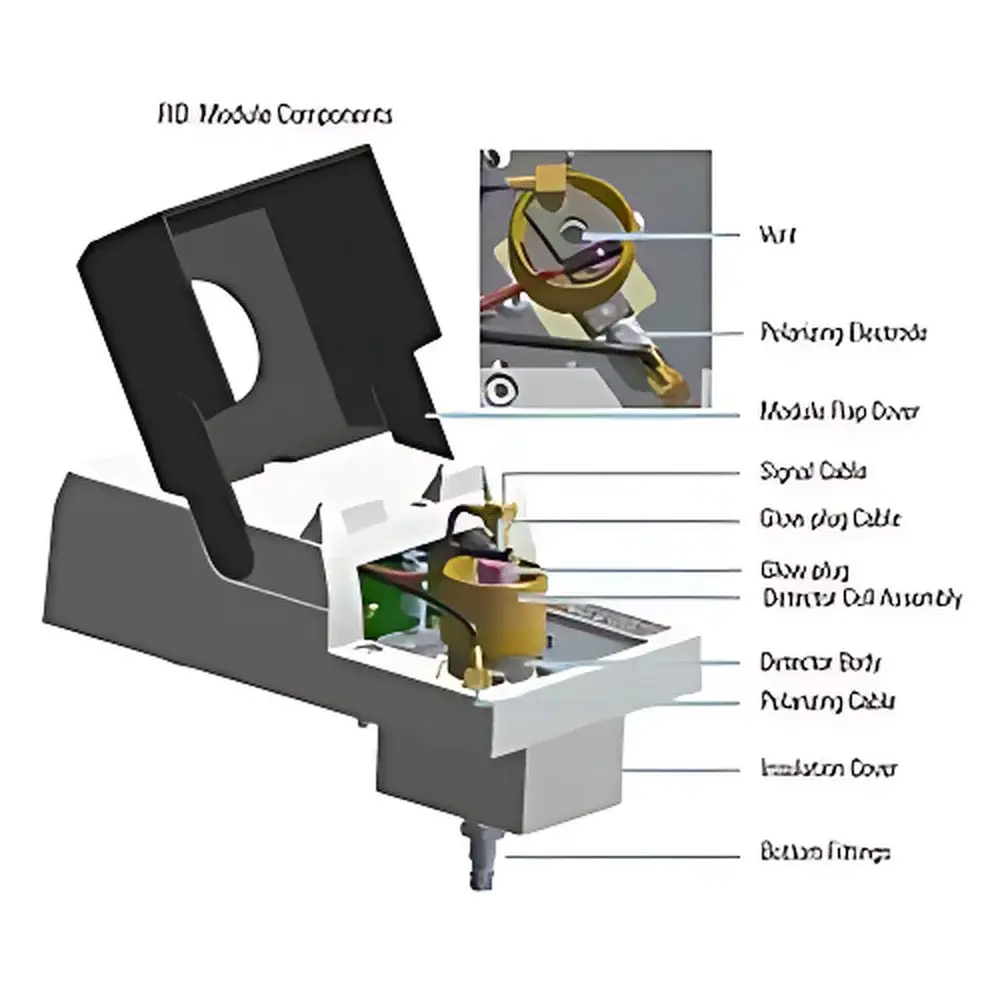
Thermo Scientific TRACE 1300 Series FID Detector with Instant Connect Interface
| Brand | Thermo Fisher |
|---|---|
| Origin | Italy |
| Manufacturer Type | Original Equipment Manufacturer (OEM) |
| Origin Category | Imported |
| Model | Instant Connect FID |
| Instrument Type | Flame Ionization Detector (FID) |
| Detection Limit (MDL) | <1.4 pg C/s |
| Sensitivity | >0.03 C/gC |
| Linear Dynamic Range | >10⁷ (±10%) |
| Maximum Operating Temperature | 450°C (0.1°C increment) |
| Carrier Gas Flow Control | N₂ or He, 0–50 mL/min (0.1 mL/min increment) |
| Hydrogen Flow Control | 0–100 mL/min (0.1 mL/min increment) |
| Air Flow Control (IEC) | 0–500 mL/min (0.1 mL/min increment) |
| Column Compatibility | 1/8″ and 1/16″ packed columns |
| Flame Monitoring | Auto-ignition and flame-out detection |
Overview
The Thermo Scientific TRACE 1300 Series Flame Ionization Detector (FID) with Instant Connect interface is a high-performance, modular detection system engineered for gas chromatography (GC) and GC-MS platforms. Based on the well-established principle of hydrocarbon combustion in a hydrogen–air flame, the detector ionizes organic compounds as they elute from the column; the resulting ion current is measured by a high-impedance electrometer to generate quantitative analytical signals. Designed for precision, robustness, and operational continuity, this FID integrates seamlessly into Thermo’s modular GC architecture—enabling rapid reconfiguration without tools or specialized training. Its core function remains consistent with ASTM D2887, ISO 10301, and USP method requirements for hydrocarbon quantification in petrochemical, environmental, pharmaceutical, and food safety applications.
Key Features
- Instant Connect Modular Design: Interchangeable detector modules mount and dismount in under two minutes, supporting method-specific instrument reconfiguration and minimizing downtime during maintenance or method switching.
- Ultra-Wide Linear Dynamic Range: Exceeds 10⁷ (±10%) — enabling accurate quantitation across trace-level contaminants and major components within a single run, critical for complex matrices such as diesel fuel or wastewater extracts.
- High Sensitivity & Low MDL: Achieves a minimum detection limit of 0.03 Coulombs per gram carbon — compliant with EPA Method 8260D and ASTM D5504 for volatile organic compound (VOC) analysis.
- Precision Gas Flow Control: Independent digital mass flow controllers for H₂ (0–100 mL/min), air (0–500 mL/min), and make-up gas (N₂ or He, 0–50 mL/min), all adjustable in 0.1 mL/min increments for optimal flame stability and reproducibility.
- Thermal Stability & Flexibility: Operates up to 450°C with 0.1°C resolution, accommodating high-boiling-point analytes and ensuring baseline stability during temperature-programmed runs.
- Intelligent Flame Management: Real-time flame monitoring with automatic re-ignition upon flame-out detection eliminates manual intervention and ensures uninterrupted data acquisition.
Sample Compatibility & Compliance
This FID is compatible with both 1/8″ and 1/16″ packed columns, supporting legacy and specialty separation configurations. It meets essential regulatory expectations for routine QC/QA workflows, including GLP-compliant audit trails when integrated with Thermo Chromeleon CDS software (v7.3+). The detector supports 21 CFR Part 11–compliant electronic signatures and data integrity protocols when deployed in FDA-regulated environments. Its performance aligns with ISO/IEC 17025 accreditation criteria for calibration traceability, linearity verification, and detection limit validation. Routine operation complies with IEC 61000-6-3 (EMC) and IEC 61010-1 (safety) standards for laboratory instrumentation.
Software & Data Management
Controlled via Thermo Chromeleon Chromatography Data System (CDS), the Instant Connect FID supports full remote configuration, real-time diagnostics, and automated calibration routines. The software provides built-in tools for dynamic range verification, signal-to-noise ratio calculation, and linear regression analysis per USP Analytical Instrument Qualification guidelines. Audit trail functionality logs all parameter changes, user actions, and system events with time stamps and operator IDs—ensuring full traceability for internal audits and regulatory inspections. Data export formats include .cdf, .csv, and .pdf, facilitating integration with LIMS and ELN platforms.
Applications
- Environmental testing: Quantification of BTEX, PAHs, and chlorinated VOCs in soil, water, and air samples per EPA Methods 8021B, 8260D, and 8270E.
- Petrochemical analysis: Hydrocarbon group-type analysis (HTA) in fuels and lubricants per ASTM D5134 and D6730.
- Pharmaceutical residual solvent testing: Compliant with ICH Q2(R2) and USP , supporting GMP-aligned release testing.
- Food and flavor analysis: Detection of volatile aldehydes, ketones, and esters in essential oils and fermented products.
- Academic and method development labs: Rapid detector swapping enables side-by-side comparison of FID vs. other detectors (e.g., TCD, ECD) under identical chromatographic conditions.
FAQ
Is this FID compatible with non-Thermo GC systems?
While optimized for Thermo TRACE 1300 and ISQ series GC platforms, mechanical and electrical interfaces may require custom mounting kits or signal conditioning for third-party instruments. Contact technical support for integration feasibility assessment.
Does the Instant Connect feature affect detector calibration stability?
No. Each module undergoes factory calibration with serialized thermal and electronic compensation. Reinstallation preserves baseline repeatability; routine calibration verification is recommended per ISO/IEC 17025 Section 5.9.2.
Can the FID operate with helium as a make-up gas instead of nitrogen?
Yes. The detector supports both nitrogen and helium as make-up gases; helium improves peak shape for early-eluting compounds and reduces detector noise in high-resolution applications.
What maintenance intervals are recommended for sustained MDL performance?
Capillary jet cleaning every 2–4 weeks (depending on sample matrix), ceramic igniter inspection quarterly, and annual electrometer calibration ensure long-term compliance with stated sensitivity and detection limit specifications.





