
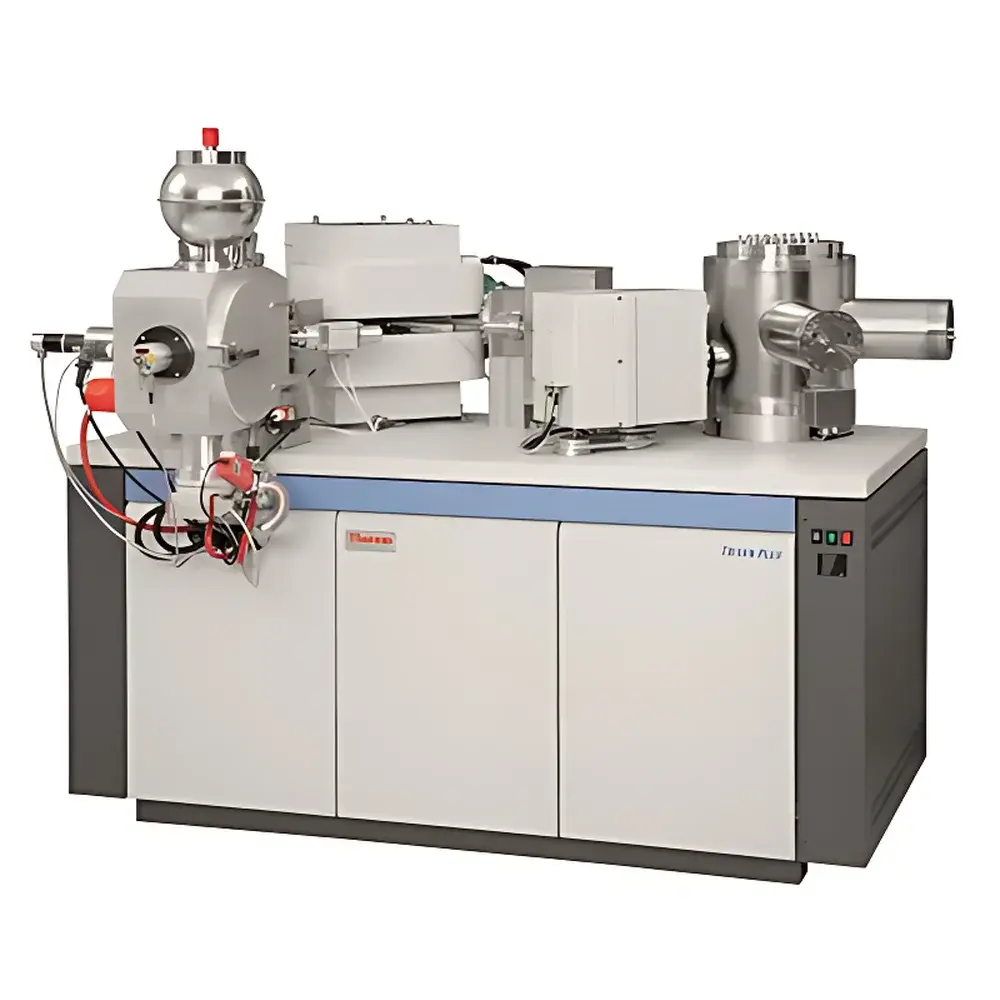
Thermo Scientific TRITON Plus Thermal Ionization Mass Spectrometer
| Brand | Thermo Fisher |
|---|---|
| Origin | Germany |
| Manufacturer Type | Original Equipment Manufacturer (OEM) |
| Origin Category | Imported Instrument |
| Model | TRITON Plus |
| Instrument Type | Stable Gas Isotope Ratio Mass Spectrometer |
| Key Features | Virtual Amplifier Architecture, Switchable High-Range Faraday Amplifiers (10¹⁰–10¹³ Ω), Dual RPQ Energy Filtering, Zoom Optics, Multi-Collector Discrete-Dynode Electron Multipliers, High-Throughput TIMS Configuration |
| Compliance | Designed for GLP/GMP environments |
Overview
The Thermo Scientific TRITON Plus Thermal Ionization Mass Spectrometer (TIMS) is a high-precision, multi-collector isotope ratio mass spectrometer engineered specifically for ultra-trace isotopic analysis of solid and purified elemental samples. Operating on the fundamental principle of thermal ionization—where analytes are loaded onto rhenium or tungsten filaments and heated to induce surface ionization—the TRITON Plus delivers exceptional mass resolution, long-term signal stability, and sub-permil reproducibility in isotope ratio measurements. Its architecture integrates a double-radius magnetic sector mass analyzer with electrostatic energy filtering, enabling rigorous separation of isobaric interferences and precise isotopic abundance quantification across elements including Sr, Nd, Hf, Pb, U, Pu, and Ca. Designed and manufactured in Bremen, Germany, the TRITON Plus serves as the reference platform for radiogenic and stable isotope geochemistry, nuclear forensics, geochronology, and metrology laboratories requiring definitive isotopic fingerprinting under ISO/IEC 17025-accredited workflows.
Key Features
- Virtual Amplifier Architecture: All Faraday cup signals—including those from multiple simultaneously active cups—are routed through a single, shared amplifier chain. This eliminates inter-amplifier gain drift and calibration offset, establishing a new benchmark for internal precision in δ-value determination (typically ≤ 0.003‰ RSD for 87Sr/86Sr over 100 cycles).
- Software-Configurable Amplifier Matrix: Supports up to ten discrete feedback resistors (10¹⁰ Ω to 10¹³ Ω) mounted in parallel. Amplifier selection per Faraday cup is executed dynamically via Qtegra ISM software—enabling real-time optimization for low-abundance isotopes (e.g., 142Ce) alongside high-intensity beams (e.g., 144Nd) within the same acquisition sequence.
- Dual Reverse Geometry Quadrupole (RPQ) Filters: Installed upstream of the main magnet, the dual RPQ system provides sequential kinetic energy and angular dispersion filtering. This configuration improves abundance sensitivity by up to two orders of magnitude (to ≤ 1 × 10⁻⁹), critical for suppressing tailing from major isotopes during minor-isotope measurement (e.g., 236U interference on 235U in nuclear safeguards applications).
- Zoom Ion Optics & Multi-Collector Detection: Features an adjustable ion optical path with variable focal length, allowing dynamic beam focusing across mass ranges without mechanical re-alignment. Coupled with nine Faraday cups and three discrete-dynode electron multipliers, it enables simultaneous collection of up to 12 isotopic signals with independent gain control.
- High-Throughput Filament Loading System: Integrated auto-loader accommodates up to 12 pre-conditioned filaments, supporting unattended overnight runs and standardized thermal ramp protocols compliant with ASTM D7997 (for Sr isotopic analysis in geological materials).
Sample Compatibility & Compliance
The TRITON Plus accepts chemically purified sample solutions deposited onto single- or triple-filament assemblies using standard micro-drop evaporation techniques. It is routinely deployed for analysis of silicate rocks, carbonate standards, uranium oxide powders, seawater-derived strontium fractions, and nuclear fuel cycle materials. The instrument meets stringent regulatory requirements for isotopic reference material certification and is compatible with ISO 17025 method validation protocols. When operated with Qtegra ISM v3.0+ and configured with electronic signature modules, it satisfies FDA 21 CFR Part 11 requirements for audit trail generation, user access control, and data integrity assurance—making it suitable for GMP-aligned environmental monitoring and nuclear regulatory reporting.
Software & Data Management
Controlled exclusively via Thermo Scientific Qtegra Intelligent Scientific Data Software (ISM), the TRITON Plus supports fully automated method sequencing, real-time peak centering, dynamic background subtraction, and multi-point mass bias correction (e.g., exponential or power-law models). Raw data files (.raw) are stored in vendor-neutral formats compatible with third-party evaluation tools such as Vizor, LAMDA, and IsoplotR. All acquisition parameters—including filament temperature profiles, amplifier assignments, and RPQ voltages—are timestamped and embedded in metadata, ensuring full traceability for GLP audits. Optional add-ons include the Isotope Ratio Data Manager (IRDM) module for certified reference material normalization and uncertainty propagation per GUM guidelines.
Applications
- High-precision 87Rb–87Sr, 147Sm–143Nd, and 176Lu–176Hf geochronology in igneous and metamorphic systems
- U–Pb and U-series disequilibrium dating of zircon, monazite, and carbonates
- Nuclear forensic isotopic screening of uranium and plutonium materials (IAEA safeguards-relevant nuclides)
- Stable calcium and magnesium isotope ratio analysis in biomineralization and paleoclimate studies
- Certification of isotopic reference materials (e.g., NIST SRM 987, JMC 475) in national metrology institutes
FAQ
What sample introduction methods are supported?
Solid samples must be chemically purified and loaded onto metal filaments (Re, W, Ta) via micropipette deposition; no continuous-flow or laser ablation interfaces are natively supported.
Is the TRITON Plus compliant with ISO/IEC 17025 for accredited testing labs?
Yes—when operated with validated SOPs, calibrated reference materials, and Qtegra ISM’s Part 11 mode enabled, it fulfills technical requirements for accreditation scope in isotopic ratio analysis.
Can the dual RPQ be used independently or only in tandem?
Both configurations are supported: either RPQ can be engaged individually for targeted energy filtering, or both activated sequentially for maximum abundance sensitivity improvement.
What is the typical long-term mass fractionation stability?
Under controlled laboratory conditions (±0.5 °C ambient stability, regulated vacuum < 5 × 10⁻⁹ mbar), instrumental mass bias drift remains below 0.01% per 24 hours for 86Sr/88Sr, verified using repeated NBS 987 analyses.
Does Thermo Fisher provide application-specific method packages?
Yes—validated workflows for geological Sr–Nd–Hf–Pb analysis, nuclear U–Pu isotopic characterization, and biomedical Ca–Mg isotope studies are available through Thermo Scientific Application Support Centers and the Global Isotope Network.




