
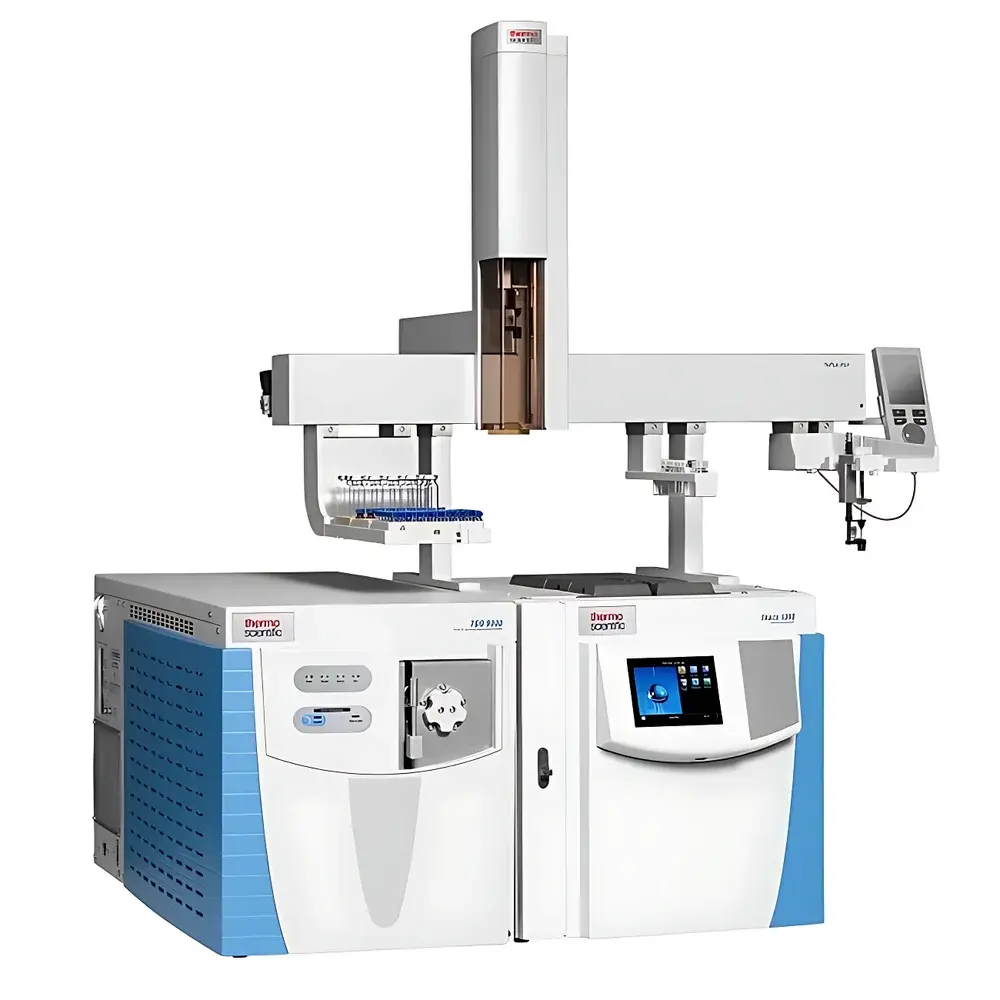
Thermo Scientific TSQ 9000 Triple Quadrupole GC-MS/MS System
| Brand | Thermo Fisher |
|---|---|
| Origin | Singapore |
| Manufacturer | Thermo Fisher Scientific |
| Product Origin | Imported |
| Model | TSQ 9000 |
| Instrument Type | Triple Quadrupole Mass Spectrometer |
| Chromatography Configuration | Gas Chromatography-Coupled |
Overview
The Thermo Scientific TSQ 9000 Triple Quadrupole GC-MS/MS System is a high-performance, purpose-engineered platform for targeted quantitative analysis of trace-level analytes in complex matrices. Built upon a robust triple quadrupole architecture, the system operates on tandem mass spectrometry (MS/MS) principles—employing Q1 for precursor ion selection, Q2 as a collision cell for controlled fragmentation via collision-induced dissociation (CID), and Q3 for product ion detection. This configuration delivers exceptional selectivity and signal-to-noise ratio, essential for regulatory-compliant quantitation in food safety, environmental monitoring, forensic toxicology, and clinical research laboratories. Designed for continuous operation under high-throughput conditions, the TSQ 9000 integrates hardware reliability with intelligent vacuum management, low-noise electronics, and optimized ion optics to ensure stable sensitivity across extended acquisition cycles.
Key Features
- High-Sensitivity Triple Quadrupole Architecture: Engineered for sub-pg on-column detection limits in electron ionization (EI) mode and low-femtogram sensitivity in chemical ionization (CI) mode—enabling reliable quantitation of pesticides, persistent organic pollutants (POPs), drugs of abuse, and mycotoxins at regulatory action levels.
- Advanced Ion Source Design: Features a heated, low-volume ion source with rapid bake-out capability and dual-mode EI/CI switching—minimizing carryover and maximizing duty cycle without manual intervention.
- Enhanced Scan Speed & Duty Cycle: Supports up to 1,000 transitions per second with <1 ms dwell time per transition, ensuring comprehensive coverage of multi-analyte methods while maintaining chromatographic fidelity.
- Robust Vacuum System: Dual-stage turbomolecular pumping with real-time pressure monitoring ensures stable operating pressure (<5 × 10⁻⁶ Torr in the analyzer region) even during prolonged GC oven ramping or large-volume injection protocols.
- Integrated GC Compatibility: Fully supports Thermo Scientific TRACE™ 1300/1310 Series GCs with active flow control, split/splitless, PTV, and cold-on-column inlets—enabling method portability and retention time locking across instruments.
Sample Compatibility & Compliance
The TSQ 9000 accommodates a broad range of sample types—including aqueous extracts, lipid-rich food homogenates, soil digests, biological fluids (urine, blood plasma), and air particulate filters—following standard preparation workflows such as QuEChERS, SPE, LLE, and derivatization. Its performance aligns with internationally recognized validation frameworks including AOAC Official Methods of Analysis®, EPA Methods 525.3, 8270, and 1694, ISO/IEC 17025:2017 requirements for testing laboratories, and FDA Bioanalytical Method Validation Guidance. The system supports 21 CFR Part 11–compliant audit trails, electronic signatures, and secure user access controls when operated with Thermo Scientific Chromeleon™ CDS software in validated environments.
Software & Data Management
Controlled via Thermo Scientific Chromeleon Chromatography Data System (CDS) v7.3 or later, the TSQ 9000 provides end-to-end workflow integration—from method development and instrument calibration to batch processing, peak integration, and report generation. Quantitation is performed using internal standard (IS) or standard addition approaches with customizable calibration curve models (linear, quadratic, weighted least-squares). Raw data files (.RAW) are stored in vendor-neutral formats compatible with third-party review tools. Audit trail functionality logs all user actions—including method edits, sequence modifications, and result reprocessing—with timestamps and operator IDs, supporting GLP and GMP documentation requirements.
Applications
- Quantitative residue analysis of over 500 pesticides in fruits, vegetables, and infant formula per EU SANTE/11312/2021 guidelines.
- Detection and confirmation of polycyclic aromatic hydrocarbons (PAHs), dioxins, and PCB congeners in sediment and biota samples at sub-parts-per-quadrillion levels.
- High-throughput screening and pharmacokinetic profiling of pharmaceutical metabolites in human plasma using stable isotope-labeled internal standards.
- Forensic identification and quantification of synthetic cannabinoids, fentanyl analogues, and novel psychoactive substances (NPS) in postmortem toxicology specimens.
- Environmental fate studies involving trace-level degradation products of pharmaceuticals and personal care products (PPCPs) in wastewater effluent and surface water.
FAQ
Is the TSQ 9000 compliant with 21 CFR Part 11 for regulated laboratories?
Yes—the system supports full 21 CFR Part 11 compliance when deployed with Chromeleon CDS in a validated configuration, including role-based access control, electronic signatures, and immutable audit trails.
Can the TSQ 9000 be retrofitted with newer ion sources or detectors?
No—the TSQ 9000 uses a fixed, factory-integrated ion source and detector assembly; upgrades are limited to firmware revisions and software enhancements released by Thermo Fisher Scientific.
What GC interfaces are supported out-of-the-box?
The system natively supports Thermo Scientific TRACE GCs with direct column coupling, transfer line temperature control (up to 450 °C), and active flow management for retention time stability.
Does the TSQ 9000 support scheduled MRM (sMRM) for improved peak fidelity?
Yes—sMRM dynamically adjusts dwell times and Q1/Q3 resolution settings based on retention time windows, optimizing sensitivity and chromatographic resolution across wide-gradient methods.
Is remote monitoring and diagnostics available?
Remote instrument status monitoring and basic diagnostic reporting are enabled via Thermo Fisher’s Instrument Connect cloud service (subscription required), subject to local network security policies and firewall configurations.




