
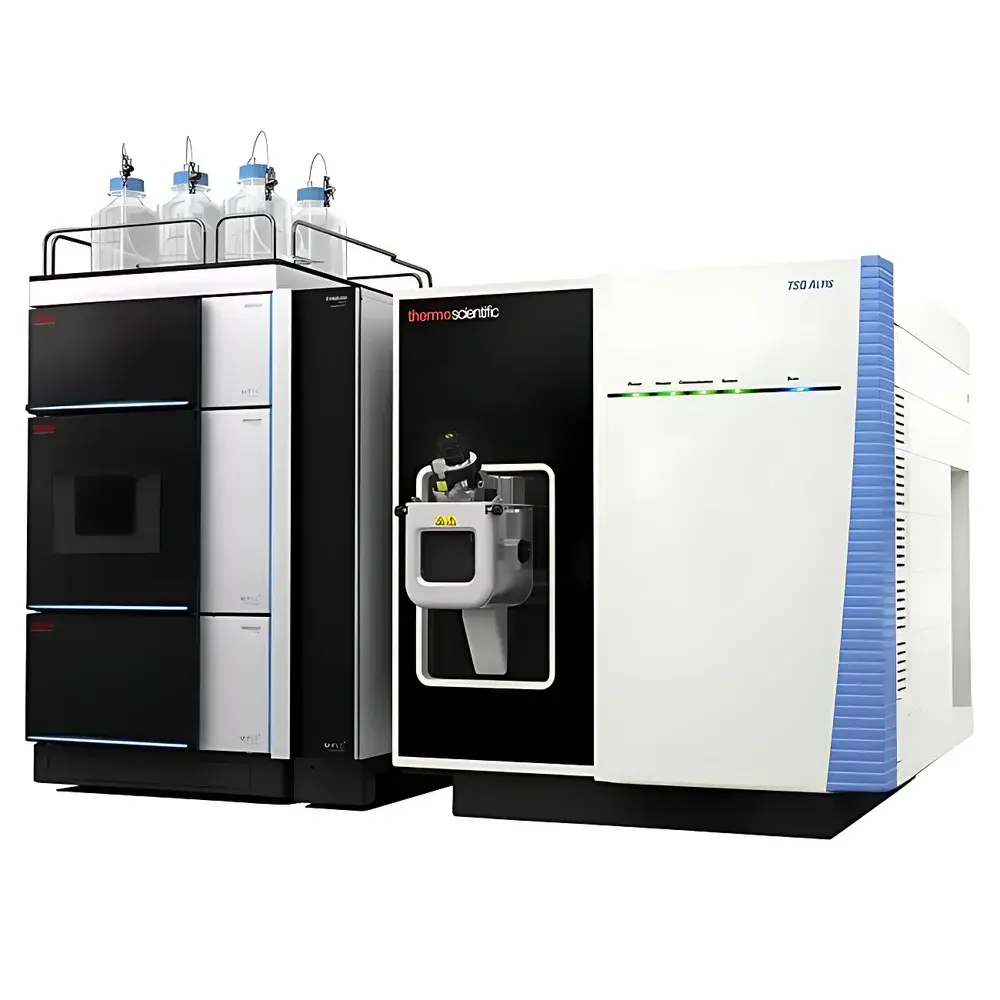
Thermo Scientific TSQ Altis™ Triple Quadrupole Mass Spectrometer
| Brand | Thermo Fisher |
|---|---|
| Origin | USA |
| Manufacturer Type | Original Equipment Manufacturer (OEM) |
| Product Origin | Imported |
| Model | Thermo Scientific™ TSQ Altis™ |
| Instrument Type | Tandem Quadrupole (Triple Quad) |
| Mass Range | 5–2000 m/z |
| Sensitivity | ≥500,000:1 (S/N, peak-to-peak, at 1 pg injected on-column of reserpine) |
| Resolution | 0.2 amu (full width at half maximum, FWHM) |
| Mass Accuracy | ≤0.1 amu (internal calibration, over full mass range) |
Overview
The Thermo Scientific TSQ Altis™ Triple Quadrupole Mass Spectrometer is a high-performance, purpose-engineered system designed for robust, high-throughput quantitative analysis in regulated and research environments. Operating on the principle of tandem mass spectrometry (MS/MS) via three sequential quadrupole mass filters—Q1 (mass selection), q2 (collision-induced dissociation cell), and Q3 (mass analysis)—the TSQ Altis™ delivers exceptional selectivity, reproducibility, and dynamic range for targeted small-molecule quantitation. Its architecture integrates seamlessly with ultra-high-performance liquid chromatography (UHPLC) platforms, enabling precise retention-time alignment and minimized carryover. Engineered for precision under sustained operational loads, the system maintains consistent ion transmission efficiency and detector response across extended acquisition sequences—critical for multi-analyte assays in clinical toxicology, pharmaceutical bioanalysis, food safety, and environmental monitoring.
Key Features
- High Sensitivity & Low Detection Limits: Achieves signal-to-noise ratios ≥500,000:1 (peak-to-peak) for standard compounds such as reserpine under optimized LC-MS/MS conditions—enabling reliable quantitation at sub-picomolar concentrations in complex biological matrices.
- Stable Ion Optics & Robust Vacuum Architecture: Features an actively temperature-stabilized ion transfer interface and dual-stage differential pumping system, minimizing sensitivity drift during multi-day runs and supporting >95% instrument uptime in 24/7 laboratory operations.
- Ultra-Fast SRM Transition Switching: Supports sub-millisecond dwell times and rapid polarity switching (<20 ms), allowing up to 1,000+ scheduled SRM transitions per run without compromising duty cycle or quantitative accuracy.
- Precision Mass Filtering: Delivers 0.2 amu resolution (FWHM) and ≤0.1 amu mass accuracy using internal calibration standards, ensuring consistent analyte identification and interference rejection across method lifecycles.
- Modular UHPLC Integration: Compatible with Thermo Scientific Vanquish UHPLC systems—including binary and quaternary pumps, column heaters, and autosamplers with needle wash and low-dead-volume flow paths—to maintain chromatographic integrity and reduce system variability.
Sample Compatibility & Compliance
The TSQ Altis™ accommodates a broad spectrum of sample types, including plasma, serum, urine, tissue homogenates, plant extracts, food digests, and environmental water extracts—provided they are compatible with reversed-phase, HILIC, or ion-pairing LC separation chemistries. The system supports both electrospray ionization (ESI) and atmospheric pressure chemical ionization (APCI) sources, with optional heated electrospray (HESI) and source gas optimization for thermally labile or low-volatility analytes. From a regulatory perspective, the platform complies with key international standards including ISO/IEC 17025:2017 (for testing laboratories), ASTM D7622 (for pesticide residue analysis), and USP and (for method validation). When operated with Thermo Scientific Chromeleon Chromatography Data System (CDS) configured for 21 CFR Part 11 compliance, the system supports full audit trails, electronic signatures, and role-based access control—meeting GLP and GMP data integrity requirements.
Software & Data Management
Data acquisition, processing, and reporting are managed through Thermo Scientific Compound Discoverer™ and TraceFinder™ software suites—both built on a scalable, database-driven architecture. TraceFinder™ provides validated, template-based workflows for quantitative LC-MS/MS methods, including automated peak integration, calibration curve fitting (linear/log-linear with weighting), and QC sample flagging based on user-defined acceptance criteria (e.g., %CV, %bias, IS response stability). All raw data files (.raw) are stored in vendor-neutral formats compliant with mzML 1.1 specifications. Audit logs record every parameter change, calibration event, and report generation action—ensuring full traceability for FDA, EMA, or PMDA inspections. Optional integration with LIMS platforms (e.g., LabWare, STARLIMS) enables automated sample assignment, result dissemination, and electronic batch record linkage.
Applications
- Pharmaceutical bioanalysis: PK/PD studies, metabolite identification support, and impurity profiling in drug development.
- Clinical research: Quantitative measurement of endogenous biomarkers (e.g., steroids, vitamins, neurotransmitters) and therapeutic drugs in human biospecimens.
- Food safety: Multi-residue screening and confirmation of pesticides, mycotoxins, veterinary drug residues, and adulterants.
- Environmental analysis: Detection and quantification of persistent organic pollutants (POPs), pharmaceuticals in wastewater, and flame retardants in sediment.
- Forensic toxicology: High-confidence identification and quantitation of controlled substances, novel psychoactive substances (NPS), and metabolites in postmortem samples.
FAQ
What ionization sources are supported by the TSQ Altis™?
The system ships standard with electrospray ionization (ESI) and atmospheric pressure chemical ionization (APCI) sources; optional configurations include heated ESI (HESI), nanospray, and atmospheric pressure photoionization (APPI) modules.
Is the TSQ Altis™ suitable for regulated bioanalytical laboratories?
Yes—when deployed with validated TraceFinder™ workflows and Chromeleon CDS in 21 CFR Part 11 mode, it meets ICH M10, FDA Bioanalytical Method Validation Guidance, and EMA Guideline on Bioanalytical Method Validation requirements.
How does the TSQ Altis™ ensure long-term mass calibration stability?
It employs an integrated internal calibration delivery system with periodic infusion of reference compounds (e.g., caffeine, MRFA), enabling real-time mass recalibration without interrupting sample analysis.
Can the instrument be upgraded for higher mass accuracy or HRAM capability?
No—the TSQ Altis™ is a dedicated triple quadrupole platform optimized for sensitivity and speed in targeted quantitation; for high-resolution accurate-mass applications, Thermo Scientific Q Exactive™ or Orbitrap Exploris™ systems are recommended.
What maintenance intervals are recommended for routine operation?
Ion source cleaning is advised every 2–4 weeks depending on sample load; turbomolecular pump oil replacement every 18–24 months; and annual preventive maintenance including RF tuning, detector gain calibration, and vacuum integrity verification.




