
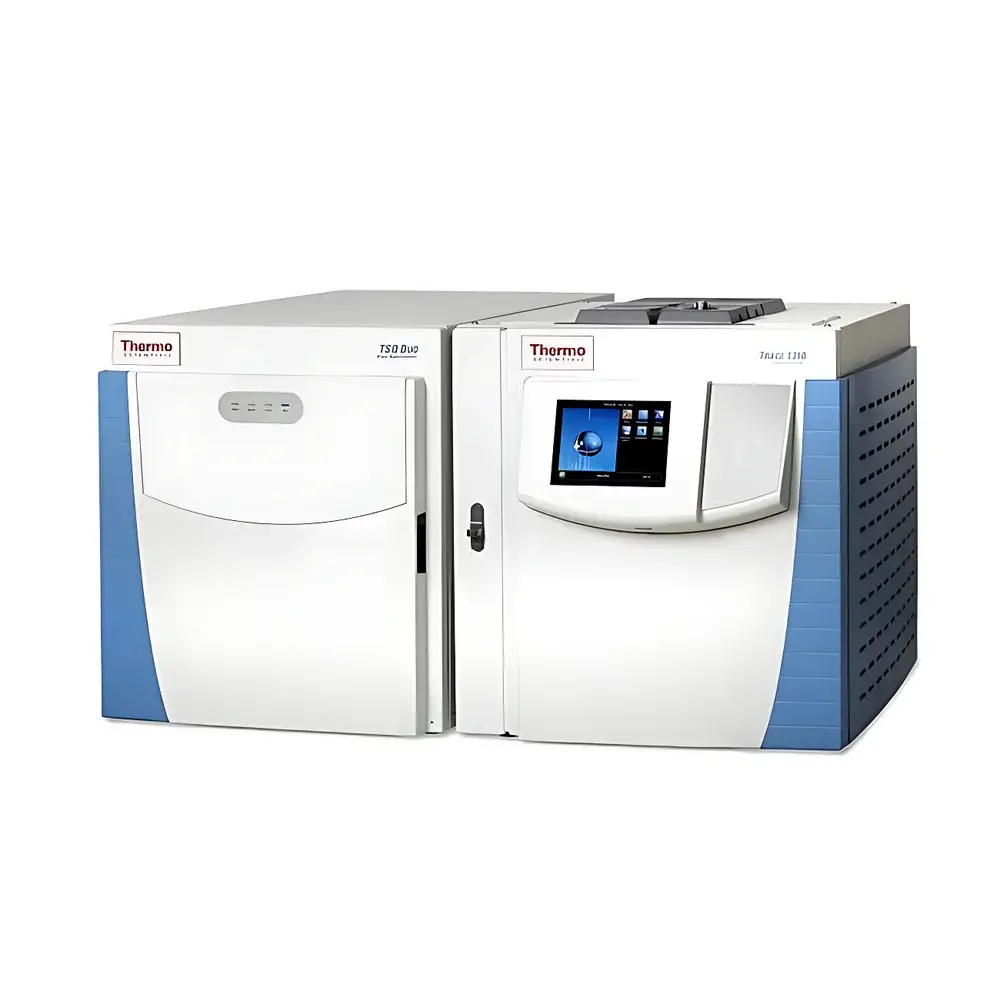
Thermo Scientific TSQ Duo Triple Quadrupole GC-MS/MS
| Brand | Thermo Fisher |
|---|---|
| Origin | USA |
| Manufacturer Type | Original Equipment Manufacturer (OEM) |
| Product Origin | Imported |
| Model | TSQ Duo Triple Quadrupole GC-MS/MS |
| Instrument Type | Triple Quadrupole Mass Spectrometer |
| Chromatography Configuration | Conventional Gas Chromatography-Mass Spectrometry (GC-MS) |
Overview
The Thermo Scientific TSQ Duo Triple Quadrupole GC-MS/MS is a purpose-engineered hybrid mass spectrometry platform that bridges the operational gap between single-quadrupole GC-MS and high-end triple quadrupole systems. It operates on tandem mass spectrometry principles—specifically, collision-induced dissociation (CID) in a Q1–q2–Q3 configuration—to deliver selective reaction monitoring (SRM) with enhanced specificity and sub-picomolar sensitivity for trace-level analytes in complex matrices. Unlike conventional GC-MS platforms limited to full-scan or selected ion monitoring (SIM), the TSQ Duo enables seamless mode switching between single-quadrupole acquisition (for broad-spectrum screening and library matching against NIST MS Searchable Libraries) and triple-quadrupole SRM (for quantitative confirmation and regulatory-grade compliance). Its architecture is optimized for laboratories transitioning from legacy GC-MS workflows while maintaining compatibility with existing method libraries, instrument infrastructure, and personnel skill sets.
Key Features
- Hybrid acquisition capability: Simultaneous or sequential operation in single-quadrupole (full-scan/SIM) and triple-quadrupole (SRM/MRM) modes without hardware reconfiguration.
- AutoSRM software module: Automates SRM method development—including precursor ion selection, optimal collision energy determination, and product ion optimization—based on full-scan or SIM data inputs.
- SIM Bridge functionality: Converts legacy SIM methods into validated SRM transitions with minimal user intervention, preserving method continuity during platform migration.
- ExtractaBrite ion source: A field-replaceable, high-efficiency electron ionization (EI) source engineered for robust performance under high-matrix-load conditions; reduces source cleaning frequency and improves long-term signal stability.
- Two-minute source exchange: Modular design allows rapid ion source replacement without venting the vacuum system or recalibrating mass axis—minimizing instrument downtime.
- Timed acquisition upgrade path: Supports dynamic dwell time allocation across increasing numbers of target analytes within a single run, maintaining cycle time integrity without sacrificing data point density.
Sample Compatibility & Compliance
The TSQ Duo accommodates standard 0.25–0.53 mm ID capillary columns compatible with Agilent, Restek, and Thermo Scientific TraceGOLD GC columns. It supports both EI and optional CI (chemical ionization) configurations for expanded compound coverage. The system complies with analytical requirements outlined in EPA Methods 8270D, 8260C, and 1613B; EU Commission Regulation (EU) No 2020/2088 for pesticide residue analysis; and ISO/IEC 17025:2017 for testing laboratory competence. When operated with Chromeleon CDS v7.3 or later, it meets audit-trail, electronic signature, and data integrity requirements per FDA 21 CFR Part 11 and EU Annex 11 for regulated environments.
Software & Data Management
Control and data processing are fully integrated within Thermo Scientific Dionex Chromeleon Chromatography Data System (CDS) software. Chromeleon provides unified control of GC oven, inlet, and MS parameters; real-time spectral viewing; automated peak integration with retention time locking; and customizable reporting templates compliant with GLP/GMP documentation standards. All raw data files (.raw) are stored in a secure, timestamped, and version-controlled repository. Audit trails record all user actions—including method edits, sequence modifications, and result reprocessing—with immutable timestamps and operator IDs. Optional modules support IQ/OQ/PQ protocol execution and instrument qualification documentation generation.
Applications
The TSQ Duo serves as a primary quantitative workhorse in environmental testing labs (e.g., persistent organic pollutants, dioxins/furans, PAHs), food safety laboratories (pesticides, mycotoxins, veterinary drug residues), forensic toxicology (drugs of abuse, metabolites in biological fluids), and clinical research (steroid profiling, vitamin D metabolites). Its dual-mode architecture makes it especially valuable in contract research organizations (CROs) and public health labs where method flexibility, regulatory readiness, and staff cross-training efficiency are critical success factors.
FAQ
Can the TSQ Duo operate as a standalone single-quadrupole GC-MS?
Yes—it retains full single-quadrupole functionality including full-scan acquisition, SIM, and NIST library search capabilities without requiring triple-quadrupole activation.
Is Chromeleon CDS required for TSQ Duo operation?
Yes—Chromeleon CDS v7.2 or higher is mandatory for instrument control, method development, data acquisition, and compliance reporting.
Does the system support scheduled SRM transitions?
Yes—timed SRM windows can be defined per analyte retention time window to maximize dwell time and sensitivity for co-eluting compounds.
What maintenance intervals are recommended for the ExtractaBrite source?
Under typical environmental or food testing loads, routine cleaning is recommended every 2–4 weeks; however, extended intervals up to 8 weeks have been documented in low-matrix applications.
Can methods developed on TSQ 8000 Evo be directly deployed on TSQ Duo?
Yes—method portability is ensured via shared SRM transition definitions, chromatographic parameter mapping, and Chromeleon’s cross-platform method import/export framework.





