
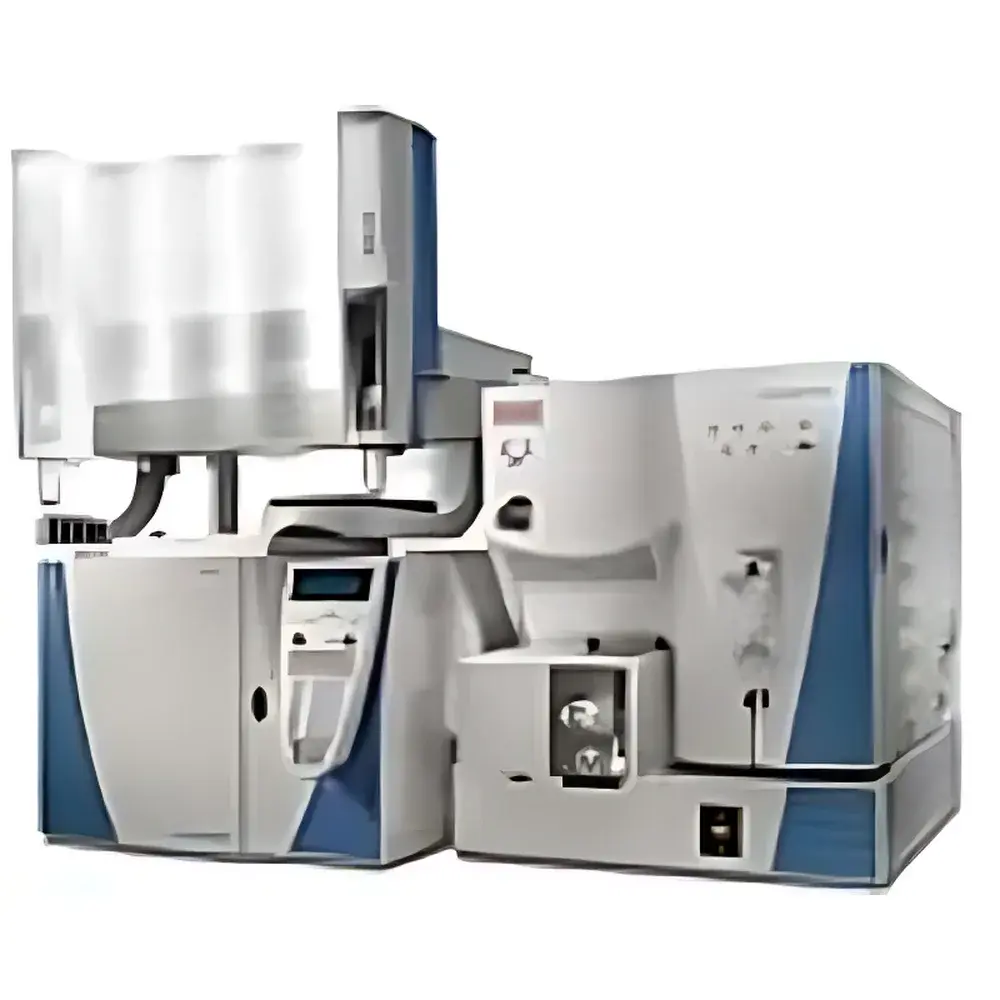
Thermo Scientific TSQ Quantum GC Triple Quadrupole Gas Chromatography-Mass Spectrometer
| Origin | USA |
|---|---|
| Manufacturer Type | Authorized Distributor |
| Origin Category | Imported |
| Model | TSQ Quantum GC |
| Price Range | USD 135,000 – 205,000 (FOB) |
| Instrument Type | Triple Quadrupole Mass Spectrometer |
| Chromatography Configuration | Standalone GC-Coupled System |
| Ionization Modes | Electron Ionization (EI) and Chemical Ionization (CI), switchable without venting |
| Collision Cell | Zero-Crosstalk RF-Only Quadrupole Collision Cell |
| Acquisition Modes | High-Selectivity SRM (H-SRM), Quantitative Enhanced Data-dependent MS/MS (QED-MS/MS) |
| Regulatory Compliance | Fully compliant with FDA 21 CFR Part 11 audit trail, electronic signature, and data integrity requirements |
| Optional Inlets | PPINICI Pulsed Positive/Negative Ion Chemical Ionization Source, DEP/DIP Solid Probe Inlet |
| Flow Control | Digital Mass Flow Controller (MFC) for carrier and reagent gases |
Overview
The Thermo Scientific TSQ Quantum GC is a high-performance triple quadrupole gas chromatography–mass spectrometry (GC-MS/MS) system engineered for demanding quantitative trace analysis in regulated and research environments. Built upon over 25 years of leadership in tandem mass spectrometry for GC applications, the instrument employs a true triple quadrupole architecture—comprising Q1 (mass selection), Q2 (collision-induced dissociation cell), and Q3 (mass analysis)—to deliver exceptional selectivity and sensitivity via selected reaction monitoring (SRM) and its advanced variant, High-Selectivity SRM (H-SRM). Unlike single-quadrupole or ion-trap systems, the TSQ Quantum GC achieves sub-femtogram-level detection limits through optimized ion transmission efficiency, low-noise detection electronics, and a collision cell designed to eliminate cross-talk between precursor and product ion channels. Its core operational principle relies on sequential mass filtering: Q1 isolates a specific precursor ion; Q2 fragments it under controlled collision energy; and Q3 transmits only a designated product ion for detection. This orthogonal, two-stage mass selection enables unambiguous identification and precise quantification—even in highly complex matrices such as environmental extracts, food homogenates, or biological fluids.
Key Features
- Zero-crosstalk RF-only quadrupole collision cell: Eliminates signal interference between adjacent SRM transitions, ensuring analytical specificity and reducing false-positive reporting.
- H-SRM acquisition mode with 1-ms dwell time per transition: Enables high-throughput multi-residue screening—up to 400+ analytes in a single GC run without compromising sensitivity or chromatographic resolution.
- Quantitative Enhanced Data-dependent MS/MS (QED-MS/MS): Simultaneously acquires targeted SRM data for quantitation and data-dependent full-scan MS/MS spectra for structural confirmation—fully automated and synchronized within one acquisition method.
- Switchable EI/CI ion sources without breaking vacuum: Reduces instrument downtime and preserves column integrity during method development or routine operation.
- Digital mass flow control (MFC) for helium or hydrogen carrier gas: Ensures reproducible retention times, optimal peak shape, and compliance with method transfer requirements across laboratories.
- PPINICI source: Supports rapid polarity switching (positive/negative mode) within a single injection for comprehensive screening of acidic, basic, and neutral compounds.
- DEP/DIP solid probe inlet: Facilitates direct thermal desorption analysis of non-volatile or thermally labile samples without derivatization or solvent extraction.
Sample Compatibility & Compliance
The TSQ Quantum GC accommodates a broad range of sample types—including volatile and semi-volatile organic compounds (VOCs/SVOCs), pesticides, PCBs, PAHs, flame retardants, and pharmaceutical impurities—following standard EPA, ASTM, ISO, and AOAC extraction protocols. It supports all common GC columns (e.g., 5% phenyl methylpolysiloxane, polyethylene glycol) and operates under GLP/GMP-compliant workflows. The system’s software architecture meets FDA 21 CFR Part 11 requirements, including role-based user access, immutable audit trails, electronic signatures, and secure data archiving. All instrument control, data acquisition, and report generation functions are validated per IQ/OQ/PQ protocols and support regulatory submissions to EMA, PMDA, and Health Canada.
Software & Data Management
Controlled by Thermo Scientific Chromeleon CDS (Chromatography Data System) v7.3 or later, the TSQ Quantum GC integrates seamlessly into enterprise-wide LIMS environments via ASTM E1384 or HL7 interfaces. Method templates include pre-configured H-SRM and QED-MS/MS workflows aligned with USP , ICH Q2(R2), and ISO/IEC 17025 validation criteria. Raw data files (.raw) are stored in vendor-neutral formats compatible with third-party processing tools (e.g., Compound Discoverer, Sieve, Skyline). Audit logs record every parameter change, integration event, and calibration action—with timestamps, operator IDs, and IP addresses—for full traceability.
Applications
The TSQ Quantum GC is routinely deployed in environmental testing laboratories for EPA Method 8270D and 8260C compliance; in food safety labs for EU SANTE/11312/2021 multi-residue pesticide analysis; in forensic toxicology for controlled substance quantification per SWGTOX guidelines; and in pharmaceutical QC for residual solvent and genotoxic impurity testing per ICH Q3C and Q3D. Its dual GC/LC platform compatibility (via optional interface modules) allows shared method development infrastructure across small-molecule characterization workflows.
FAQ
Does the TSQ Quantum GC support method transfer from legacy TSQ systems?
Yes—backward-compatible method libraries, SRM transition lists, and calibration curves can be imported directly into Chromeleon without re-optimization.
Can H-SRM be used with hydrogen carrier gas?
Yes—the digital MFC and optimized ion optics maintain H-SRM sensitivity and precision across helium, hydrogen, and nitrogen carrier gases.
Is the zero-crosstalk collision cell serviceable in-house?
No—this module is factory-aligned and sealed; maintenance requires certified Thermo Field Service Engineers and traceable calibration certificates.
How does QED-MS/MS differ from conventional DDA or DIA workflows?
QED-MS/MS couples scheduled SRM quantitation with intelligent, intensity-triggered MS/MS acquisition—ensuring every target compound yields both a quantitative response and a confirmatory spectrum in a single injection.
What documentation is provided for 21 CFR Part 11 compliance?
A complete validation package—including URS, FRS, risk assessment, test scripts, summary reports, and administrator/operator training records—is supplied with each system installation.
Related Products





