
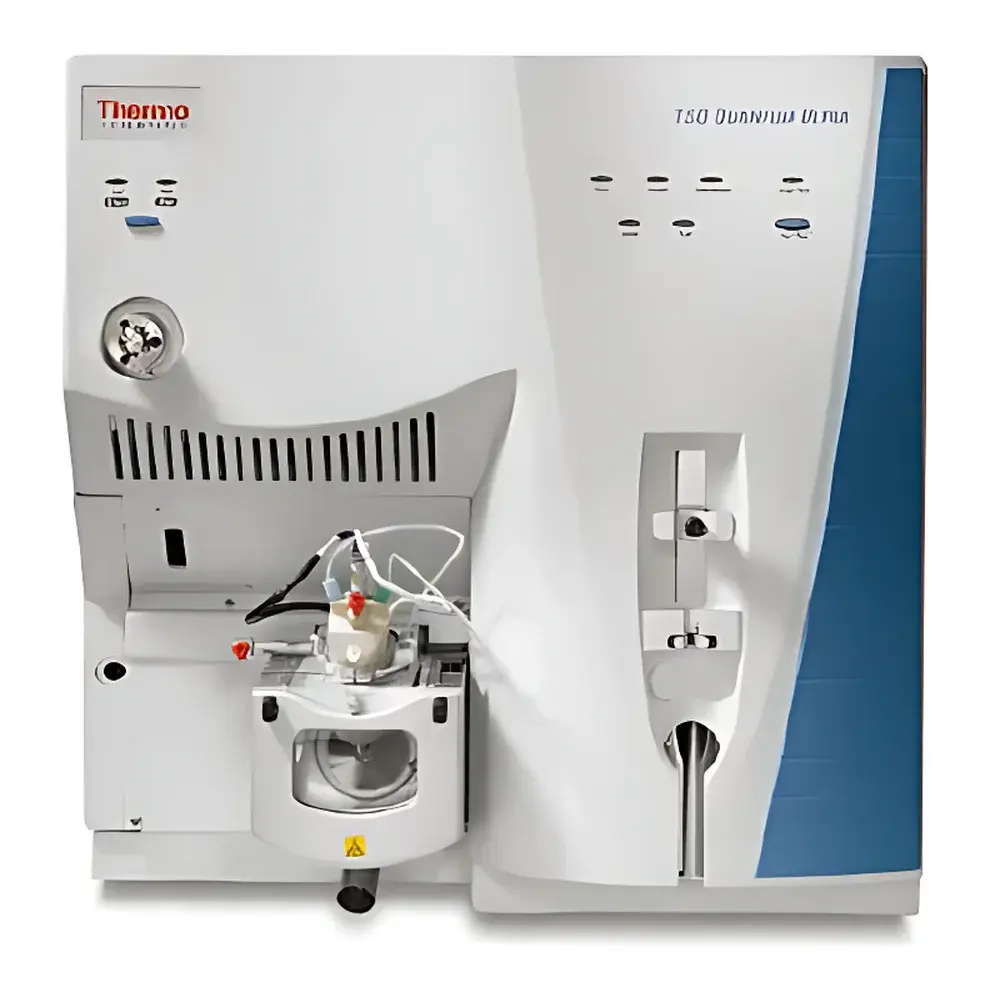
Thermo Scientific TSQ Quantum Ultra Triple Quadrupole Liquid Chromatography Mass Spectrometer
| Brand | Thermo Fisher |
|---|---|
| Origin | USA |
| Manufacturer Type | Original Equipment Manufacturer (OEM) |
| Origin Category | Imported Instrument |
| Model | TSQ Quantum Ultra |
| Instrument Type | Tandem Quadrupole (Triple Quadrupole) |
| Price Range | USD 140,000 – 280,000 (est. FOB US port) |
Overview
The Thermo Scientific TSQ Quantum Ultra is a high-performance triple quadrupole liquid chromatography mass spectrometer (LC-MS/MS) engineered for demanding quantitative analysis in regulated and research-intensive laboratories. Operating on the principle of tandem mass spectrometry—where precursor ions are selected in Q1, fragmented in a pressurized collision cell (Q2), and product ions are analyzed in Q3—the system delivers exceptional specificity, sensitivity, and reproducibility across complex biological, environmental, and food matrices. Designed as the flagship platform within the TSQ Quantum series, the TSQ Quantum Ultra integrates hardware refinements and intelligent acquisition logic to extend dynamic range, improve duty cycle efficiency, and maintain robust performance under high-throughput conditions. Its architecture supports both targeted quantitation (e.g., SRM/MRM) and context-aware qualitative confirmation without method reconfiguration, making it suitable for laboratories requiring simultaneous compliance with regulatory data integrity standards and exploratory analytical flexibility.
Key Features
- Patented Quantitative Enhanced Data-dependent MS/MS (QED-MS/MS): Automatically triggers product ion scans when precursor ion intensity exceeds user-defined thresholds—enabling concurrent quantification and structural confirmation in a single LC run.
- Inverse Collision Energy Ramp: During QED-MS/MS acquisition, the collision energy sweeps linearly from high to low values within <1 second, generating information-rich MS/MS spectra optimized for library matching and fragmentation pattern interpretation.
- Enhanced Ion Transmission Optics: Improved RF stability and optimized ion path geometry increase signal-to-noise ratio and reduce matrix-induced suppression effects in challenging sample types (e.g., plasma, soil extracts, fortified food homogenates).
- Dual-Mode Source Compatibility: Supports electrospray ionization (ESI) and atmospheric pressure chemical ionization (APCI) with rapid polarity switching (<20 ms), enabling broad compound coverage in multi-analyte workflows.
- Robust Vacuum Architecture: Dual-stage differential pumping with turbomolecular and backing pumps ensures stable operation at high flow rates and extended duty cycles, critical for 24/7 laboratory environments.
- Integrated Hardware Synchronization: Precise timing alignment between LC gradient events, MS scan functions, and detector acquisition enables sub-second dwell times and high-density MRM scheduling without spectral skew.
Sample Compatibility & Compliance
The TSQ Quantum Ultra is validated for use with liquid chromatographic systems delivering flow rates from 5 µL/min (nano-LC) to 1 mL/min (conventional HPLC), accommodating reversed-phase, HILIC, and ion-pairing separations. It routinely analyzes small molecules (e.g., pesticides, pharmaceuticals, endogenous metabolites) in matrices including human serum, urine, tissue homogenates, milk, cereals, wastewater, and plant extracts. The instrument meets essential regulatory requirements for GLP and GMP environments: audit trail functionality, electronic signature support, and secure user access controls align with FDA 21 CFR Part 11 guidelines. Method validation documentation adheres to ICH M10 and ASTM D7622–19 protocols for bioanalytical LC-MS/MS assays. Routine performance verification follows Thermo Scientific’s PQ/QC procedures compliant with ISO/IEC 17025:2017 for testing laboratories.
Software & Data Management
Controlled via Thermo Scientific Chromeleon Chromatography Data System (CDS) v7.3 or later, the TSQ Quantum Ultra supports fully integrated method development, acquisition, processing, and reporting. Quantitation workflows leverage Xcalibur Software’s Quan Browser for peak integration, calibration curve fitting (linear, quadratic, weighted), and outlier detection. All raw data files (.raw) are stored in vendor-neutral formats compatible with third-party platforms (e.g., Skyline, SimGlycan) for secondary interpretation. Audit trails record every parameter change, user login/logout, report generation, and instrument state transition—with immutable timestamps and operator ID binding. Data export supports CSV, PDF, and XML formats required for submission to regulatory agencies (EMA, PMDA, NMPA).
Applications
- Food Safety: Multi-residue screening of >300 pesticides, mycotoxins, and veterinary drug residues per injection using QED-MS/MS-enabled workflows.
- Pharmaceutical Development: PK/PD studies with LLOQs ≤ 1 pg/mL in human plasma; metabolite identification supported by retrospective MS/MS spectrum mining.
- Clinical Research: Quantitative analysis of biomarkers (e.g., steroids, acylcarnitines, vitamin D metabolites) under CLIA- and CAP-aligned validation frameworks.
- Environmental Monitoring: Detection of persistent organic pollutants (POPs), PFAS, and pharmaceutical contaminants in surface water at sub-ppt levels.
- Forensic Toxicology: High-confidence identification and quantitation of novel psychoactive substances (NPS) via automated library search against NIST and Wiley spectral databases.
FAQ
What distinguishes QED-MS/MS from conventional data-dependent acquisition (DDA)?
QED-MS/MS is triggered exclusively on pre-specified precursor ions above defined intensity thresholds during scheduled MRM runs—unlike generic DDA—which prioritizes top-N most abundant ions regardless of identity. This preserves quantitative precision while adding confirmatory MS/MS capability without sacrificing throughput.
Is the TSQ Quantum Ultra compatible with UHPLC systems?
Yes. Its fast polarity switching, low dead volume source design, and sub-50-ms dwell time support UHPLC gradients with cycle times ≤ 30 seconds and column IDs down to 1 mm.
Can the system be upgraded to meet current 21 CFR Part 11 requirements?
All TSQ Quantum Ultra units shipped after 2015 include built-in Part 11 features (audit trail, e-signature, role-based access). Legacy installations may require Chromeleon CDS v7.2+ and firmware update v2.12 or higher.
What maintenance intervals are recommended for routine operation?
Ion transfer tube cleaning every 2–4 weeks; collision cell cleaning every 3–6 months; vacuum pump oil replacement every 6 months; annual preventive maintenance by Thermo-certified field service engineers.




