
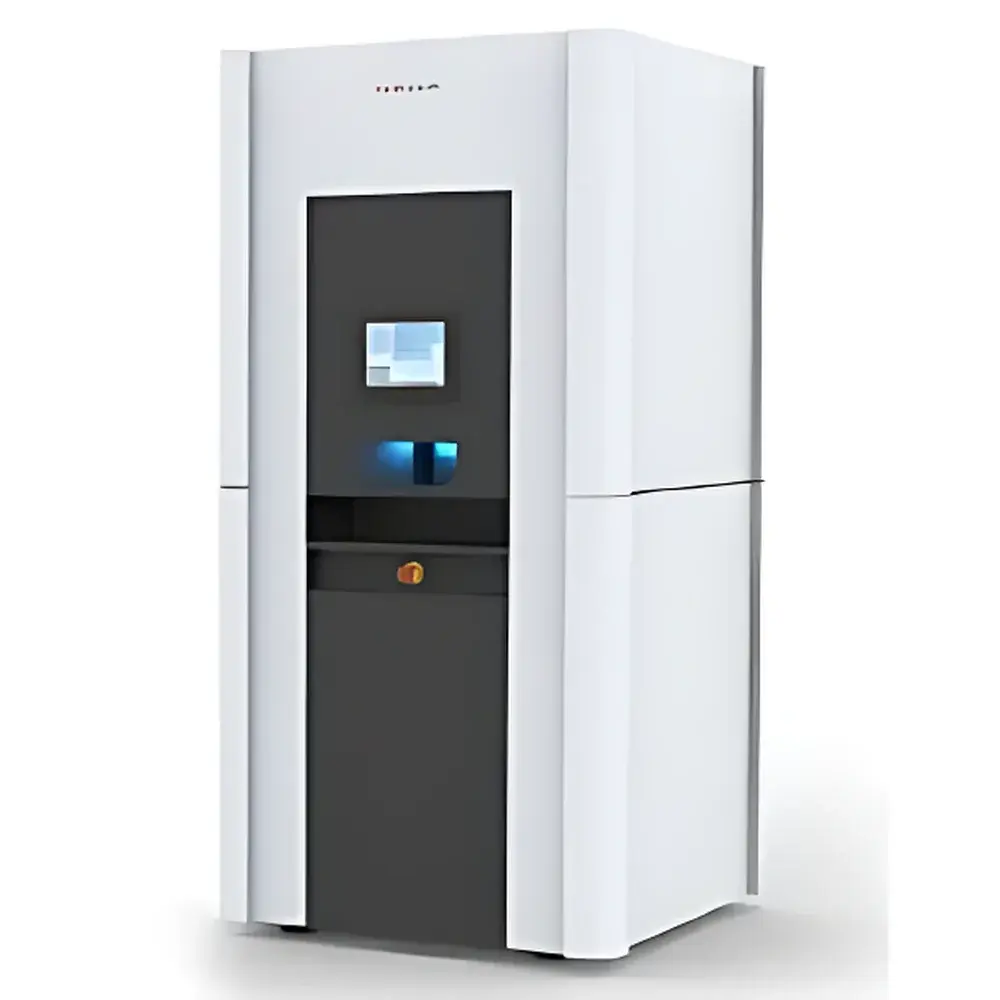
Thermo Scientific Tundra Cryo-Transmission Electron Microscope
| Brand | Thermo Fisher Scientific |
|---|---|
| Origin | Netherlands |
| Model | Tundra |
| Acceleration Voltage | 200 kV (standard configuration) |
| Magnification Range | ×50 to ×1,000,000 |
| Specimen Stage | Single-tilt cryo-transfer holder with automated loading |
| Minimum Information Limit | ≤3.5 Å under optimal conditions (SPA workflow) |
| Footprint | 3.2 m × 2.8 m (including shielding and service clearance) |
Overview
The Thermo Scientific™ Tundra™ Cryo-Transmission Electron Microscope (Cryo-TEM) is a purpose-built, 200 kV field-emission gun (FEG) electron microscope engineered for single-particle analysis (SPA) in structural biology laboratories. Unlike high-end multi-million-dollar cryo-TEM platforms requiring dedicated infrastructure and expert operators, the Tundra integrates streamlined hardware architecture, embedded automation, and AI-assisted acquisition workflows to deliver near-atomic resolution structural data—typically ≤3.5 Å resolution under optimized SPA conditions—within standard bioscience lab environments. Its design adheres to the core physical principles of cryogenic transmission electron microscopy: vitrified biological specimens are imaged under high vacuum at liquid nitrogen temperatures (≤−180 °C), minimizing beam-induced motion and radiation damage while preserving native conformational states. The system employs a cold field-emission electron source, a high-stability objective lens with spherical aberration correction (Cs-corrected optics optional per configuration), and a direct electron detector (DED) optimized for low-dose imaging and dose-fractionated movie acquisition.
Key Features
- Integrated cryo-transfer system with automated sample shuttle and pre-aligned cartridge loading—enabling rapid, reproducible grid insertion without manual alignment or vacuum break.
- AI-guided acquisition software (Tundra AI Assistant) that evaluates micrograph quality in real time, recommends optimal defocus range and exposure settings, and auto-triggers focus/astigmatism correction routines.
- Predefined, application-specific acquisition templates—including “Quick Screen”, “High-Res SPA”, and “2D Class Averaging”—accessible via intuitive touchscreen interface with minimal user input.
- Compact footprint (3.2 m × 2.8 m) compatible with standard laboratory floor loading (≤500 kg/m²) and standard 230 V / 32 A power supply; no external water chiller or helium cryogen required.
- Embedded GLP-compliant audit trail: all acquisition parameters, user actions, calibration events, and software version logs are timestamped and stored in encrypted binary metadata alongside raw image files.
Sample Compatibility & Compliance
The Tundra supports standard 300-mesh copper or gold TEM grids coated with continuous carbon or holey carbon films (e.g., Quantifoil R2/2, UltrAuFoil). It accommodates both plunge-frozen and high-pressure frozen (HPF) samples transferred via Gatan 626 or similar cryo-holders. All cryo-handling protocols comply with ISO 13485–certified manufacturing standards for medical device-related structural validation. For regulated environments, the system supports 21 CFR Part 11–compliant electronic signatures when paired with Thermo Fisher’s Connect LMS platform, enabling traceable user authentication, role-based access control, and immutable data archiving. Routine performance verification follows ASTM E2793–21 (Standard Practice for Calibration of Transmission Electron Microscopes) and ISO/IEC 17025–aligned internal QC procedures.
Software & Data Management
Acquisition and preliminary processing are managed through Thermo Scientific EPU 3.0 software, extended with Tundra-specific modules for real-time motion correction, CTF estimation, and on-the-fly particle picking. Raw data (TIFF/DM4 format) and processed metadata are automatically synced to local NAS or cloud-hosted repositories via secure SFTP or Thermo Fisher Cloud APIs. All datasets retain FAIR (Findable, Accessible, Interoperable, Reusable) compliance through embedded MIAME- and EMDB-compatible metadata schemas. Software updates are delivered via signed firmware packages with SHA-256 verification; rollback capability is retained for up to three prior versions to ensure experimental reproducibility across longitudinal studies.
Applications
The Tundra Cryo-TEM serves as a primary structural characterization tool for academic and industrial life science labs engaged in membrane protein complex analysis, vaccine antigen design, antibody–epitope mapping, and oligomeric state validation of recombinant biologics. It enables iterative experimental cycles—sample screening, grid optimization, data collection, and initial 2D classification—within a single day, significantly accelerating target validation timelines. Its robustness supports routine use in core facilities serving multiple research groups, and its standardized output formats integrate natively with RELION, cryoSPARC, and cisTEM pipelines for downstream high-resolution 3D reconstruction.
FAQ
Is the Tundra suitable for novice TEM users?
Yes—the system eliminates manual alignment steps, embeds contextual help prompts, and uses guided workflows that require no prior TEM training.
Does it support automated data collection across multiple grids?
Yes—via programmable stage navigation and grid-level metadata tagging, enabling unattended overnight acquisition across up to 12 grids per session.
What regulatory documentation is provided for GMP/GLP environments?
Factory-issued IQ/OQ protocols, 21 CFR Part 11 readiness assessment reports, and instrument-specific risk assessments are included with delivery.
Can existing cryo-TEM data processing pipelines be used with Tundra output?
Yes—all raw movies and metadata conform to the EMPIAR and EMDB submission standards; no proprietary format conversion is required.
What maintenance intervals are recommended?
Annual preventive maintenance (PM) by Thermo Fisher Field Service Engineers is recommended; column cleaning and filament replacement are scheduled based on cumulative beam-on time (threshold: 1,000 hours).





