
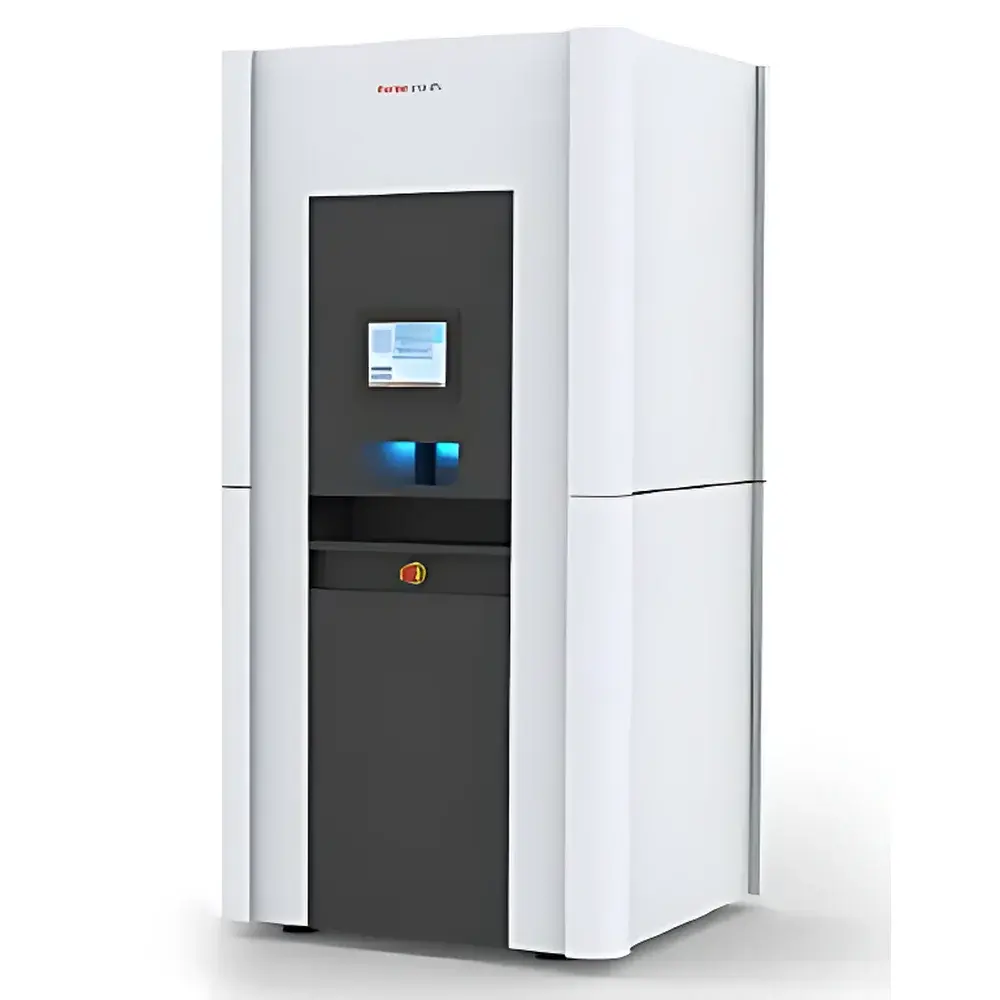
Thermo Scientific Tundra Cryo-Transmission Electron Microscope
| Brand | Thermo Scientific |
|---|---|
| Origin | Netherlands |
| Manufacturer Type | Authorized Distributor |
| Origin Category | Imported |
| Model | Tundra |
| Accelerating Voltage | Fixed 100 kV |
| Maximum Magnification | 650,000× |
Overview
The Thermo Scientific™ Tundra™ Cryo-Transmission Electron Microscope (Cryo-TEM) is a purpose-built, entry-level cryogenic electron microscope engineered for single-particle analysis (SPA) in structural biology laboratories. It operates on the fundamental principle of high-voltage electron transmission through vitrified biological specimens—rapidly frozen to preserve native hydration and conformational states in amorphous ice. At a fixed accelerating voltage of 100 kV, the system delivers consistent beam energy optimized for high signal-to-noise imaging of macromolecular complexes without requiring ultra-high vacuum infrastructure or liquid helium cooling. Unlike conventional high-end Cryo-TEM platforms, the Tundra is designed with a simplified optical column architecture and integrated thermal management, enabling stable operation in standard laboratory environments (20–25 °C, <60% RH) without dedicated TEM rooms or vibration-isolation foundations. Its compact footprint (<3 m² floor space) and modular installation protocol reduce facility modification requirements—making it accessible to academic core facilities, biotech R&D labs, and teaching institutions where infrastructure and expertise are constrained.
Key Features
- Vitrification-optimized imaging workflow: Integrated cryo-transfer stage with automated anti-contamination shutter and dual-stage cryo-holder support ensures reproducible specimen handling at ≤−180 °C under high vacuum.
- User-centric automation: AI-assisted acquisition pipeline guides novice users through grid screening, focus optimization, drift correction, and dose-fractionated movie acquisition—all via preconfigured protocols aligned with common SPA sample types (e.g., membrane proteins, viral capsids, ribonucleoprotein complexes).
- Iterative sample assessment: Real-time low-dose preview mode enables rapid evaluation of ice thickness, particle distribution, and aggregation state—reducing wasted beam time and accelerating biochemical optimization cycles.
- Self-improving acquisition engine: Onboard machine learning algorithms analyze metadata from prior sessions (defocus spread, CTF estimation accuracy, particle picking yield) to refine subsequent acquisition parameters—enhancing long-term reproducibility across operators and instruments.
- Intuitive software interface: Touch-enabled control panel with context-aware tooltips, visual feedback on beam alignment status, and one-click transition between low-magnification survey and high-resolution data collection modes.
Sample Compatibility & Compliance
The Tundra supports standard 300-mesh copper or gold grids with continuous carbon or graphene oxide films, compatible with common vitrification methods including plunge-freezing (using Vitrobot™ or manual blotting) and high-pressure freezing (HPF)-processed lamellae (with optional FIB-SEM integration). It meets ISO 14644-1 Class 5 cleanroom requirements for internal column environment and complies with IEC 61000-6-3 (EMC emissions) and IEC 61000-6-2 (immunity) standards. Data acquisition workflows adhere to FAIR principles (Findable, Accessible, Interoperable, Reusable), with native export to EMDB- and PDB-compatible formats (MRC, STAR, CIF). Audit trails—including operator ID, timestamped parameter logs, and raw movie metadata—are retained per session to support GLP-compliant documentation and FDA 21 CFR Part 11 readiness when paired with validated LIMS integration.
Software & Data Management
Powered by Thermo Scientific™ EPU™ Software v4.x, the Tundra provides end-to-end SPA workflow management—from automated grid mapping and multi-location acquisition to on-the-fly motion correction and contrast transfer function (CTF) estimation. All processing steps generate traceable JSON metadata compliant with the EMPIAR (Electron Microscopy Public Image Archive) submission schema. Raw data are stored in vendor-agnostic HDF5 containers with embedded calibration parameters (pixel size, magnification, defocus range), ensuring interoperability with third-party reconstruction packages (RELION, cryoSPARC, cisTEM). Optional cloud-sync modules enable secure, encrypted transfer to institutional HPC clusters or commercial GPU-accelerated processing services—minimizing local computational overhead while preserving data sovereignty.
Applications
- Atomic-resolution structure determination of heterogeneous protein complexes (e.g., spliceosome submodules, GPCR-arrestin assemblies)
- Conformational dynamics mapping of flexible domains in large enzymes (e.g., AAA+ ATPases, CRISPR-Cas effectors)
- In situ structural analysis of cellular organelles isolated via cryo-FIB milling
- Quality control of therapeutic protein formulations (e.g., monoclonal antibody aggregates, virus-like particles)
- Teaching and method development in undergraduate and graduate structural biology curricula
FAQ
Is the Tundra suitable for high-resolution reconstruction (≤3.0 Å)?
Yes—when coupled with high-quality vitrified samples, dose-symmetric acquisition, and appropriate downstream processing, the Tundra routinely achieves near-atomic resolution (2.8–3.5 Å) for well-behaved targets such as apoferritin or β-galactosidase.
Does it support automated data collection across multiple grids?
Yes—the EPU software enables unattended multi-grid screening and targeted acquisition using grid-level metadata tagging and adaptive focus modeling.
Can existing Thermo Scientific TEM users migrate workflows to the Tundra?
Yes—EPU v4.x maintains backward compatibility with legacy acquisition scripts and supports cross-platform parameter portability via standardized .epuconfig files.
What maintenance intervals are recommended?
Annual column cleaning and filament replacement; quarterly calibration of beam tilt, stigmator, and image shift—performed by certified field service engineers using remote diagnostics support.
Is remote training and technical support available?
Yes—Thermo Scientific offers virtual onboarding, live troubleshooting via secure screen-sharing, and access to an on-demand video library covering sample prep, alignment, and basic reconstruction pipelines.




