
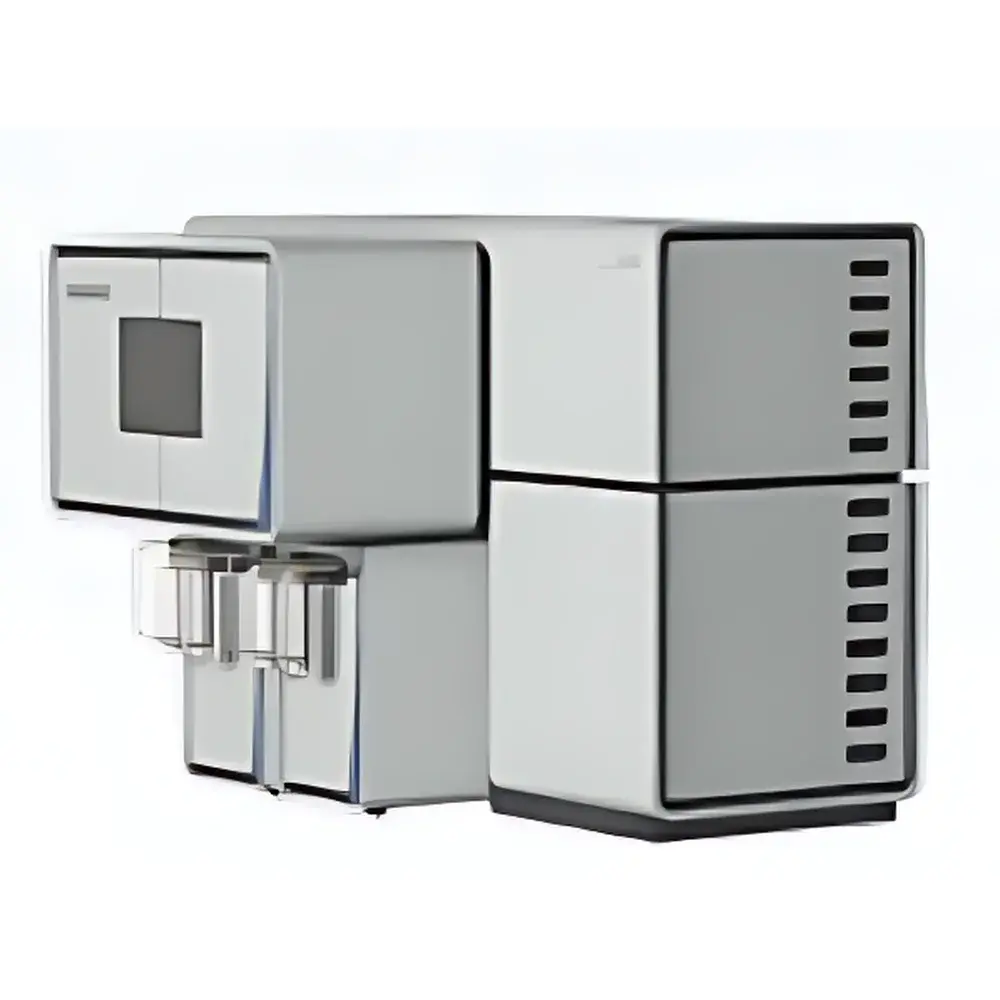
Thermo Scientific Ultra High-Resolution Isotope Ratio Mass Spectrometer
| Brand | Thermo Fisher |
|---|---|
| Origin | Germany |
| Manufacturer Type | Original Equipment Manufacturer (OEM) |
| Origin Category | Imported |
| Model | Ultra |
| Price Range | USD 420,000 – 700,000 |
| Instrument Type | Stable Gas-Source Isotope Ratio Mass Spectrometer |
Overview
The Thermo Scientific Ultra High-Resolution Isotope Ratio Mass Spectrometer (IRMS) is a purpose-engineered dual-focusing sector-field mass spectrometer designed for ultra-precise measurement of stable isotope ratios in light elements (e.g., H, C, N, O, S) from gas-source samples. Operating on the principle of magnetic sector mass separation combined with electrostatic energy filtering, the Ultra achieves exceptional mass-resolving power (M/ΔM > 25,000 at 10% valley definition), enabling unambiguous separation of isobaric and near-isobaric interferences—critical for site-specific isotopic analysis (position-specific isotope analysis, PSIA) and molecular coupling studies. Its architecture supports both continuous-flow (CF-IRMS) and multi-collector static-mode operation, delivering long-term stability (<0.05‰ δ-value drift over 8 hours) and high reproducibility (±0.01–0.03‰ 1σ for δ13C, δ15N, δ18O under optimized conditions). The system is engineered for integration with peripheral preparation devices—including elemental analyzers (EA), gas chromatographs (GC), laser fluorination systems, and cryogenic purification modules—ensuring full traceability from sample introduction to final isotopic ratio calculation.
Key Features
- Dual-focusing sector-field mass analyzer with switchable entrance slits, enabling automated selection among high-, medium-, and low-resolution modes (M/ΔM = 10,000–25,000+) without hardware reconfiguration.
- Variable multi-collector array accommodating up to nine simultaneously configurable detectors: Faraday cups (with 1011 Ω resistors), discrete-dynode secondary electron multipliers (SEMs), and axial SEM equipped with proprietary RPQ (retarding potential quadrupole) lens for <1 × 10⁻⁹ abundance sensitivity—essential for detecting trace isotopologues in complex matrices.
- High-stability ion optics with active thermal management and vibration-damped mounting, minimizing signal noise and enhancing long-term mass calibration fidelity.
- Integrated high-vacuum system featuring dual-stage turbomolecular pumping and cryo-trapping, achieving base pressures <5 × 10⁻⁹ mbar during analysis—critical for minimizing background hydrocarbon interference and memory effects.
- Modular front-end compatibility with ISO/IEC 17025-compliant gas handling interfaces, including standardized 1/8″ VCR connections and pressure-controlled inlet manifolds for seamless coupling to EA, GC, or TC/EA systems.
Sample Compatibility & Compliance
The Ultra IRMS accepts gaseous samples introduced via helium carrier stream (CF-IRMS mode) or static-fill manifold (multi-static mode), supporting CO2, N2, CO, CH4, SO2, NO, H2, O2, and halogenated compounds following standard conversion protocols (e.g., high-temperature combustion, pyrolysis, fluorination). It complies with ASTM D7627 (δ13C in natural gas), ISO 14284 (iron and steel isotopes), and USP (isotopic purity of pharmaceuticals). Data acquisition and reporting meet FDA 21 CFR Part 11 requirements through optional audit-trail-enabled software modules, supporting GLP/GMP laboratory workflows and regulatory submissions. All detector configurations adhere to IUPAC Technical Report guidelines for isotopic delta notation and uncertainty propagation.
Software & Data Management
Controlled by Thermo Scientific Qtegra ISM software v4.5+, the Ultra offers method-driven automation for instrument tuning, peak centering, baseline correction, and non-linear detector response normalization. Raw data are stored in vendor-neutral .raw format compliant with mzML 1.1 schema; processed results export to CSV, Excel, or LIMS-compatible XML. Built-in statistical tools include Monte Carlo-based uncertainty estimation, internal standard correction (e.g., CO2-based reference gas bracketing), and multi-point linearity validation per ASTM D6866 Annex A3. Audit trails log all parameter changes, user actions, and calibration events with timestamped digital signatures—fully traceable for ISO 17025 accreditation audits.
Applications
- Climate science: High-precision δ13C and δ2H in atmospheric CH4 to distinguish biogenic vs. thermogenic sources; position-specific 13C in CO2 for photosynthetic pathway discrimination.
- Biogeochemistry: Triple-oxygen (δ17O, δ18O) anomalies in nitrates and sulfates to reconstruct paleo-oxidation conditions.
- Forensics: Compound-specific δ15N and δ13C in illicit drugs, explosives, and human remains for geographic origin attribution.
- Petroleum geochemistry: Site-specific deuterium distribution in alkanes (D/Hsite) to infer thermal maturity and migration history.
- Pharmaceutical QA: Verification of synthetic origin via 13C-pattern analysis (isotopic fingerprinting) in APIs per ICH Q5C guidelines.
FAQ
What types of gases can be analyzed directly on the Ultra IRMS?
CO2, N2, CO, CH4, SO2, NO, O2, H2, and SF6—provided they are purified to >99.999% purity and introduced via helium carrier or static fill.
Does the Ultra support simultaneous measurement of multiple isotopes?
Yes—via configurable multi-collector arrays, it enables true simultaneous detection of up to nine isotopic species (e.g., 12C16O16O+, 13C16O16O+, 12C16O18O+, 16O18O+, etc.) with sub-ppq abundance sensitivity.
Is remote diagnostics and service support available?
Yes—Thermo Fisher’s SecureConnect™ platform enables encrypted remote access for real-time performance monitoring, predictive maintenance alerts, and secure firmware updates under ISO/IEC 27001-certified infrastructure.
Can the Ultra be integrated into an existing CF-IRMS lab infrastructure?
Yes—it conforms to standard CF-IRMS interface specifications (e.g., 0–10 V analog output, RS-232/USB control, TTL trigger signals) and supports third-party gas chromatographs and elemental analyzers via open communication protocols (TCP/IP, Modbus TCP).




