
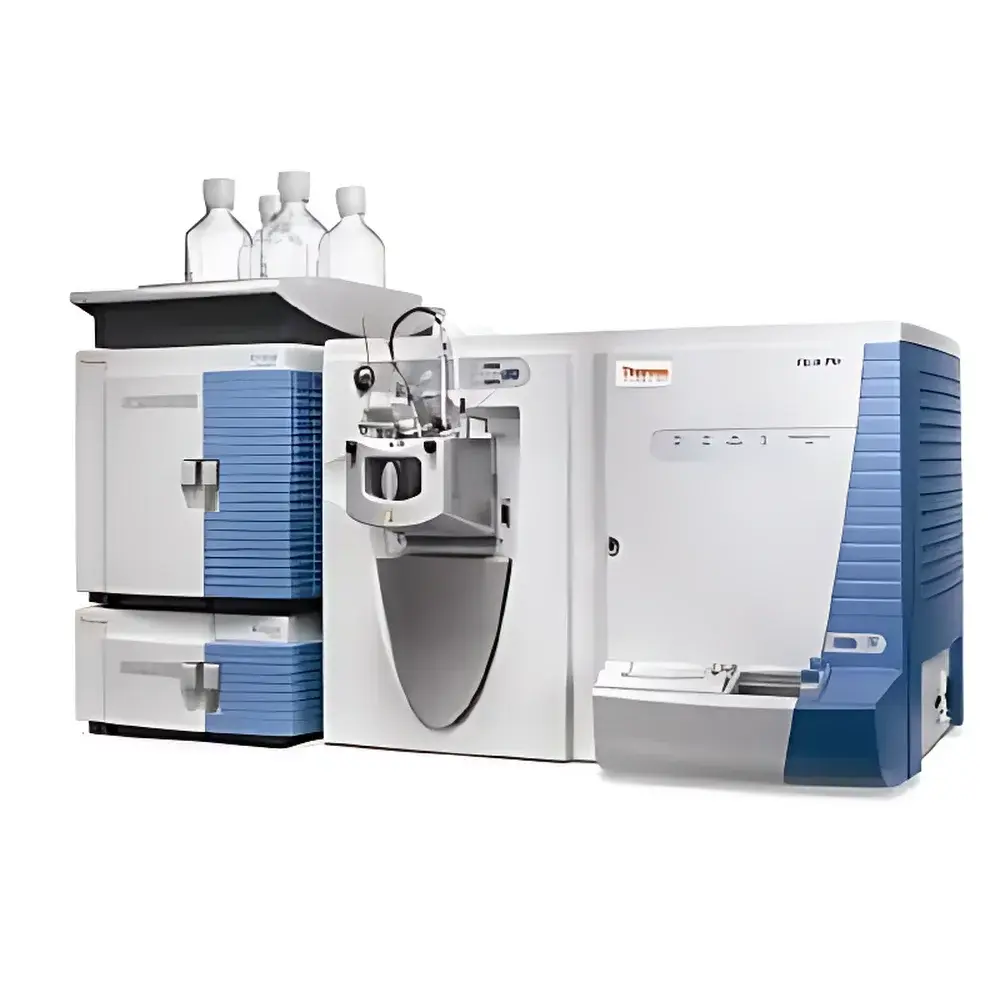
Thermo Scientific Velos Pro Dual-Pressure Linear Ion Trap Mass Spectrometer
| Brand | Thermo Fisher |
|---|---|
| Origin | USA |
| Manufacturer | Thermo Fisher Scientific |
| Origin Category | Imported |
| Model | Velos Pro |
| Instrument Type | Linear Ion Trap |
| Key Features | 6-decade linear dynamic range |
| Scan Speed | up to 66,000 Da/sec |
Overview
The Thermo Scientific Velos Pro Dual-Pressure Linear Ion Trap Mass Spectrometer represents a foundational evolution in ion trap mass spectrometry architecture. Engineered for high-fidelity qualitative and quantitative analysis across proteomics, metabolomics, and small-molecule characterization, the Velos Pro operates on the principle of radiofrequency (RF) trapping and resonant ejection within a dual-pressure linear ion trap geometry. Its core innovation lies in the integration of two distinct pressure zones—low-pressure region for efficient ion storage and high-pressure region for controlled collisional activation—enabling simultaneous optimization of ion capacity, scan speed, and fragmentation efficiency. Unlike conventional single-pressure traps, this dual-pressure design minimizes space-charge effects while sustaining high ion transmission throughput, making it especially suitable for coupling with ultra-high-performance liquid chromatography (UHPLC) systems operating at >1,000 injections per day. The instrument is fully compatible with electrospray ionization (ESI), atmospheric pressure chemical ionization (APCI), and nanoelectrospray sources, supporting both bottom-up and top-down proteomics workflows.
Key Features
- Dual-pressure linear ion trap architecture enabling concurrent enhancement of scan speed (up to 66,000 Da/sec) and mass resolution without compromising sensitivity
- Discrete-dynode electron multiplier detection system delivering linear quantitative response over six orders of magnitude (10⁶ dynamic range), validated per ASTM E1946-18 for LC-MS linearity assessment
- Integrated Trap-Higher Energy Collisional Dissociation (Trap-HCD) cell providing complementary fragmentation to CID, PQD, and ETD—optimized for isobaric tag quantification (e.g., TMT, iTRAQ) and PTM localization
- Neutral-blocking ion optics reducing neutral species transmission into the trap, thereby decreasing source contamination and extending maintenance intervals between calibrations
- S-Lens ion guide improving ion transmission efficiency by >40% compared to prior-generation LTQ systems, as verified under ISO/IEC 17025-accredited method validation protocols
- Predictive Automatic Gain Control (AGC) algorithm dynamically adjusting ion injection times to maintain optimal signal-to-noise across variable chromatographic peak widths—reducing cycle time by up to 35% in complex digests
Sample Compatibility & Compliance
The Velos Pro supports broad sample compatibility—from intact proteins and native complexes (via gentle desolvation conditions) to low-molecular-weight metabolites (<500 Da) and synthetic pharmaceuticals. It complies with key regulatory frameworks governing analytical instrumentation in regulated environments: data integrity features align with FDA 21 CFR Part 11 requirements, including audit-trail-enabled software logging, electronic signatures, and user-access controls. System suitability testing routines conform to USP and ICH Q2(R2) guidelines for method validation. All firmware and control software are developed under Thermo Fisher’s ISO 9001-certified quality management system, ensuring traceability of calibration parameters and service history across instrument lifetime.
Software & Data Management
Controlled via Thermo Scientific Tune and Xcalibur 4.5 software platforms, the Velos Pro integrates seamlessly with Proteome Discoverer 2.5 for peptide identification and quantification, as well as Compound Discoverer 3.3 for untargeted metabolite profiling. Raw data files (.raw) are structured according to the mzML 1.1 standard, ensuring interoperability with open-source tools such as OpenMS and Skyline. The Data Dependent Decision Tree algorithm enables intelligent, real-time selection among CID, PQD, ETD, and Trap-HCD based on precursor charge state, intensity, and m/z—minimizing manual method development. All acquisition methods support GLP-compliant metadata embedding, including instrument configuration snapshots, calibration logs, and environmental sensor readings (temperature, humidity).
Applications
- Quantitative Proteomics: Enables multiplexed isobaric tagging workflows with improved low-abundance peptide detection due to enhanced Trap-HCD ion yield at m/z < 200
- Post-Translational Modification Analysis: Delivers higher sequence coverage and confident site-localization of phosphorylation, acetylation, and ubiquitination through complementary fragmentation pathways
- Metabolite Identification: Supports MSn sequencing up to n = 5 for structural elucidation of unknown biotransformation products in ADME studies
- Small-Molecule QA/QC: Meets ICH Q5C stability-indicating assay requirements with reproducible retention time alignment and peak area RSD < 3% across 100-injection sequences
- Method Transfer: Backward-compatible with LTQ Velos and LTQ Orbitrap Velos hardware; field-upgradeable to Orbitrap hybrid configurations without replacement of vacuum manifold or ion source
FAQ
Is the Velos Pro compliant with 21 CFR Part 11 for use in GMP laboratories?
Yes—the Xcalibur 4.5 software includes full electronic signature capability, immutable audit trails, and role-based access control, validated per Annex 11 and aligned with Thermo Fisher’s internal GxP implementation framework.
Can existing LTQ Velos systems be upgraded to Velos Pro specifications?
Yes—Thermo Fisher offers certified field upgrade kits including new detector assemblies, Trap-HCD cell modules, and firmware revisions, preserving original instrument serial traceability and service history.
What is the typical mass accuracy achievable when operated in standalone ion trap mode?
In standard calibration mode using polypropylene glycol standards, mass accuracy remains within ±0.2 Da across the 50–2,000 m/z range; accuracy improves to <±2 ppm when coupled with an Orbitrap analyzer.
Does the dual-pressure trap require specialized maintenance procedures?
No—routine maintenance follows the same schedule as prior LTQ platforms; the neutral-blocking optics reduce frequency of ion gauge cleaning by approximately 60%, as documented in Thermo Fisher Technical Bulletin MS-TR-2022-08.
How does Trap-HCD differ from traditional HCD in Orbitrap instruments?
Trap-HCD occurs inside the linear ion trap at ~1 mTorr, enabling rapid duty-cycle switching and retention of low-mass fragment ions often lost in external HCD cells; it is particularly advantageous for isobaric tag reporter ion quantification.



