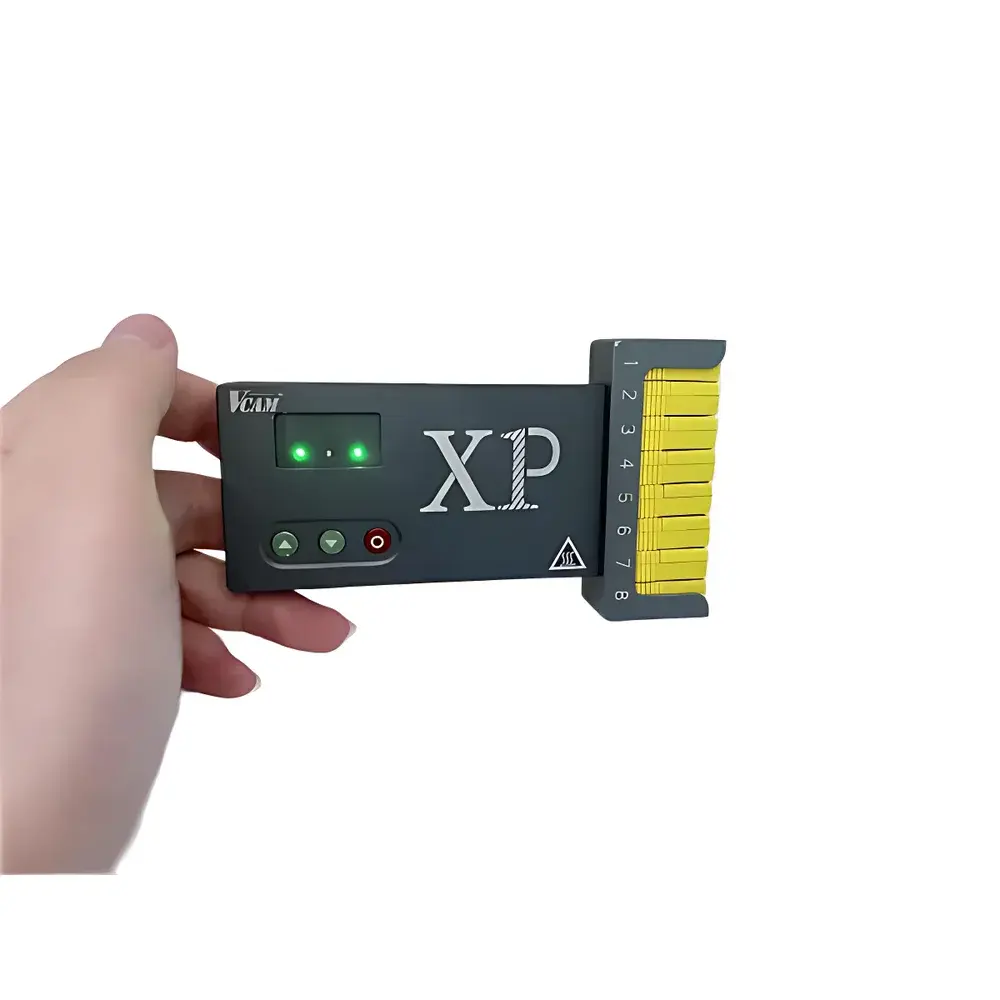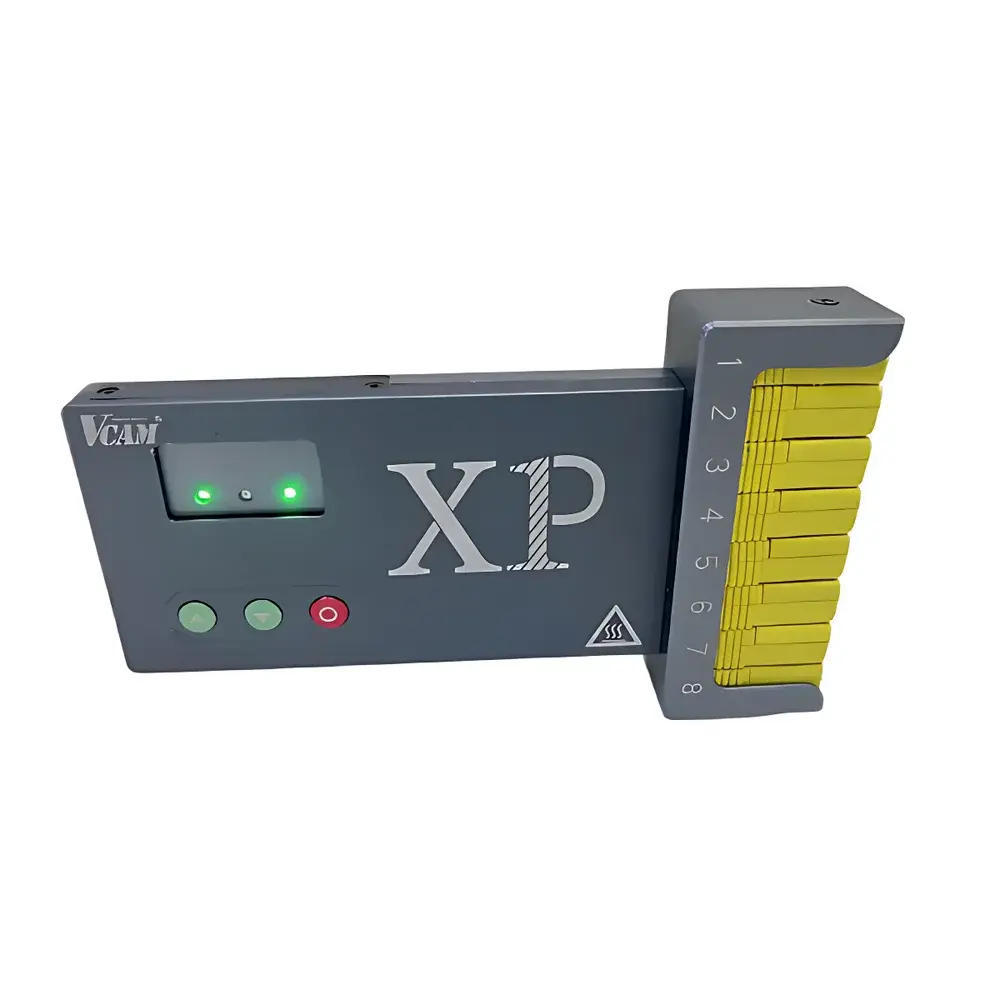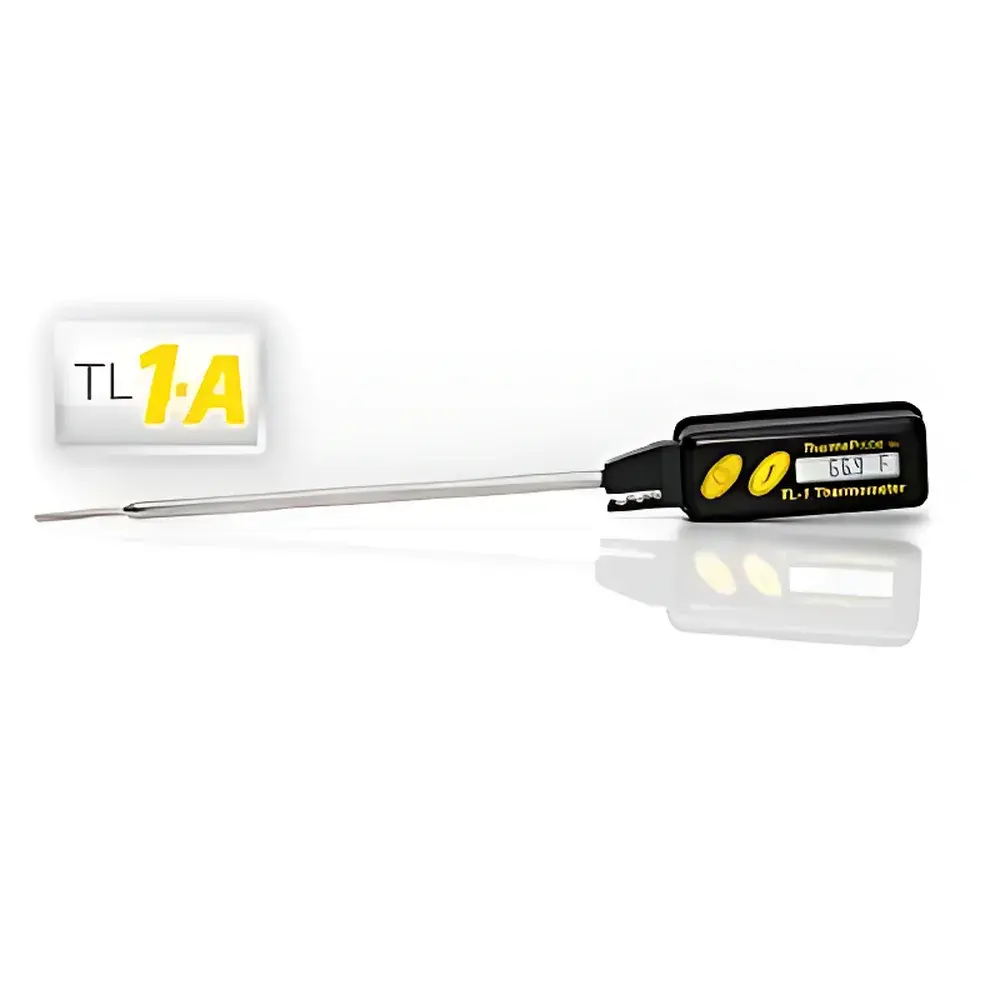
Thermoprobe TL1-A Intrinsically Safe Digital Laboratory Thermometer
| Brand | Thermoprobe |
|---|---|
| Origin | USA |
| Model | TL1-A |
| Temperature Range | -10°C to 160°C |
| Accuracy | ±0.07°C (-10°C to 160°C), ±0.1°F (14°F to 320°F) |
| Resolution | 0.01°C |
| Operating Ambient Temperature | -20°C to 54°C (-4°F to 130°F) |
| Display | 0.25" LCD |
| Power Supply | 3V CR2032 coin cell battery |
| Probe Length | 20 cm (8"), Probe Diameter: 6.35 mm (1/4"), Tip Diameter: 4.76 mm (3/16") |
| Enclosure | Anodized aluminum housing (3.5" × 12"), silicone-sealed |
| Weight | 93 g (3.3 oz) |
| Auto-off | After 20 minutes of inactivity or continuous operation |
| Units | Switchable °C / °F |
| Sensor Material | Stainless steel |
| Thermal Response Time (in water bath) | 14 seconds |
| Battery Life | ~400 hours at 21°C (70°F) |
Overview
The Thermoprobe TL1-A Intrinsically Safe Digital Laboratory Thermometer is a rigorously engineered temperature measurement instrument designed for use in hazardous environments where explosion risk exists—such as chemical synthesis labs, pharmaceutical cleanrooms, solvent-handling facilities, and petrochemical QC laboratories. Built to comply with intrinsic safety requirements for Class I, Division 1 (Groups A–D) and ATEX/IECEx Zone 0/1 applications (certification documentation available upon request), the TL1-A integrates a precision-grade stainless steel RTD sensor with a fully isolated, low-energy electronic architecture. Its measurement principle relies on high-stability platinum resistance (Pt100-class equivalent performance) calibrated against NIST-traceable standards, delivering metrologically defensible data across its full operating range of –10°C to 160°C. Unlike general-purpose thermometers, the TL1-A features a certified intrinsically safe barrier integrated within its anodized aluminum enclosure—eliminating the need for external safety barriers while maintaining signal integrity and long-term drift stability.
Key Features
- Intrinsically safe design certified for use in explosive atmospheres per UL 913 8th Edition and IEC 60079-11:2017 requirements
- NIST-traceable calibration certificate supplied with each unit, supporting ISO/IEC 17025-compliant laboratory quality systems
- High-resolution 0.01°C display with dual-unit capability (°C/°F) and intuitive membrane keypad interface
- Stainless steel probe (20 cm length, 6.35 mm shank, 4.76 mm tip) optimized for rapid thermal equilibration—14-second response time in stirred water bath
- Rugged anodized aluminum housing (3.5″ × 12″) with silicone gasket sealing, rated IP65 for dust and water resistance
- Low-power electronics powered by a single CR2032 3V lithium coin cell, delivering up to 400 hours of continuous operation at 21°C
- Intelligent power management: auto-shutdown after 20 minutes of inactivity or uninterrupted operation to preserve battery life and prevent thermal drift
- Operating ambient range of –20°C to 54°C; battery functionality validated down to –20°C (though output voltage may decline below 4°C/40°F)
Sample Compatibility & Compliance
The TL1-A is compatible with liquid, semi-solid, and gaseous samples encountered in regulated laboratory workflows—including aqueous buffers, organic solvents, polymer melts, and sterilization validation media. Its stainless steel probe meets USP guidance for analytical instrument qualification and supports Phase-appropriate verification per FDA Process Validation Guidance (2011). The device complies with ASTM E74-22 (Standard Practice for Calibration of Thermometers) and supports GLP/GMP audit readiness through documented traceability, calibration history retention, and stable baseline performance. While not a data-logging instrument, its fixed-point repeatability (±0.02°C over 100 cycles at 25°C) satisfies routine monitoring requirements under ISO 17025 Clause 6.4.2.
Software & Data Management
The TL1-A operates as a standalone, non-networked measurement endpoint with no embedded firmware update capability or USB/Bluetooth connectivity. All configuration and readout occur via front-panel controls and the integrated LCD. For laboratories requiring electronic record integration, optional analog output modules (0–5 V or 4–20 mA) are available under separate part number TL1-A-ANALOG (subject to additional intrinsic safety review). Calibration data—including date, standard reference, deviation values, and technician ID—is recorded manually or entered into LIMS via standardized template (e.g., CSV import). The NIST-traceable certificate includes uncertainty budgets per GUM (JCGM 100:2008) and supports 21 CFR Part 11 compliance when paired with validated electronic signature workflows in validated LIMS environments.
Applications
- Temperature verification during autoclave, dry-heat oven, and incubator qualification (IQ/OQ/PQ)
- In-process monitoring of exothermic reactions in explosion-proof fume hoods or gloveboxes
- Calibration transfer between reference thermometers and working standards in metrology labs
- Stability testing of APIs and formulated products per ICH Q1A(R2)
- Environmental chamber validation in pharmaceutical manufacturing suites
- Batch release testing where electrical ignition sources must be eliminated near flammable vapors
FAQ
Is the TL1-A certified for Class I, Division 1 hazardous locations?
Yes—the TL1-A carries UL listing for Class I, Division 1, Groups A–D per UL 913 8th Edition. Full certification documentation is provided with shipment.
Can the probe be autoclaved?
No—the stainless steel probe is chemically resistant but not rated for steam sterilization; repeated exposure to >121°C will degrade sensor stability and void calibration validity.
What is the uncertainty of measurement at 100°C?
At 100°C, expanded uncertainty (k=2) is ±0.11°C, derived from calibration certificate data and sensor stability analysis per ISO/IEC 17025 Annex A.
Does it support user calibration adjustment?
No—field calibration adjustment is disabled to maintain intrinsic safety integrity and metrological traceability; recalibration must be performed by an accredited lab using NIST-traceable references.
How is battery replacement handled in classified areas?
The battery compartment is sealed with a captive screw and requires tool-assisted access; replacement must occur outside the hazardous zone per NEC Article 500 and IEC 60079-14 guidelines.