
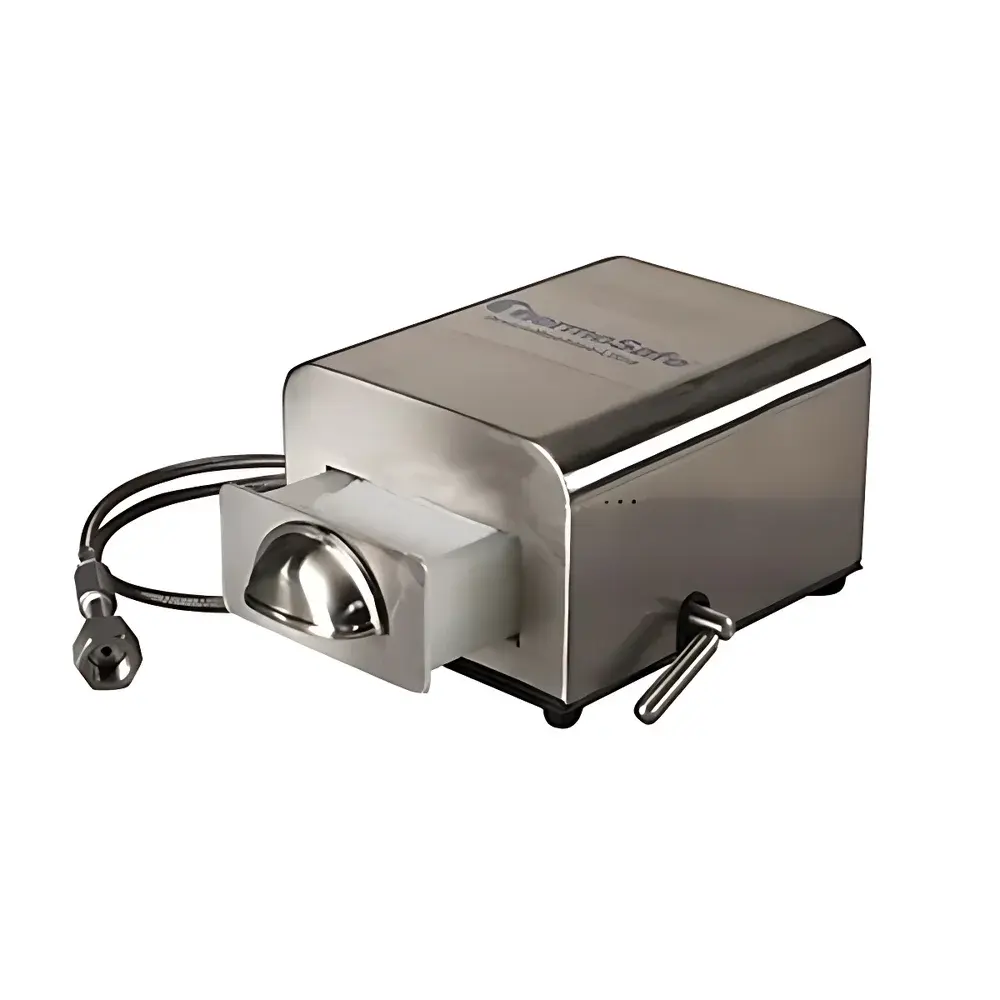
Thermosafe Model 560 Dry Ice Maker
| Brand | Cole-Parmer |
|---|---|
| Origin | USA |
| Manufacturer Type | Authorized Distributor |
| Import Status | Imported |
| Ice Production Method | Direct CO₂ phase transition (liquid → solid) |
| Ice Output | 22.7 kg/day |
| Ice Storage Capacity | 12 kg |
| Water Consumption | None |
| Cooling Medium | Liquefied CO₂ (cylinder-fed) |
| Dimensions (L×W×H) | 23 × 21 × 14 cm |
| Net Ice Block Weight | 0.45 kg ±10% |
| Ice Block Dimensions (L×W×H) | 15.2 × 10.2 × 3.8 cm |
| CO₂ Cylinder Requirement | Standard 22.7 kg (50 lb) liquid CO₂ cylinder |
| Cycle Time | 60–90 seconds per block (temperature-dependent) |
| Construction | 304 Stainless Steel |
| Safety Features | Integrated pressure gauge, stainless steel high-pressure hose, automatic safety relief valve (ASV), ASV self-closing upon cylinder valve shutdown |
Overview
The Thermosafe Model 560 Dry Ice Maker is a compact, non-electric, cryogenic solid carbon dioxide production system engineered for laboratory, biomedical, and cold-chain logistics environments where reliable, on-demand dry ice generation is required without access to mains power or complex infrastructure. Unlike compressor-based or refrigerant-cycle ice makers, the Model 560 operates exclusively on the Joule–Thomson expansion principle: pressurized liquid CO₂ (typically stored at ~57 bar and −18 °C in a standard 22.7 kg cylinder) undergoes rapid adiabatic expansion into a low-pressure, ambient-temperature forming chamber. This thermodynamic process induces instantaneous phase transition from liquid to solid CO₂—bypassing the liquid phase—yielding dense, ready-to-use dry ice blocks with minimal sublimation loss during formation. The unit’s passive design eliminates electrical hazards, electromagnetic interference, and thermal load concerns—making it suitable for use inside biosafety cabinets, cold rooms, and explosion-proof zones compliant with Class I, Division 2 (CID2) requirements.
Key Features
- Zero-power operation: No electrical connection, motor, or compressor required—ideal for field deployment, mobile labs, and backup cold storage scenarios.
- Stainless steel (304) construction: Corrosion-resistant housing, forming chamber, and fittings ensure long-term durability under repeated exposure to cryogenic temperatures and CO₂ saturation.
- Precision-engineered forming die: Produces uniform 15.2 × 10.2 × 3.8 cm dry ice blocks weighing 0.45 kg ±10%, optimized for consistent thermal mass and handling ergonomics.
- Integrated safety architecture: Includes ASME-certified pressure gauge, calibrated safety relief valve (set point: 120 psi), and fail-safe automatic valve closure when the upstream CO₂ cylinder valve is shut—preventing residual line pressure accumulation.
- Rapid cycle time: Full block formation in 60–90 seconds under typical lab conditions (20–25 °C); cycle efficiency improves at lower ambient temperatures due to reduced heat influx into the expansion chamber.
- High yield per cylinder: A single 22.7 kg (50 lb) liquid CO₂ cylinder produces 9–12 blocks—equivalent to ≥4.05 kg of usable dry ice—with no consumables or maintenance beyond periodic O-ring inspection.
Sample Compatibility & Compliance
The Model 560 is compatible with all standard industrial-grade liquid CO₂ cylinders equipped with CGA-630 yoke connections. It does not require external water supply, glycol loops, or ventilation ducting—simplifying installation in ISO Class 5–7 cleanrooms and GLP-compliant laboratories. While the device itself carries no CE or UL certification (as it contains no electrical components), its mechanical design conforms to ASME B31.3 Process Piping Code guidelines for low-temperature service. Users deploying the unit in regulated environments (e.g., FDA-regulated biobanking, USP compounding pharmacies, or ISO 13485 medical device manufacturing) must validate dry ice purity per ASTM D1253 (residual hydrocarbon content) and maintain traceable CO₂ source documentation from certified suppliers. The absence of moving parts or firmware eliminates software validation requirements under 21 CFR Part 11.
Software & Data Management
This is a fully mechanical, analog-operated instrument with no embedded electronics, firmware, or digital interface. Consequently, no software installation, calibration records, audit trails, or data export functionality is provided—or required. All operational parameters (e.g., cylinder pressure, cycle count, block weight consistency) are verified manually using supplied tools and documented per institutional SOPs. For laboratories requiring electronic recordkeeping, integration is achieved externally via manual entry into LIMS or ELN platforms using standardized template fields (e.g., “CO₂ cylinder lot number”, “block production timestamp”, “ambient temperature at cycle initiation”).
Applications
- On-site dry ice replenishment for cryopreservation workflows (cell lines, primary tissues, PBMCs).
- Transport validation studies requiring precise, traceable dry ice mass for ISTA 7E or ASTM D3103 thermal packaging testing.
- Field-deployable cold chain support for vaccine distribution in off-grid or disaster-response settings.
- Controlled sublimation experiments in physical chemistry and materials science laboratories.
- Backup cooling for ultra-low temperature freezers during power outages or maintenance cycles.
- Preparation of chilled reaction baths for exothermic organic synthesis protocols (e.g., Grignard, lithiation).
FAQ
Does the Model 560 require electricity or compressed air?
No. It operates solely via the intrinsic thermodynamic properties of expanding liquid CO₂ and requires no external energy input.
What CO₂ cylinder specifications are compatible?
Standard 22.7 kg (50 lb) liquid CO₂ cylinders with CGA-630 outlet valves and minimum purity grade of 99.9% (USP/EP grade recommended for pharmaceutical applications).
Can the unit produce dry ice continuously?
Yes—provided sufficient CO₂ supply and adequate ambient heat dissipation; continuous operation is limited only by cylinder capacity and chamber cooldown recovery between cycles.
Is the dry ice produced suitable for food or pharmaceutical contact?
Only if sourced from a USP/EP/ISO 8573-1 Grade A certified CO₂ supplier; the unit itself does not purify gas—it preserves inlet gas quality.
How often should the safety relief valve be tested or replaced?
Per ASME B31.3 and manufacturer recommendations, inspect the ASV annually for seal integrity and verify set-point accuracy using calibrated test equipment; replace O-rings every 12 months or after 500 cycles.



