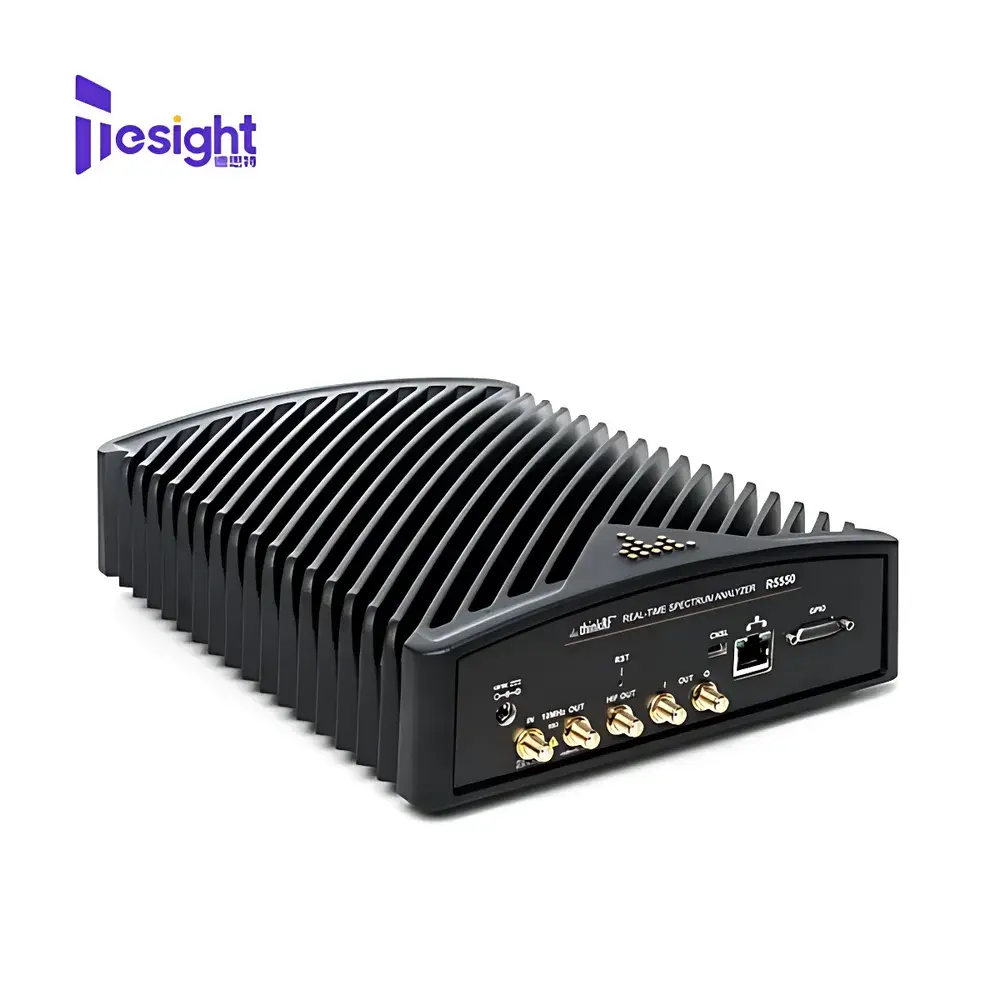
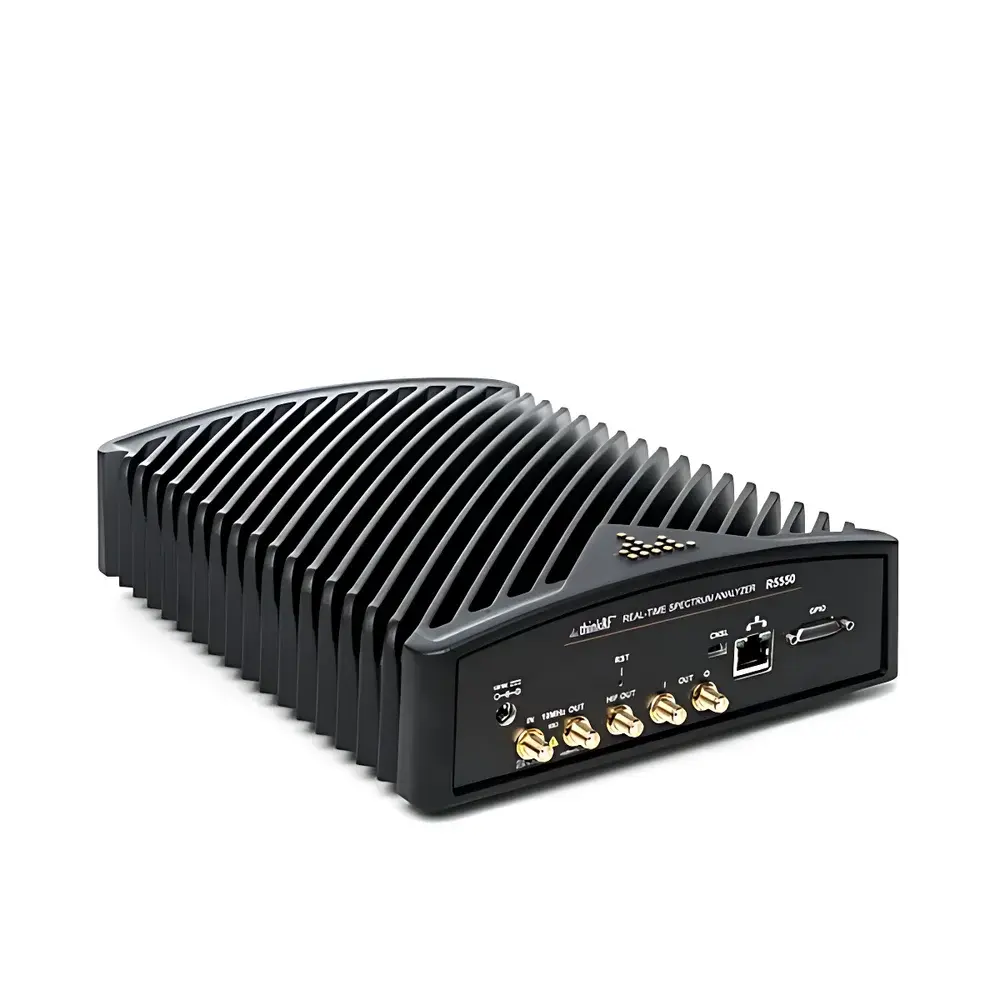
thinkRF R5550-427 Real-Time Spectrum Analyzer (27 GHz, 100 MHz RTBW)
| Brand | thinkRF |
|---|---|
| Model | R5550-427 |
| Frequency Range | 9 kHz – 27 GHz |
| Real-Time Bandwidth (RTBW) | 0.1 / 10 / 40 / 100 MHz |
| Displayed Average Noise Level (DANL) | −160 to −148 dBm/Hz (0.1–27 GHz, 25 °C ±5 °C, typical) |
| Third-Order Intercept (TOI) | +12 dBm (typ.) |
| Phase Noise | −90 dBc/Hz @ 100 Hz, −92 dBc/Hz @ 1 kHz, −99 dBc/Hz @ 10 kHz, −109 dBc/Hz @ 100 kHz, −118 dBc/Hz @ 1 MHz |
| Max Sweep Speed | 28 GHz/s @ 10 kHz RBW |
| Attenuator Range | 0–30 dB (10 dB steps) |
| Power Consumption | 23 W |
| Weight | 2.72 kg |
| Dimensions | 257.3 × 193.7 × 66 mm |
| ADC Architecture | 14-bit 125 MS/s wideband ADC (≥70 dB DR), 24-bit 325 kS/s narrowband ADC (≥100 dB DR) |
| FPGA | Xilinx Zynq-7020 (dual-core ARM Cortex-A9, 1 GB DDR3, Gigabit Ethernet, embedded DSP logic) |
| Synchronization | Clock-in/out & IF output support |
| Interface | Gigabit Ethernet, GPIO |
Overview
The thinkRF R5550-427 is a high-performance, software-defined real-time spectrum analyzer engineered for mission-critical RF monitoring, signal intelligence (SIGINT), electromagnetic environment mapping, and regulatory compliance testing. Unlike conventional swept-tuned analyzers, the R5550-427 employs a hybrid receiver architecture—combining superheterodyne, zero-intermediate-frequency (ZIF), and direct-sampling techniques—to deliver true real-time spectral processing across its full 9 kHz to 27 GHz frequency range. Its 100 MHz instantaneous bandwidth enables capture and analysis of wideband modern waveforms including 802.11ac/ax, LTE-Advanced, 5G NR FR1 uplink/downlink bursts, and pulsed radar signals without gap or blind time. The instrument’s real-time FFT engine, implemented in a Xilinx Zynq-7020 SoC with dedicated DSP firmware, supports >99% probability of intercept (POI) at dwell times down to 10 µs—critical for detecting transient, frequency-hopping, or low-duty-cycle emitters in congested RF environments.
Key Features
- Compact, fanless design (257.3 × 193.7 × 66 mm; 2.72 kg) optimized for lab, field-deployable, and vehicular RF monitoring applications
- Dual-ADC architecture: 14-bit 125 MS/s wideband digitizer (≥70 dB dynamic range) and 24-bit 325 kS/s narrowband digitizer (≥100 dB dynamic range) for simultaneous high-fidelity broadband surveillance and precision narrowband measurement
- Gigabit Ethernet control interface enabling remote operation, distributed sensor networks, and integration into centralized spectrum management systems
- Real-time bandwidth options: 0.1, 10, 40, and 100 MHz—scalable via firmware to match application-specific signal occupancy and processing requirements
- Low-phase-noise local oscillator supporting high-fidelity modulation analysis: −118 dBc/Hz @ 1 MHz offset ensures accurate EVM and ACLR measurements on complex OFDM and QAM signals
- Full clock synchronization I/O and IF output port for multi-unit phase-coherent array deployment or external high-speed digitizer interfacing
- Embedded Linux OS with open API (RESTful HTTP, SCPI over TCP/IP) and Python SDK for automated test scripting, custom visualization, and CI/CD-integrated validation workflows
Sample Compatibility & Compliance
The R5550-427 supports unattended, long-duration RF recording and playback via its internal SSD or network-attached storage (NAS) integration. It complies with IEEE 1057 (digitizer specifications), MIL-STD-461G (EMI emissions limits for deployed instrumentation), and RoHS 3 directives. Its timestamped I/Q data export format (IEEE 32-bit float, metadata-rich .sigmf) ensures interoperability with GNU Radio, MATLAB, and RF Explorer-compatible post-processing tools. For regulated environments—including FCC Part 15/24 enforcement, aviation spectrum auditing, and defense spectrum certification—the instrument provides audit-ready logging, user-access controls, and deterministic trigger timestamps traceable to UTC via NTP or PTP (IEEE 1588). While not FDA-certified (as it is not a medical device), its firmware architecture supports GLP/GMP-aligned configuration management when deployed in quality-controlled RF test laboratories.
Software & Data Management
The R5550-427 ships with thinkRF’s Web-based Spectrum Analysis Suite (v5.x), offering real-time spectrogram, persistence waterfall, power-vs-time, and density-of-occupancy visualizations. All raw I/Q streams are recorded with full metadata—including GPS location (when GNSS module is attached), temperature, attenuation state, and calibration epoch—for forensic replay and spectral signature correlation. Data export supports CSV (for statistical analysis), HDF5 (for large-scale ML training datasets), and standard RF recording formats (.iq, .rf64). The REST API enables integration with enterprise SIEM platforms (e.g., Splunk, Elastic Stack) for automated anomaly detection using spectral entropy, occupied bandwidth drift, or unexpected emission mask violations. Firmware updates are signed and verified, and configuration snapshots can be version-controlled via Git-compatible repositories.
Applications
- Regulatory spectrum monitoring: Continuous wideband surveillance for unauthorized transmissions, interference hunting, and license compliance verification per ITU-R SM.1753 and ETSI EN 301 893
- Electronic warfare (EW) and COMINT: Detection, classification, and geolocation of agile emitters using real-time FFT + digital IF processing
- 5G NR and Wi-Fi 6E/7 system validation: Over-the-air (OTA) characterization of beamformed signals, channel sounding, and coexistence testing in shared spectrum bands (e.g., 6 GHz UNII-5–8)
- Aerospace & defense platform integration: SWaP-optimized RF front-end for UAV-mounted SIGINT pods and ground-mobile electronic support measures (ESM)
- Academic and research labs: Reproducible RF experimentation with open-source toolchain support (GNU Radio Companion, PySDR), ideal for wireless security, cognitive radio, and spectrum sensing algorithm development
FAQ
Does the R5550-427 support external reference clock input for phase-coherent multi-analyzer setups?
Yes. It features a 10 MHz reference input/output port and supports IEEE 1588 Precision Time Protocol (PTP) for sub-microsecond timestamp alignment across distributed nodes.
Can I perform real-time demodulation of LTE or 5G NR signals directly on the device?
The R5550-427 captures full-bandwidth I/Q data in real time but does not include embedded protocol stack decoders. Demodulation and layer-1 analysis require post-processing in MATLAB, Python (using srsRAN or iio-oscilloscope), or third-party RF analysis software.
Is factory calibration traceable to NIST or other national metrology institutes?
Yes. Each unit ships with a certificate of calibration traceable to NIST standards, covering amplitude accuracy, frequency response, and phase noise performance across its operational range.
What is the maximum continuous recording duration at 100 MHz RTBW?
With a 1 TB SSD option and lossless 16-bit I/Q compression, continuous recording exceeds 12 hours at full 100 MHz bandwidth; duration scales linearly with storage capacity and selected bit depth.
Does the R5550-427 meet MIL-STD-810G for shock/vibration in mobile deployments?
It meets MIL-STD-810G Method 514.6 (vibration) and Method 516.6 (shock) when mounted in an approved shock-isolated chassis—full environmental qualification reports are available under NDA upon request.