
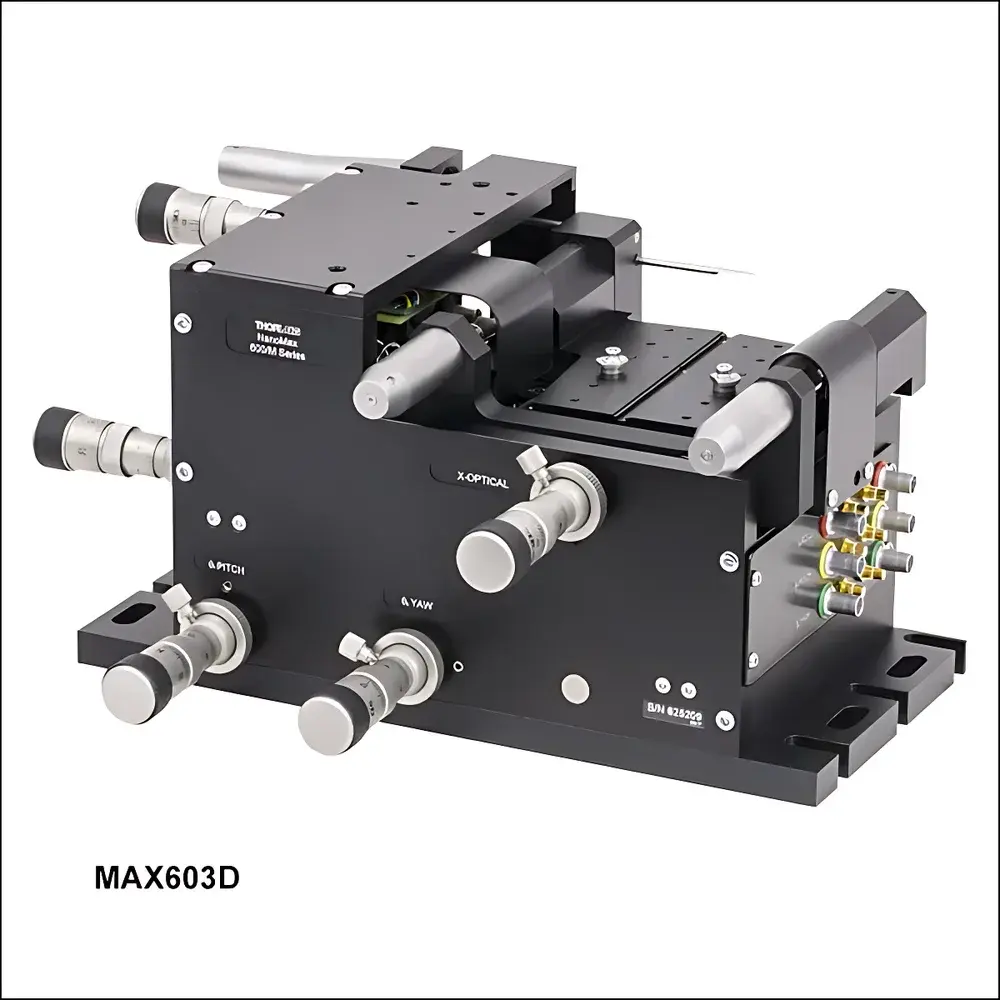


Thorlabs NanoMax™ MAX601D 6-Axis Manual Translation Stage with Differential Adjusters
| Brand | Thorlabs |
|---|---|
| Model | MAX601D |
| Type | Manual 6-Axis Nanopositioning Flexure Stage |
| Travel (X/Y/Z) | 4 mm |
| Travel (θx/θy/θz) | 6° (105 mrad) |
| Fine Adjustment Range (X/Y/Z) | 300 µm |
| Fine Adjustment Range (θx/θy/θz) | 18 arcmin (5.2 mrad) |
| Coarse Adjustment Resolution | 5 µm |
| Fine Adjustment Resolution | 0.5 µm |
| Maximum Load Capacity | 1 kg |
| Platform Height | 112.5 mm |
| Stiffness (X/Z) | 1 N/µm |
| Stiffness (Y) | 0.5 N/µm |
| Resonant Frequency | >130 Hz (±10%) |
| Common Rotation Pivot | Yes |
| Coupled Actuator Mounting | Yes |
| Compatibility | DRV3 Differential Micrometers (pre-installed) |
| Modular Drive Interface | Yes |
Overview
The Thorlabs NanoMax™ MAX601D is a high-precision, manually operated 6-axis nanopositioning flexure stage engineered for demanding optical alignment tasks requiring sub-micrometer repeatability and minimal crosstalk. Unlike stacked multi-stage architectures, the MAX601D integrates all six degrees of freedom—three linear (X, Y, Z) and three rotational (θx, θy, θz)—within a monolithic, parallel-kinematic flexure mechanism. Its design is grounded in compliant mechanism theory, eliminating mechanical backlash, stiction, and wear-induced drift. The stage employs a common rotation pivot point—coincident with its geometric center—to ensure that angular motions do not induce parasitic lateral translation, thereby preserving beam path integrity during iterative alignment. This architecture is especially critical in fiber coupling, free-space optical interconnects, photonic integrated circuit (PIC) packaging, and interferometric metrology setups where alignment stability directly determines coupling efficiency and signal fidelity.
Key Features
- Parallel Flexure Architecture: All six degrees of freedom are realized through precision-machined monolithic stainless-steel flexures, delivering smooth, frictionless motion with negligible hysteresis and long-term dimensional stability.
- Dual-Range Manual Actuation: Pre-configured with DRV3 differential micrometers enabling coarse travel of 4 mm per linear axis and fine adjustment of ±300 µm; angular axes offer ±6° gross rotation and ±18 arcmin fine tuning.
- High Mechanical Stiffness: X- and Z-axis stiffness rated at 1 N/µm; Y-axis at 0.5 N/µm—ensuring resistance to external perturbations and maintaining positional hold under dynamic loading up to 1 kg.
- Optimized Kinematic Design: Integrated common pivot point eliminates coupling between rotational and translational DOFs; all adjusters are rigidly coupled to the baseplate to suppress actuator-induced crosstalk.
- Standardized Platform Geometry: Top plate features T-slots conforming to Thorlabs’ modular mounting standard (M4 thread pattern), enabling direct integration with kinematic mounts, lens tubes, fiber launch systems, and other NanoMax-compatible accessories.
- Modular Drive Interface: Tool-less disassembly allows rapid replacement of actuators—including optional piezoelectric, stepper motor, or manual micrometer variants—without recalibration or realignment.
Sample Compatibility & Compliance
The MAX601D is designed for laboratory-grade optical alignment applications under controlled environmental conditions (temperature-stable, low-vibration environments). It complies with mechanical interface standards defined in ISO 10110-7 (optical component mounting) and supports traceable alignment workflows aligned with ISO/IEC 17025 requirements for calibration laboratories. While the stage itself contains no electronic components and therefore falls outside scope of electromagnetic compatibility (EMC) directives, its mechanical design facilitates integration into systems certified to IEC 61000-6-2 (immunity) and IEC 61000-6-4 (emission) when paired with compatible drivers. For GMP/GLP-regulated photonics assembly processes, the stage’s deterministic kinematics and absence of lubricants support cleanroom-compliant operation (ISO Class 5–7). Documentation includes full dimensional drawings, material certifications (316L stainless steel), and traceable manufacturing records upon request.
Software & Data Management
As a purely manual stage, the MAX601D does not require firmware, drivers, or software control. However, its deterministic scaling factors—e.g., 1.5× mechanical amplification on X/Y axes—and calibrated vernier scales (10 µm coarse, 1 µm fine divisions) enable reproducible, documentation-ready positioning without digital instrumentation. Users may log settings using standardized lab notebooks or LIMS-integrated templates referencing Thorlabs’ official calibration guide (Document #T99011, Rev. D). When integrated into automated systems via optional motorized actuators (e.g., KDC101 controllers), position data can be logged via ASCII command protocols compliant with SCPI standards and archived in CSV or HDF5 formats for audit trails per FDA 21 CFR Part 11 requirements.
Applications
- Fiber-to-fiber, fiber-to-waveguide, and fiber-to-laser diode coupling optimization
- Alignment of micro-optical elements (lenses, gratings, MEMS mirrors) in free-space beam paths
- Active/passive alignment of photonic integrated circuits during wafer-level testing
- Stabilization and tip/tilt correction in heterodyne interferometers and cavity ring-down spectrometers
- Multi-axis calibration of optical encoders and autocollimators
- Sub-micron registration in mask aligners and nanoimprint lithography tooling
FAQ
What is the purpose of the common rotation pivot in the MAX601D?
The common pivot ensures that all three rotational degrees of freedom intersect at a single point coincident with the stage’s center of symmetry—minimizing parasitic translation during angular adjustment and preserving optical axis alignment.
How does the 1.5× mechanical amplification on X/Y axes affect positioning accuracy?
This leveraged motion increases sensitivity to micrometer rotation but requires users to apply the correct scale factor when converting dial readings to actual displacement; calibration certificates provide axis-specific correction tables.
Can the MAX601D be used in vacuum environments?
Yes—the monolithic stainless-steel construction and absence of adhesives or elastomers make it suitable for UHV applications up to 10⁻⁹ Torr, provided DRV3 micrometers are replaced with vacuum-rated equivalents (e.g., UHV-MICRO series).
Is thermal drift compensated in this manual stage?
No active compensation is included; however, the low coefficient of thermal expansion (CTE ≈ 17.3 × 10⁻⁶ /°C for 316L SS) and symmetric flexure layout minimize thermally induced misalignment over typical lab temperature ranges (20–25 °C).
What maintenance is required for long-term performance?
No scheduled maintenance is needed; periodic inspection of micrometer threads and flexure surfaces for particulate contamination is recommended—cleaning with lint-free wipes and spectroscopic-grade isopropanol suffices.



