
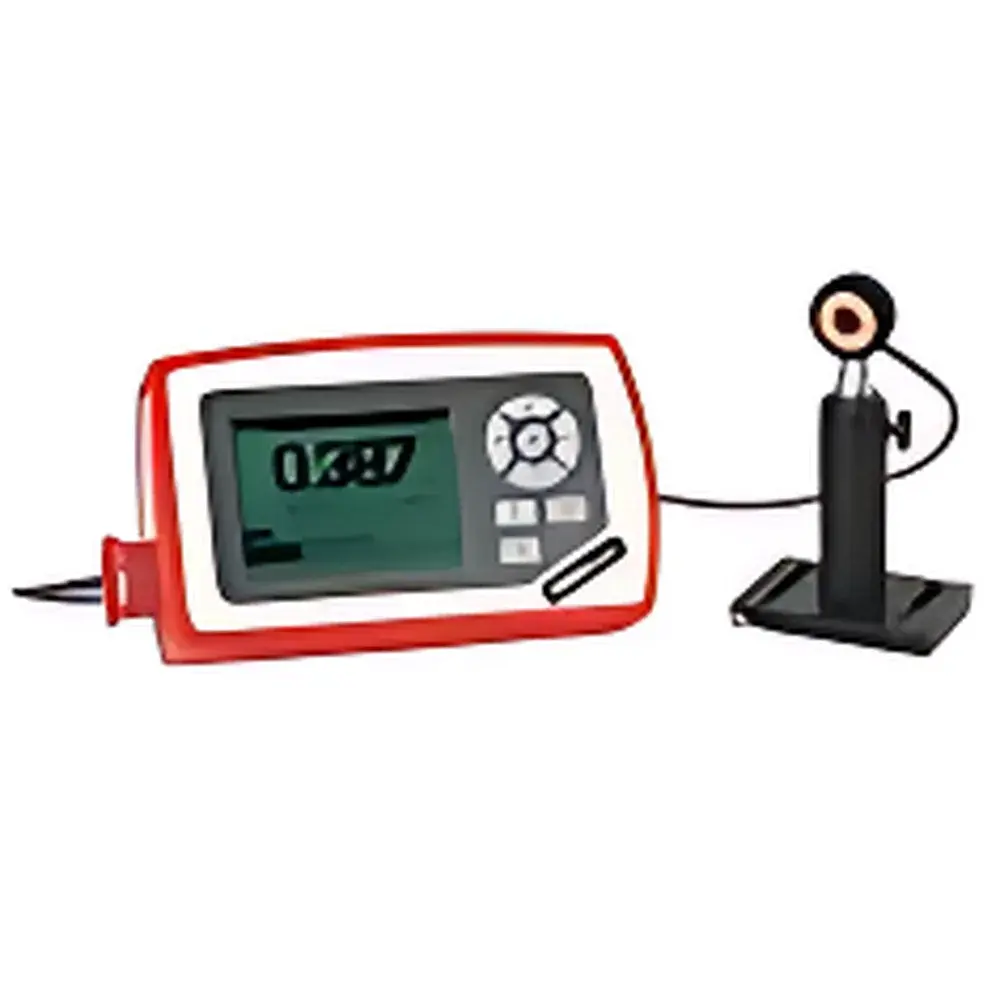
Thorlabs PM100D Series Optical Power and Energy Meter
| Brand | Thorlabs |
|---|---|
| Origin | USA |
| Model | PM100D |
| Detector Compatibility | >25 Photodiode, Thermopile, and Pyroelectric Sensors |
| Wavelength Range | 190 nm – 25 µm |
| Power Range | 100 pW – 200 W (sensor-dependent) |
| Energy Range | 10 µJ – 15 J (sensor-dependent) |
| Interface | USB 2.0, RS-232, Analog Output (0–1 V or 0–5 V) |
| Display | 4.3" Color TFT LCD with Touchscreen |
| Calibration Traceability | NIST-traceable |
Overview
The Thorlabs PM100D Series is a benchtop optical power and energy meter engineered for precision, flexibility, and long-term stability in demanding laboratory and industrial environments. Built around a high-resolution 24-bit analog-to-digital converter and low-noise signal conditioning circuitry, the PM100D employs dual-slope integration and auto-zeroing techniques to minimize drift and ensure repeatable measurements across wide dynamic ranges. Its architecture supports real-time measurement of continuous-wave (CW) laser power, pulsed laser energy, and modulated optical signals—making it suitable for applications ranging from diode laser characterization and fiber optic component testing to ultrafast laser diagnostics and photovoltaic R&D. The device operates on fundamental photometric and radiometric principles: photodiode-based sensors rely on the photoelectric effect with calibrated responsivity curves; thermopile sensors measure absorbed radiant heat via the Seebeck effect across a thermocouple junction array; pyroelectric sensors detect transient temperature gradients induced by pulsed irradiation. All sensor calibrations are NIST-traceable and include spectral correction factors for accurate irradiance-weighted readings per ISO 11554 and ANSI Z136.1 standards.
Key Features
- High-resolution 4.3-inch color touchscreen display with intuitive graphical interface and multi-language support (English, German, French, Chinese, Japanese)
- Dual-channel capability (via optional PM100D-2CH firmware upgrade) for simultaneous monitoring of two independent sensors
- Real-time statistics including min/max/avg, standard deviation, and relative deviation tracking over user-defined time windows
- Programmable auto-ranging, zeroing, and filtering (moving average, median, low-pass) to suppress noise in low-signal or high-bandwidth scenarios
- Integrated data logging (up to 10,000 points internal memory) with timestamped CSV export via USB mass storage mode
- Comprehensive sensor database with automatic recognition of Thorlabs’ C-series probes (S1xxC, S3xxC, ESxxxC), including wavelength-specific calibration coefficients and damage threshold warnings
- Robust mechanical design with ESD-protected input stage, thermal stabilization of critical analog components, and IP20-rated enclosure for benchtop use
Sample Compatibility & Compliance
The PM100D is compatible with over 25 Thorlabs-certified optical sensors, spanning photodiode (Si, Ge, InGaAs), thermopile (broadband, UV-enhanced, IR-optimized), and pyroelectric detector families. Each probe is supplied with individual calibration certificates specifying spectral responsivity (A/W), linearity deviation (<±0.5% full scale), and uncertainty budgets at multiple wavelengths. The system complies with IEC 61326-1 (EMC for laboratory equipment), IEC 61010-1 (safety requirements), and supports GLP/GMP workflows through optional audit trail logging (enabled via PM100D-AT firmware). Sensor interchangeability is facilitated by standardized SMA905 or FC/PC fiber interfaces, integrated thermal compensation algorithms, and automatic gain scaling based on connected probe ID. For regulated environments, raw measurement data—including timestamps, sensor serial numbers, calibration dates, and environmental conditions—can be exported with digital signatures compliant with FDA 21 CFR Part 11 when used with Thorlabs’ optional LabVIEW or Python SDKs.
Software & Data Management
Thorlabs provides native software tools including the PM100D Control Panel (Windows/macOS), which enables remote operation, scriptable automation (TCL/Python API), and live waveform visualization. Measurement data can be streamed continuously at up to 1 kHz sampling rate for dynamic laser stability analysis. The included SDK supports integration into custom test benches using LabVIEW, MATLAB, Python (pyvisa), or .NET frameworks. All exported files conform to ASTM E2918-22 (standard practice for reporting optical power measurement data) and include metadata headers required for ISO/IEC 17025-accredited laboratories. Firmware updates are delivered via signed binary packages with SHA-256 verification to ensure integrity and traceability throughout the instrument lifecycle.
Applications
- Laser diode output power stabilization and aging studies in semiconductor manufacturing
- Fiber-coupled source characterization for telecom (O-, C-, L-bands) and biomedical OCT systems
- Calibration transfer between primary standards and field-deployable meters in metrology labs
- Pulsed laser energy profiling for LIBS, LIDAR, and micromachining process development
- Photodetector quantum efficiency mapping using calibrated broadband sources
- UV curing lamp intensity monitoring in pharmaceutical packaging and adhesive curing lines
- IR laser safety compliance testing per IEC 60825-1 and ANSI Z136.1 exposure limit calculations
FAQ
Is the PM100D compatible with non-Thorlabs sensors?
The PM100D is designed for optimal performance with Thorlabs C-series sensors. While third-party sensors with analog voltage output (0–1 V or 0–5 V) and known calibration constants may be connected, automatic identification, spectral correction, and damage threshold alerts are not supported.
What is the maximum sampling rate for continuous data acquisition?
At full resolution (24-bit), the PM100D achieves 400 Hz native sampling; with oversampling disabled and reduced resolution, rates up to 1 kHz are attainable via USB streaming.
Does the PM100D support external triggering for pulsed measurements?
Yes—the rear-panel BNC trigger input accepts TTL-compatible signals for synchronized energy capture, gate width control, and burst-mode averaging.
Can measurement uncertainty be calculated automatically?
Uncertainty propagation is performed in real time using sensor-specific calibration uncertainties, linearity corrections, noise floor contributions, and environmental derating factors as defined in GUM (JCGM 100:2008) and NIST SP 960-12.
Is firmware update reversible?
All firmware versions are archived and downgradable via bootloader mode, preserving compatibility with legacy validation protocols in regulated facilities.





