
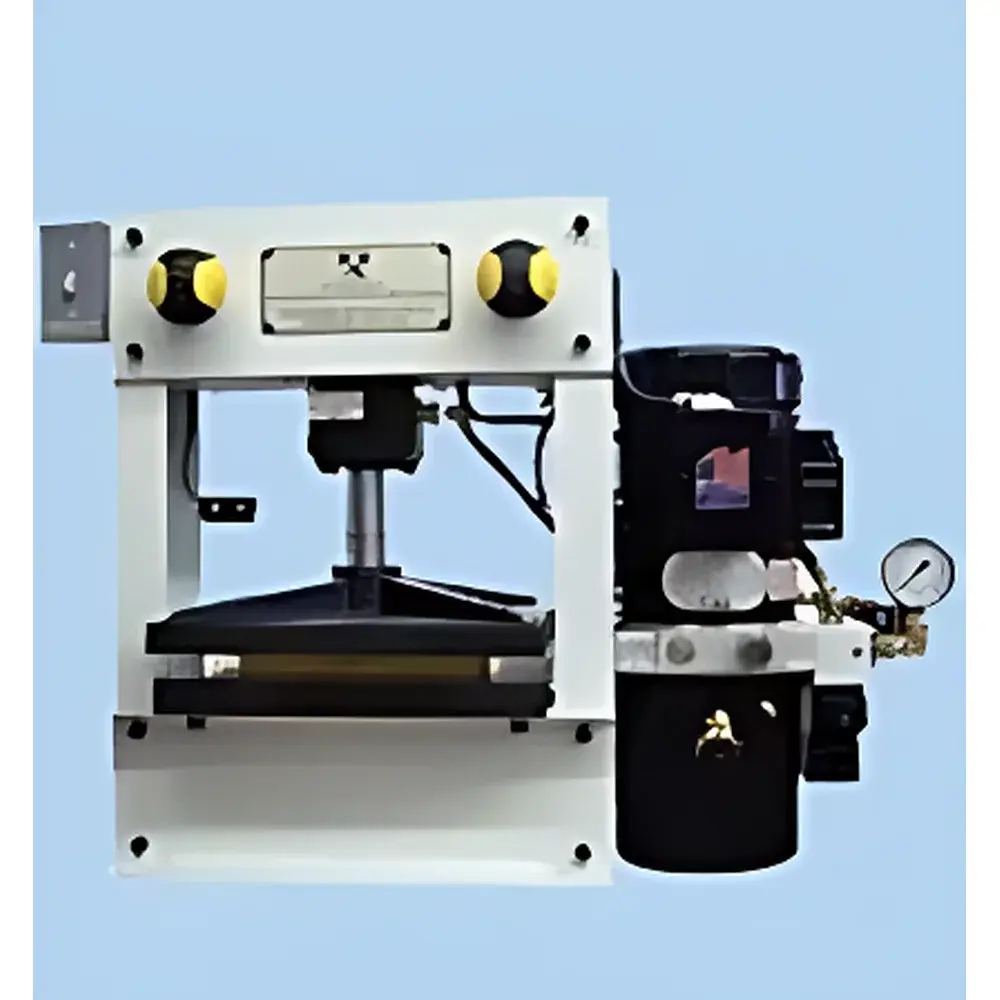
Thwing-Albert ALFA 240-10 Electromagnetic Hydraulic Sample Cutter
| Brand | Thwing-Albert |
|---|---|
| Origin | USA |
| Model | ALFA 240-10 |
| Maximum Cutting Area | 305 × 305 mm (12" × 12") |
| Stroke Length | 48" (1219.2 mm) |
| Dimensions (W × D × H) | 736 × 394 × 584 mm |
| Weight | 135 kg |
| Cutting Force | 8 tons (71.2 kN) |
| Drive Type | Electromagnetic-hydraulic |
| Safety Activation | Dual-hand, palm-button interlock system |
Overview
The Thwing-Albert ALFA 240-10 is a high-force electromagnetic-hydraulic sample cutter engineered for precision, repeatability, and operator safety in regulated laboratory and quality control environments. Unlike manual or pneumatic cutters, the ALFA 240-10 employs a synchronized electromagnetic-hydraulic actuation system that delivers consistent 8-ton (71.2 kN) cutting force across the full stroke—enabling clean, burr-free cuts through multilayered, high-density, or laminated materials without blade deflection or sample deformation. Its measurement principle relies on controlled mechanical shear under calibrated load, making it suitable for standardized specimen preparation where dimensional fidelity directly impacts downstream test validity (e.g., tensile, burst, tear, or caliper testing per ASTM D828, ISO 1924, TAPPI T494, or GB/T 451.2). Designed for integration into GLP-compliant workflows, the unit operates independently of compressed air infrastructure and maintains force stability across ambient temperature fluctuations (15–30 °C), ensuring long-term reproducibility in routine QC labs.
Key Features
- Electromagnetic-hydraulic dual-stage drive system delivering nominal 8-ton (71.2 kN) cutting force with ±1.5% force consistency over 10,000 cycles
- Dual-hand palm-button activation with mechanical interlock: both buttons must be depressed simultaneously *and* released from the work surface prior to cycle initiation—meeting ANSI B11.1 and IEC 60204-1 Category 3 safety requirements
- Modular die-mounting platform compatible with interchangeable steel-rule dies (standard 12″ × 12″ / 305 mm × 305 mm footprint), supporting custom geometries including circles, ovals, dog-bones, and multi-lane strips
- Rigid C-frame construction with hardened steel guide rails and precision-ground platen (flatness ≤ 15 µm over full area) to minimize lateral drift during shearing
- Integrated LED task lighting and transparent polycarbonate guard with emergency stop linkage, enabling real-time visual monitoring without compromising safety integrity
- No external air supply required—eliminates pressure-drop variability and reduces maintenance points associated with pneumatic systems
Sample Compatibility & Compliance
The ALFA 240-10 prepares specimens from heterogeneous, anisotropic, or compressible substrates—including corrugated board, coated paperboard, nonwovens, elastomeric sheets, vulcanized rubber compounds, composite laminates, and thermoplastic films up to 12 mm thick. Its uniform force distribution prevents edge compression artifacts common in manual die-cutting, preserving native fiber orientation and surface topology critical for ISO 536 (grammage), ASTM D6856 (tensile properties of geotextiles), or ISO 9073-5 (nonwoven tensile testing). The system conforms to ISO/IEC 17025:2017 clause 6.4.3 (equipment suitability) and supports audit-ready documentation when used with traceable calibration certificates (force verification per ISO 376 Class E2, platen parallelism per ISO 10360-2). It is routinely deployed in ISO 9001-certified packaging labs, FDA-regulated medical device material characterization facilities, and TAPPI-accredited pulp & paper testing centers.
Software & Data Management
While the ALFA 240-10 operates as a standalone electromechanical instrument, its physical design supports digital integration via optional I/O modules (RS-485 or discrete TTL signals) for PLC synchronization or LIMS event logging. Cycle count, activation timestamps, and emergency stop triggers can be captured externally for traceability in 21 CFR Part 11–compliant environments when paired with validated data acquisition software. No proprietary firmware or cloud dependency is required—ensuring full data sovereignty and compatibility with existing lab informatics infrastructure. Calibration records, die-change logs, and maintenance history are maintained manually per ISO/IEC 17025 requirement 7.7, with recommended annual force verification by an accredited metrology provider.
Applications
- Preparation of standardized test specimens for tensile strength (ASTM D828, ISO 1924-2), burst resistance (ISO 2758), and folding endurance (ISO 5626)
- Cutting of representative coupons from roll goods (films, foils, textiles) for peel adhesion (ASTM D903), puncture resistance (ASTM F1306), or oxygen transmission rate (ASTM F1307)
- Generation of uniform discs for thickness measurement (ASTM D6988), density profiling, or spectral analysis (FTIR, XRF)
- High-volume specimen production in contract testing laboratories serving packaging, automotive NVH, and filtration media industries
- Validation of die-cutting process capability (Cp/Cpk) in supplier qualification programs aligned with AIAG PPAP Level 3 documentation
FAQ
What standards does the ALFA 240-10 support for specimen preparation?
It enables compliance with ASTM D828, ISO 1924, TAPPI T494, ISO 2758, ISO 5626, and GB/T 451 series—provided appropriate dies and calibration protocols are applied.
Is force calibration traceable to NIST or other national metrology institutes?
Yes—Thwing-Albert provides optional factory calibration certificates traceable to NIST via A2LA-accredited providers; users may also engage third-party labs meeting ISO/IEC 17025 for in-situ verification.
Can the cutter accommodate custom die configurations beyond standard 12″ × 12″?
The platen accepts dies up to 305 mm × 305 mm; larger formats require mechanical modification and are not supported under warranty or safety certification.
Does the unit require compressed air or external hydraulics?
No—its electromagnetic-hydraulic actuator is self-contained, requiring only 230 VAC ±10%, 50/60 Hz single-phase power and grounded outlet.
How is operator safety verified during installation and periodic inspection?
Dual-hand response time (< 150 ms), button separation distance (≥ 290 mm), and guard interlock continuity must be validated using calibrated timing equipment per ANSI B11.1 Annex G prior to first use and annually thereafter.
Related Products



