
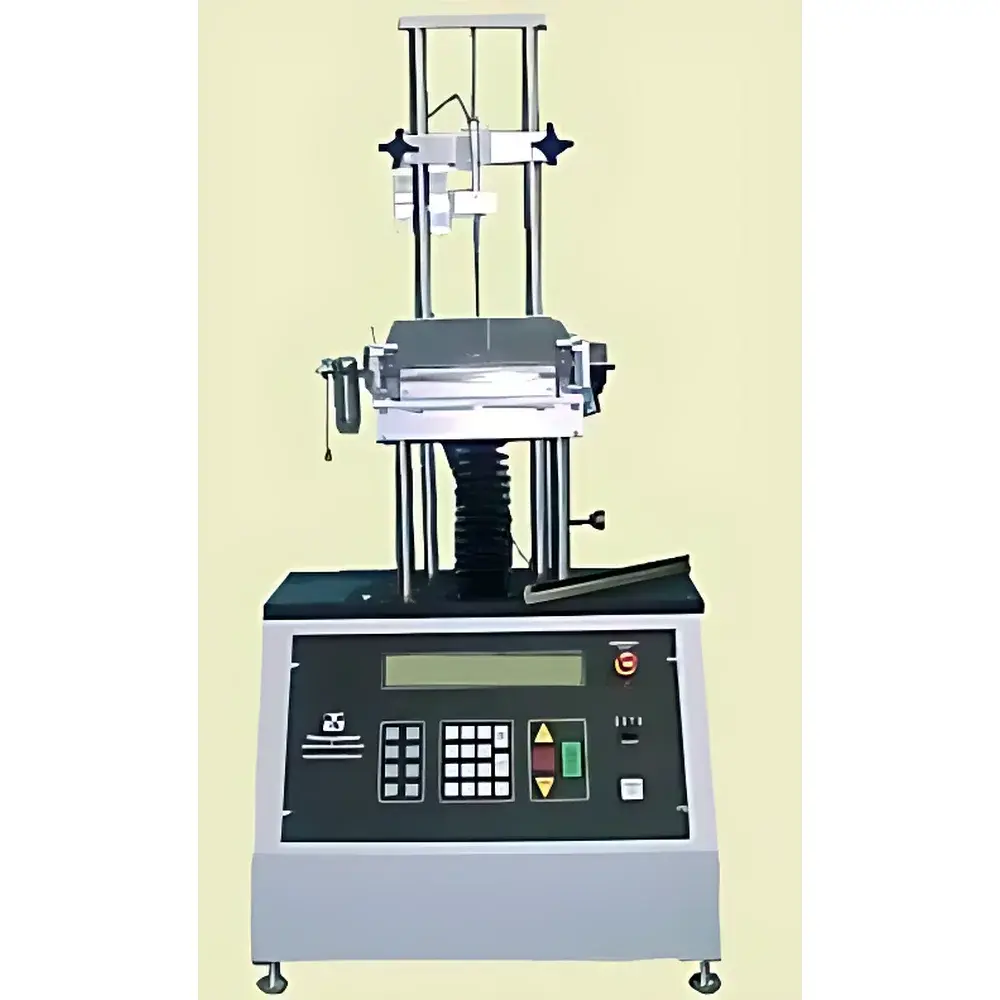
Thwing-Albert PCA-1270 Bending and Crease Stiffness Tester
| [Brand | Thwing-Albert |
|---|---|
| Origin | USA |
| Model | PCA-1270 |
| Load Cell Options | 500 g, 2000 g (standard), 5000 g, 10000 g |
| Force Accuracy | ±0.25% F.S. |
| Bending Mode Speed | 11.46°/sec |
| Score (Unfolding) Mode Speed | 5–500 mm/min |
| Angular Range | 0–90° (adjustable) |
| Angular Resolution | <0.2° |
| Displacement Accuracy | ±0.1% F.S. |
| Sample Width (Bending) | up to 152.4 mm |
| Sample Length (Score) | 25.4–457.2 mm |
| Pneumatic Pressure Requirement | 5.2 bar (75 psi) |
| Power Supply | 220 V ±10%, 50 Hz, 250 VA |
| Standby Power | 11 W |
| Test Power | 90 W |
| Fuse | 0.5 A @ 230 VAC |
| Analog Output | 1 V |
| Dimensions (W×D×H) | 610 × 483 × 1143 mm |
| Net Weight | 41 kg |
| Display Units | g, oz, lb, N, kg (force) |
Overview
The Thwing-Albert PCA-1270 Bending and Crease Stiffness Tester is a precision-engineered instrument designed to quantify the mechanical response of corrugated board, solid fiberboard, folding cartons, and other packaging substrates during critical forming operations—specifically crease bending and score unfolding. It operates on a dual-mode electromechanical principle: in Bending mode, a pneumatic actuator applies controlled angular displacement along a pre-defined crease line at a fixed rate of 11.46°/sec; in Score (Unfolding) mode, a motor-driven crosshead exerts linear force to open a folded sample at programmable speeds (5–500 mm/min). The system captures real-time force vs. angle or force vs. displacement profiles, enabling quantitative assessment of both crease resistance (bending stiffness) and box-opening force (score strength). This data directly correlates with performance on high-speed packaging lines—including blank erecting, case packing, and end-of-line sealing—where insufficient stiffness causes misfeeds, while excessive resistance leads to jamming or structural failure.
Key Features
- Two independent test modes: Bending (angular displacement-controlled, pneumatic actuation) and Score (linear displacement-controlled, electromechanical loading)
- Interchangeable load cells (500 g, 2000 g standard, 5000 g, 10000 g) calibrated to ±0.25% full-scale accuracy
- High-resolution angular measurement (<0.2° resolution) over 0–90° range, fully adjustable for process-specific thresholds
- Digital force and displacement readout with unit flexibility: force in g, oz, lb, N, kg; displacement in in, cm, mm
- Programmable auto-stop and return-to-start functionality with integrated overload protection
- Stable, repeatable loading rate control—critical for ISO 5628 (paperboard stiffness) and TAPPI T 813 (crease resistance) compliance
- Robust cast-iron frame and precision-ground linear guides ensure long-term dimensional stability under continuous operation
Sample Compatibility & Compliance
The PCA-1270 accommodates a wide range of packaging substrates: single- and double-wall corrugated board, clay-coated paperboard, laminated carton stock, and composite folding boxes. In Bending mode, samples up to 152.4 mm wide are clamped across a V-block fixture; in Score mode, specimens 25.4–457.2 mm in length are secured in fixed-jaw grips. The instrument supports standardized test protocols including TAPPI T 813 (Crease Resistance of Paperboard), ISO 5628 (Bending Resistance of Paper and Board), and ASTM D6415 (Bending Moment of Corrugated Fiberboard). Its analog 1 V output enables integration into GLP/GMP environments when paired with compliant data acquisition systems, and its deterministic mechanical architecture ensures audit-ready repeatability per FDA 21 CFR Part 11 requirements when used with validated software.
Software & Data Management
While the PCA-1270 operates as a stand-alone unit with front-panel digital display, its 1 V analog output allows seamless connection to external chart recorders, PLCs, or PC-based data acquisition systems. When interfaced with Thwing-Albert’s optional TA Instruments TestWorks™ software suite (or third-party DAQ platforms), users gain access to time-stamped force-angle/time-displacement curves, statistical reporting (mean, SD, CV%), pass/fail threshold alerts, and export to CSV or PDF. All test parameters—including speed, angle limit, load cell selection, and unit preferences—are stored in non-volatile memory. The system supports full traceability: operator ID, date/time stamp, sample ID, and calibration metadata are embedded in each dataset—essential for internal quality audits and regulatory submissions.
Applications
- Pre-production validation of board grade suitability for specific packaging machinery (e.g., case erectors, carton sealers)
- Correlation of laboratory-measured crease stiffness with field-reported jam rates and misfeed frequency
- Supplier qualification: objective quantification of board consistency across batches and mills
- Process optimization: determining optimal scoring depth, creasing rule geometry, and moisture content windows
- Root cause analysis of sealing failures linked to post-crease springback (recovery torque)
- R&D evaluation of new coatings, adhesives, or fiber blends affecting fold integrity and recovery behavior
FAQ
What standards does the PCA-1270 support?
The instrument is engineered to meet the mechanical and procedural requirements of TAPPI T 813, ISO 5628, and ASTM D6415. Its angular resolution, force accuracy, and speed control fall within the tolerances specified in these methods.
Can the PCA-1270 measure post-bend recovery (springback)?
Yes—by capturing full force-angle hysteresis loops during controlled bend-unbend cycles, the system quantifies residual torque and elastic recovery, which directly impact hot-melt adhesive bond formation and tape adhesion reliability.
Is pneumatic supply mandatory?
Only for Bending mode operation; Score mode runs entirely on electromechanical drive. A clean, dry 5.2 bar (75 psi) air source is required for consistent angular actuation.
How is calibration maintained?
Load cells are factory-calibrated with NIST-traceable deadweight standards. Annual verification using certified reference masses and angular encoders is recommended per ISO/IEC 17025 guidelines.
Does the system support multi-user access control?
As a hardware-only platform, it does not include built-in user authentication. However, when integrated with compliant software (e.g., TestWorks™ with audit trail), role-based access, electronic signatures, and change history tracking are fully supported.



