
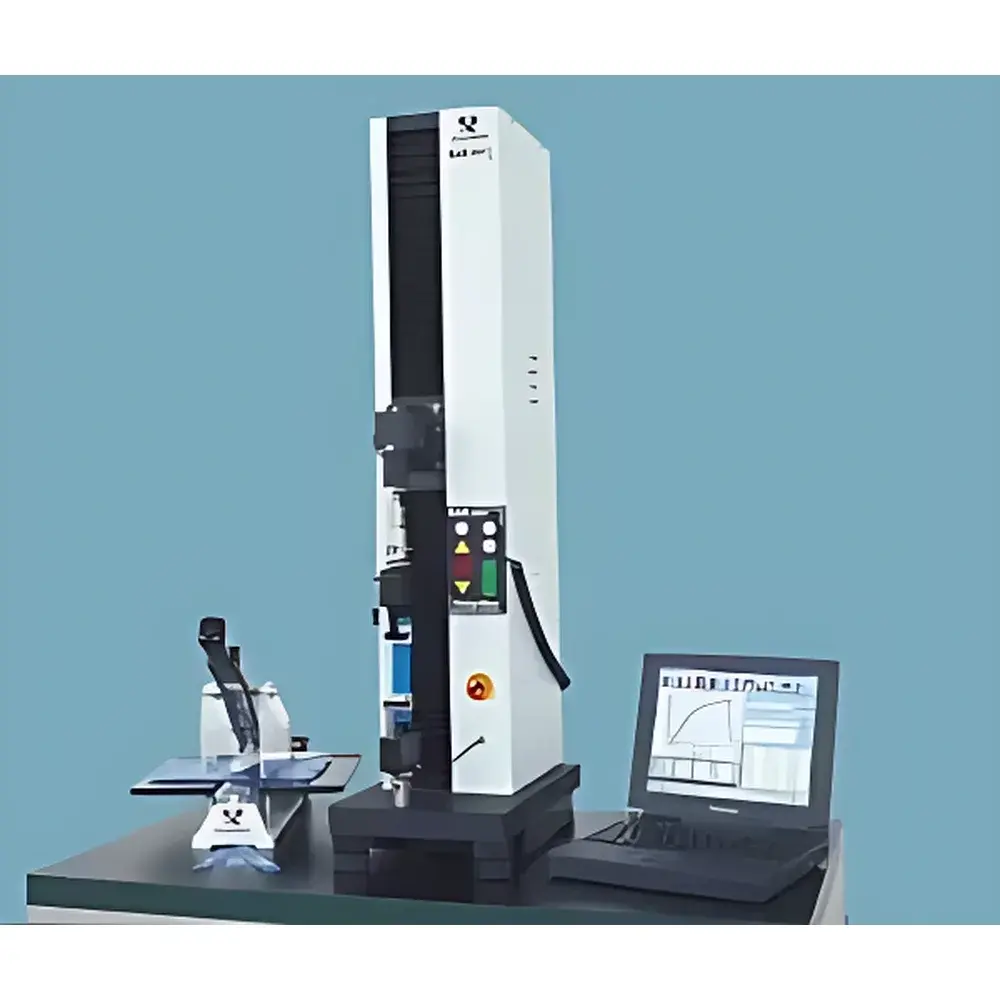
Thwing-Albert Vantage Compact Universal Testing Machine
| Brand | Thwing-Albert |
|---|---|
| Origin | USA |
| Type | Electromechanical Universal Testing Machine |
| Model | Vantage |
| Force Capacity | 0–1 kN |
| Optional Load Cells | 5 N to 1 kN |
| Force Accuracy | ±0.25% of reading |
| Crosshead Travel | 609.6 mm |
| Vertical Test Space | 89 mm |
| Speed Range | 1.27–1016 mm/min |
| Power Supply | 220 V, 60 Hz |
| Safety Features | Emergency stop button, upper/lower limit switches, overload protection |
| Interface | RS-232 serial port |
| Control Software | MAP (Materials Analysis Program) for Windows |
| Actuation | Electronically controlled pneumatic grips |
| Calibration | Automated electronic zeroing and simplified calibration routine |
| Control Panel | Magnetic, repositionable |
Overview
The Thwing-Albert Vantage Compact Universal Testing Machine is an electromechanical materials testing system engineered for precision, repeatability, and space-efficient laboratory integration. Designed around a rigid, low-profile frame with integrated drive electronics and closed-loop motion control, the Vantage eliminates the need for external controllers or auxiliary hardware—reducing footprint while maintaining full compliance with ASTM D882 (tensile properties of thin plastic sheeting), ASTM D638 (tensile properties of plastics), ISO 1798 (flexible cellular polymeric materials), TAPPI T494 (tensile strength of paper and paperboard), and FDA-relevant mechanical testing protocols for packaging and medical device components. Its core measurement principle relies on high-resolution load cell feedback coupled with encoder-based crosshead displacement tracking, enabling accurate determination of tensile strength, elongation at break, Young’s modulus, peel adhesion, tear resistance, compressive yield, and stress relaxation under controlled strain rates.
Key Features
- Integrated electromechanical architecture with embedded PWM (Pulse Width Modulation) motor controller for smooth, low-noise actuation and high-speed response across the full speed range (1.27–1016 mm/min)
- Magnetic, repositionable control panel—enabling ergonomic placement on benchtops, fixtures, or adjacent equipment without cabling constraints
- Electronically actuated pneumatic grips with programmable clamping pressure—ensuring consistent specimen alignment and minimizing slippage during high-force or low-modulus testing
- Automated electronic zeroing and one-step calibration routine—reducing operator dependency and supporting GLP-compliant documentation workflows
- RS-232 serial interface compatible with standard Windows-based PCs and laptops—no proprietary hardware drivers required
- Dual safety architecture: hardware-based emergency stop circuitry combined with software-enforced travel limits and real-time load monitoring for overload prevention
Sample Compatibility & Compliance
The Vantage accommodates specimens ranging from ultra-thin films (<1 µm thickness) to rigid biomedical polymers and laminated packaging structures. Standard test configurations include tensile bars, dog-bone coupons, peel strips, and compression cylinders. It supports ASTM D3330 (peel adhesion), ASTM D828 (tensile properties of paper), ASTM F88 (seal strength of flexible barrier materials), and USP container closure integrity testing prerequisites. All force transducers are NIST-traceable and certified to ISO/IEC 17025 requirements when used in accredited laboratories. The system meets CE marking directives for machinery safety (2006/42/EC) and electromagnetic compatibility (2014/30/EU).
Software & Data Management
Control and data acquisition are managed via Thwing-Albert’s MAP (Materials Analysis Program) software suite, a Windows-native application supporting multi-channel real-time plotting, statistical analysis (mean, SD, CV%), pass/fail thresholding, and export to CSV, PDF, or XML formats. MAP includes audit trail functionality compliant with FDA 21 CFR Part 11 requirements—including user authentication, electronic signatures, and immutable event logging for critical actions (e.g., calibration, method change, result deletion). Raw data files retain timestamped metadata including environmental conditions (if connected to optional humidity/temperature sensors), operator ID, and instrument configuration history—facilitating full traceability in GMP and ISO 9001 environments.
Applications
- Quality control of medical packaging seal integrity and pouch burst strength
- Tensile characterization of electrospun nanofibrous scaffolds and hydrogel films
- Peel adhesion assessment of pressure-sensitive adhesives used in transdermal patches
- Compression testing of foam dressings and wound contact layers
- Dynamic tear propagation analysis of multilayer food packaging laminates
- Release force evaluation of silicone-coated release liners in pharmaceutical labeling
FAQ
What load cell options are available for the Vantage system?
Standard configurations include 5 N, 25 N, 100 N, 250 N, 500 N, and 1 kN load cells—all interchangeable without recalibration due to integrated digital signal conditioning.
Does the Vantage support automated test sequences?
Yes. MAP software allows creation of multi-step test protocols—including pre-load dwell, ramp-to-force, constant-rate extension, and relaxation hold—with conditional branching based on real-time force or displacement thresholds.
Is the system compatible with LIMS or enterprise QA systems?
Via MAP’s COM/ActiveX interface and configurable XML output schema, the Vantage integrates with major laboratory information management systems (LIMS) and enterprise quality management software (QMS) for automated result ingestion and nonconformance reporting.
Can the Vantage be validated for regulated environments?
Yes. Thwing-Albert provides IQ/OQ documentation templates aligned with ASTM E2500 and ISO 13485, along with installation qualification checklists, operational verification scripts, and performance qualification test methods using certified reference standards.



