
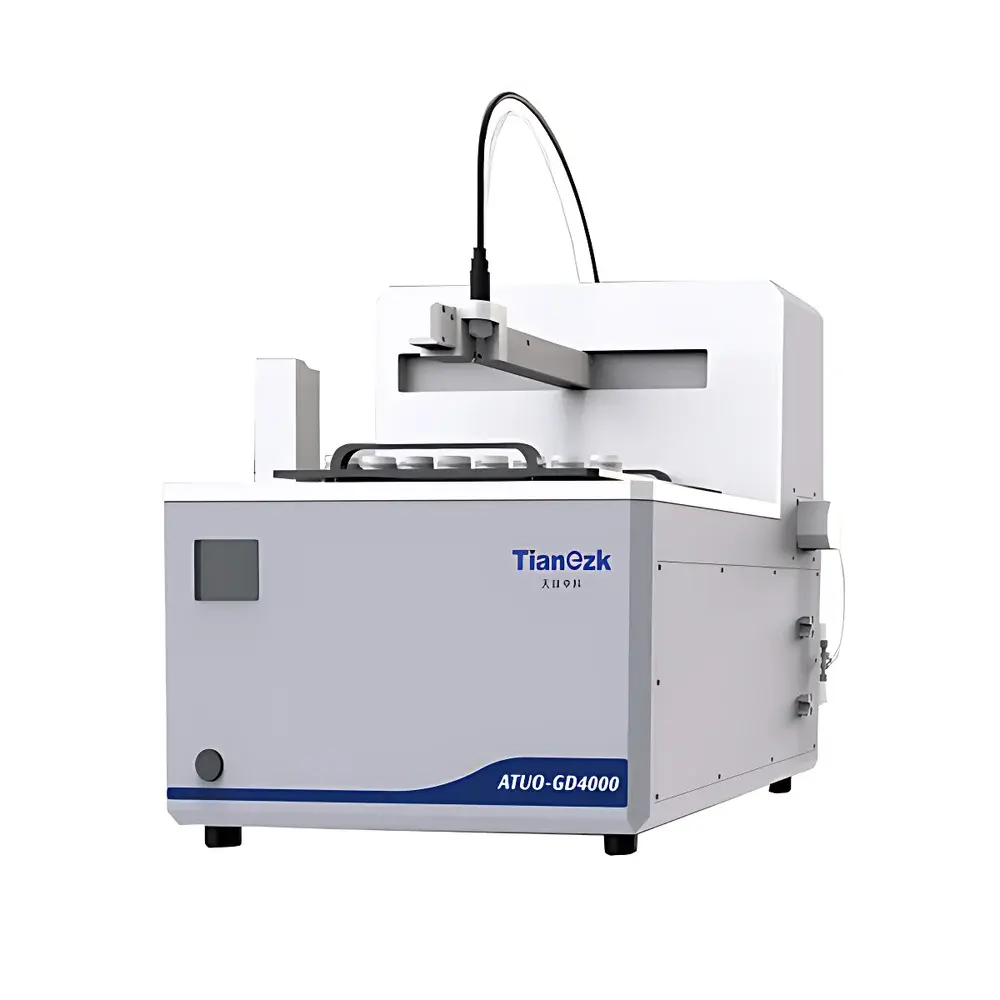
Tianezk Auto-GD2000 Fully Automated Graphite Block Digestion System
| Brand | Tianezk |
|---|---|
| Origin | Sichuan, China |
| Manufacturer Type | Direct Manufacturer |
| Instrument Type | Graphite Block Digestion System |
| Automation Level | Fully Automated |
| Sample Capacity | 20 positions |
| Temperature Range | 0–250 °C |
| Temperature Control Accuracy | ±0.5 °C |
| Heating Principle | Uniform Graphite Block Heating |
| Reagent Channels | 8 independent channels |
Overview
The Tianezk Auto-GD2000 Fully Automated Graphite Block Digestion System is engineered for high-throughput, reproducible wet-chemical digestion of solid and semi-solid samples prior to elemental analysis by ICP-OES, ICP-MS, AAS, or HG-AFS. It implements standardized open-vessel acid digestion—primarily using HNO₃, HCl, HF, and H₂O₂—under precisely controlled thermal conditions. Unlike hotplate or microwave-assisted systems, the Auto-GD2000 employs a monolithic, high-thermal-mass graphite block with embedded Pt100 sensors and PID-controlled resistive heating elements, ensuring spatial temperature uniformity across all 20 digestion positions (±1.2 °C typical deviation at 180 °C). The system executes full sequence automation—including reagent dispensing, orbital shaking, programmable ramp/hold temperature profiles, post-digestion evaporation (‘赶酸’), active air-cooling, and final volumetric adjustment—minimizing analyst intervention while maintaining strict adherence to EPA Method 3050B, ISO 11466, and GB/T 5009.11–2014 protocols.
Key Features
- Eight independently controllable reagent channels with peristaltic pumps calibrated for 0.1–10 mL precision delivery; compatible with aggressive acids including hydrofluoric acid (HF) up to 5% v/v.
- Monolithic graphite heating block with 360° radial thermal coupling—eliminates hot spots and ensures <1.5 °C inter-position temperature variance at steady state.
- Ultrasonic level sensing integrated into each digestion tube holder, enabling real-time endpoint detection during volume reduction and automated final dilution to user-defined target volumes (e.g., 25.00 mL or 50.00 mL).
- Full sequence automation: reagent addition → orbital mixing (100–600 rpm) → multi-step temperature programming (up to 10 segments) → controlled evaporation → forced-air cooling → ultrasonic-guided定容 (volumetric adjustment).
- Industrial-grade Ethernet (TCP/IP) and optional Wi-Fi 5 (802.11ac) connectivity; supports remote monitoring, method push, log export, and integration with LIMS via standard RESTful API endpoints.
- Corrosion-resistant architecture: PTFE-coated stainless-steel chassis, PFA-lined reagent tubing, ceramic-coated robotic arm joints, chemically inert borosilicate glass digestion tubes, and acid-resistant waste reservoir with level sensor and overflow protection.
Sample Compatibility & Compliance
The Auto-GD2000 accommodates standard 50 mL conical digestion vessels (borosilicate or quartz) and accepts sample masses ranging from 0.1 g (soil, sediment) to 2.0 g (plant tissue, feedstuff), with matrix-specific method templates preloaded for EPA SW-846 3050B (sediments/soils), AOAC 999.10 (food), and ISO 17294-2 (wastewater sludge). All fluidic pathways comply with USP <661.1> extractables testing requirements. The system’s audit trail meets FDA 21 CFR Part 11 criteria for electronic records and signatures when operated in secure network mode with user role-based access control (RBAC). Full GLP/GMP traceability is enabled via timestamped event logs—including reagent lot tracking, temperature profile verification, and ultrasonic volume confirmation—exportable as CSV or PDF.
Software & Data Management
The embedded Linux-based control software (v3.2.x) provides intuitive touchscreen operation and comprehensive method development tools: graphical temperature ramp editor, reagent sequence builder, shake intensity scheduler, and evaporation rate optimizer. All runs generate immutable digital records containing raw sensor data (temperature, ultrasonic amplitude, pump actuation timestamps), method parameters, operator ID, and QC flag status. Data export supports ASTM E1384-compliant XML, ISO/IEC 17025-aligned PDF reports, and direct ingestion into Thermo Fisher Qtegra, Agilent MassHunter, or PerkinElmer WinLab platforms via ODBC drivers. Firmware updates are delivered over HTTPS with SHA-256 signature validation.
Applications
- Environmental laboratories performing heavy metal quantification (Pb, Cd, As, Hg, Cr, Ni) in EPA-designated matrices including municipal wastewater biosolids (Method 6010D), contaminated soils (Method 6020B), and drinking water treatment residuals.
- Food safety testing labs applying AOAC Official Methods for total arsenic in rice, cadmium in cocoa, or lead in infant formula—fully compliant with EU Commission Regulation (EC) No 1881/2006 maximum levels.
- Pharmaceutical QA/QC units digesting excipients, herbal extracts, and packaging leachables for USP <232>/<233> elemental impurities screening.
- Geochemical research facilities processing rock powders and mineral concentrates for REE (rare earth element) analysis by high-resolution ICP-MS.
FAQ
What sample types are validated for use with the Auto-GD2000?
Soil, sediment, sludge, plant tissue, animal tissue, food composites, cosmetics, polymers, and catalysts—with method templates aligned to EPA, ISO, AOAC, and Chinese national standards.
Does the system support HF digestion for silicate-rich matrices?
Yes—reagent lines, pump heads, and digestion tubes are rated for continuous exposure to ≤5% HF; optional quartz digestion vessels available for extended HF protocols.
How is temperature uniformity verified across the 20 positions?
Each position includes an independent Pt100 sensor; factory calibration certifies inter-channel deviation ≤±0.8 °C at 200 °C, traceable to NIST SRM 1750a.
Can the Auto-GD2000 be integrated into an existing LIMS environment?
Yes—via configurable REST API or OPC UA server; supports HL7, ASTM E1384, and ISO/IEC 11179 metadata schemas.
What maintenance intervals are recommended for long-term reliability?
Quarterly verification of ultrasonic sensor sensitivity and reagent pump accuracy; annual graphite block emissivity recalibration and gasket replacement—documented in included GLP-compliant maintenance logbook.



